
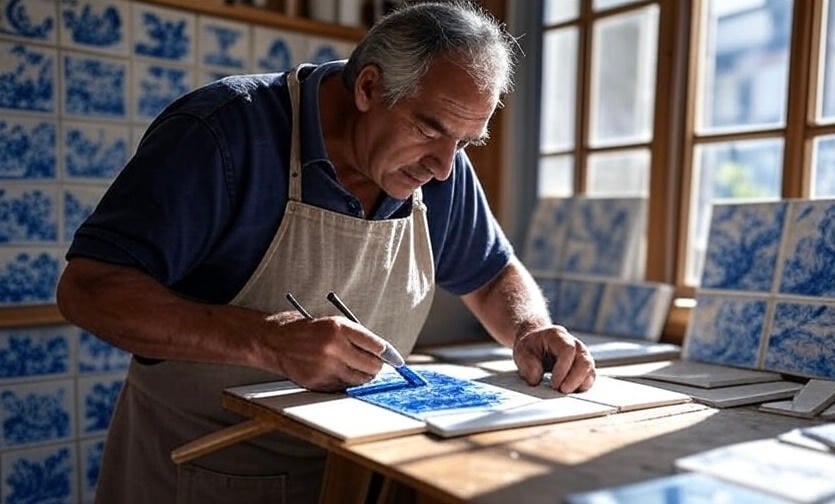
Few art forms embody Portugal’s identity as vividly as the azulejo, the hand-painted ceramic tile that adorns palaces, monasteries, fountains, and homes across the country. From the blue-and-white narratives that line Lisbon’s churches to the bold geometric designs decorating Porto’s train stations, tiles are far more than ornament. They are the nation’s visual poetry — a chronicle of history, craftsmanship, and creativity spanning more than five centuries.
For the discerning traveler, Portugal’s tilework is not simply something to admire. It is something to experience intimately: to step into ateliers where artisans keep the tradition alive, to acquire bespoke pieces that carry the essence of Portuguese heritage, and even to take part in private workshops where the brush meets ceramic under expert guidance. This is cultural luxury at its finest — art that is both timeless and personal, accessible only through curated encounters.
At Portugal Magik Private Tours, we have long woven the world of azulejos into our journeys. For many of our guests, it has been a highlight of their time in Portugal: a chance to go beyond sightseeing into discovery, connection, and creativity. As one traveler shared after a private tile-painting class in Lisbon: “It was the moment when Portugal came alive for us. We didn’t just see history — we touched it, painted it, and carried it home.”
In this editorial guide, we invite you into the world of Portuguese tilework — the finest shops, the most authentic artisan workshops, and the private classes that transform travel into personal art.
1. The Soul of the Azulejo: A Cultural Icon
Tiles arrived in Portugal through Moorish influence in the 13th century, their geometric motifs adorning palaces and gardens. By the 16th century, Portuguese artisans had adapted and expanded the art, embracing vibrant colors and narrative storytelling. Churches became clad in biblical scenes, palaces displayed mythological tales, and entire building façades shimmered with intricate patterns.
Unlike other European decorative traditions, azulejos in Portugal never faded into the past. Instead, they evolved. The 18th century brought grandeur and opulence; the 20th century saw modernist reinvention by artists like Maria Keil. Today, contemporary designers collaborate with artisans to bring tilework into new architectural contexts.
To walk through Lisbon or Porto is to walk through a living museum. Yet beyond the walls, travelers can step into the ateliers where tiles are still made by hand, one brushstroke at a time — the same way they have been for centuries.
2. Where to Acquire: The Best Tile Shops in Portugal
For those who wish to bring home a piece of Portugal, several distinguished shops offer curated collections of antique and contemporary azulejos. These are not mass-produced souvenirs, but heirloom-quality works of art.
-
Solar Antiques, Lisbon: Situated near the Alfama district, Solar is one of Europe’s largest antique tile shops. With thousands of tiles spanning the 15th to 19th centuries, it is a treasure trove for collectors. Each piece carries provenance, ensuring authenticity. For our guests, a private appointment with the curator can be arranged — a chance to browse rare panels and learn the stories behind them.
-
Cortiço & Netos, Lisbon: This boutique specializes in reclaimed tiles from demolished buildings, preserving patterns and designs from the 19th and 20th centuries. Each tile carries a fragment of Lisbon’s history, and collectors can assemble panels that feel both authentic and contemporary.
-
Cerâmica Vieira, São Miguel, Azores: For travelers venturing to the Azores, this historic factory has been producing tiles since 1862. Its shop offers both traditional motifs and modern reinterpretations, all hand-painted on the island.
These shops embody Portugal’s cultural luxury: the chance to own not only art, but a piece of living history.
3. Artisan Workshops: Where Tradition Lives
The heart of tilework lies in the workshops, where artisans transform blank ceramic into luminous azulejos using traditional techniques of glazing and hand-painting. Visiting these ateliers is an experience of intimacy and authenticity.
-
Fundação Ricardo Espírito Santo Silva (Lisbon): Founded in 1953, this foundation is dedicated to preserving Portuguese decorative arts. Its workshops train artisans in techniques from gilding to tile painting. Private visits allow travelers to witness artisans at work, creating tiles destined for both restoration projects and contemporary commissions.
-
Viúva Lamego (Lisbon): One of Portugal’s oldest tile factories, established in 1849, Viúva Lamego continues to produce hand-painted tiles using traditional methods. Their tiles adorn iconic landmarks, including Lisbon’s Rossio train station. A private tour reveals not only the production process but also collaborations with modern artists and architects.
-
Oficina de Porcelana (Porto): In Porto, small family-run ateliers continue the tradition, offering intimate glimpses into the artistry behind azulejos. Guests can meet artisans, learn about color mixing, and watch the firing process in traditional kilns.
For many travelers, these encounters are more moving than museum visits. As one guest wrote: “Seeing artisans create tiles by hand was like watching history unfold before our eyes. Every brushstroke felt like a connection to Portugal’s soul.”
Other Visitors are reading now:

4. Private Tile-Painting Classes
The ultimate way to experience Portuguese tilework is to create your own. Private classes, arranged through Portugal Magik, allow guests to step into the role of artisan under expert guidance.
In Lisbon, classes often begin with a short introduction to the history of azulejos, followed by demonstrations of traditional techniques. Guests then choose their designs — geometric Moorish patterns, floral baroque motifs, or even personal interpretations. With brushes in hand, they paint on raw tiles, learning how pigments change during the firing process.
These workshops are not only creative but deeply personal. Many guests choose to design tiles that reflect their journey, initials, or favorite colors. Once fired, the finished tiles can be shipped home — a tangible memory of their time in Portugal.
One Portugal Magik client described it as: “The perfect balance of culture and creativity. We left not only with tiles, but with stories and laughter. It was an experience no photograph could ever capture.”
5. Where to See Masterpieces in Context
While shops and workshops reveal the making of azulejos, Portugal’s greatest masterpieces still adorn its buildings. For cultural travelers, a curated visit to these sites provides context and inspiration.
-
National Azulejo Museum (Lisbon): Housed in a former convent, this museum showcases the evolution of tilework from the 15th century to the present. Highlights include a panoramic tile panel of Lisbon before the 1755 earthquake. Private tours offer deeper insight into the artistry and symbolism behind each period.
-
São Bento Station (Porto): Over 20,000 tiles narrate Portugal’s history in one of the world’s most stunning railway stations. With a private guide, travelers discover the stories behind the panels, from royal processions to pastoral scenes.
-
Palácio Nacional de Sintra: Its kitchens and halls are adorned with geometric tiles from the 15th century, among the earliest examples in Portugal.
-
Convent of São Vicente de Fora (Lisbon): Home to one of the largest collections of baroque tile panels, depicting fables of La Fontaine in exquisite detail.
Visiting these sites with an expert guide transforms admiration into understanding — a reminder that tilework is both art and storytelling.
6. Integrating Tilework Into a Luxury Journey
The beauty of Portugal’s tile tradition is that it can be woven seamlessly into broader journeys. A day in Lisbon might begin with a private tour of Alfama’s tiled façades, continue with a visit to an artisan workshop, and conclude with a hands-on painting session. A week-long itinerary might include Porto’s tiled landmarks, Lisbon’s ateliers, and Sintra’s palatial collections, culminating in bespoke purchases from antique shops.
For collectors, Portugal Magik arranges private shopping experiences with curators who provide provenance and export assistance. For families, tile workshops become intergenerational experiences of creativity. For cultural enthusiasts, curated tours connect tiles to broader Portuguese history — from Moorish influences to maritime explorations.
The result is more than sightseeing: it is participation in a living tradition, experienced with elegance and exclusivity.
Conclusion: A Living Art, A Personal Memory
Portugal’s azulejos are not just decorations on walls; they are symbols of resilience, artistry, and identity. To discover them through exclusive shops, artisan workshops, and private classes is to move beyond admiration into connection. It is cultural luxury at its purest — intimate, authentic, and unforgettable.
At Portugal Magik Private Tours, we specialize in creating these experiences. With 14 years of expertise, our award-winning company crafts private journeys that bring travelers into the heart of Portugal’s culture. Our English-speaking driver-guides ensure seamless exploration, while our network of artisans, curators, and specialists opens doors not accessible to the general public.
Most of our guests choose multi-day tours, allowing tilework experiences to be woven alongside Portugal’s other treasures: palaces, vineyards, coastlines, and Michelin-starred dining. Yet again and again, they tell us that painting their own tile, or selecting a panel from an antique shop, was among the most meaningful moments of their journey.
If you are ready to experience Portugal not only as a destination but as an art form, let us design your itinerary — one where every tile tells a story, and one becomes yours to keep.
Book Your Portugal Experience:
-
Explore our bestseller tours: Multi-Day Tours
-
Best Private Day Tours Around Lisbon: Private Day Tours
-
Read Top Guests Reviews: Reviews
-
Contact Us: Contact
-
Or simply fill in the form below to request your custom itinerary.