Spend a day following Aveiro’s waterways towards the striped houses of Costa Nova, with painted boats, convent sweets and a seafood lunch along the way. Behind the colourful scenery lies a story of salt, fishing and a coast continually reshaped by water.
Morning beside the Canal Central
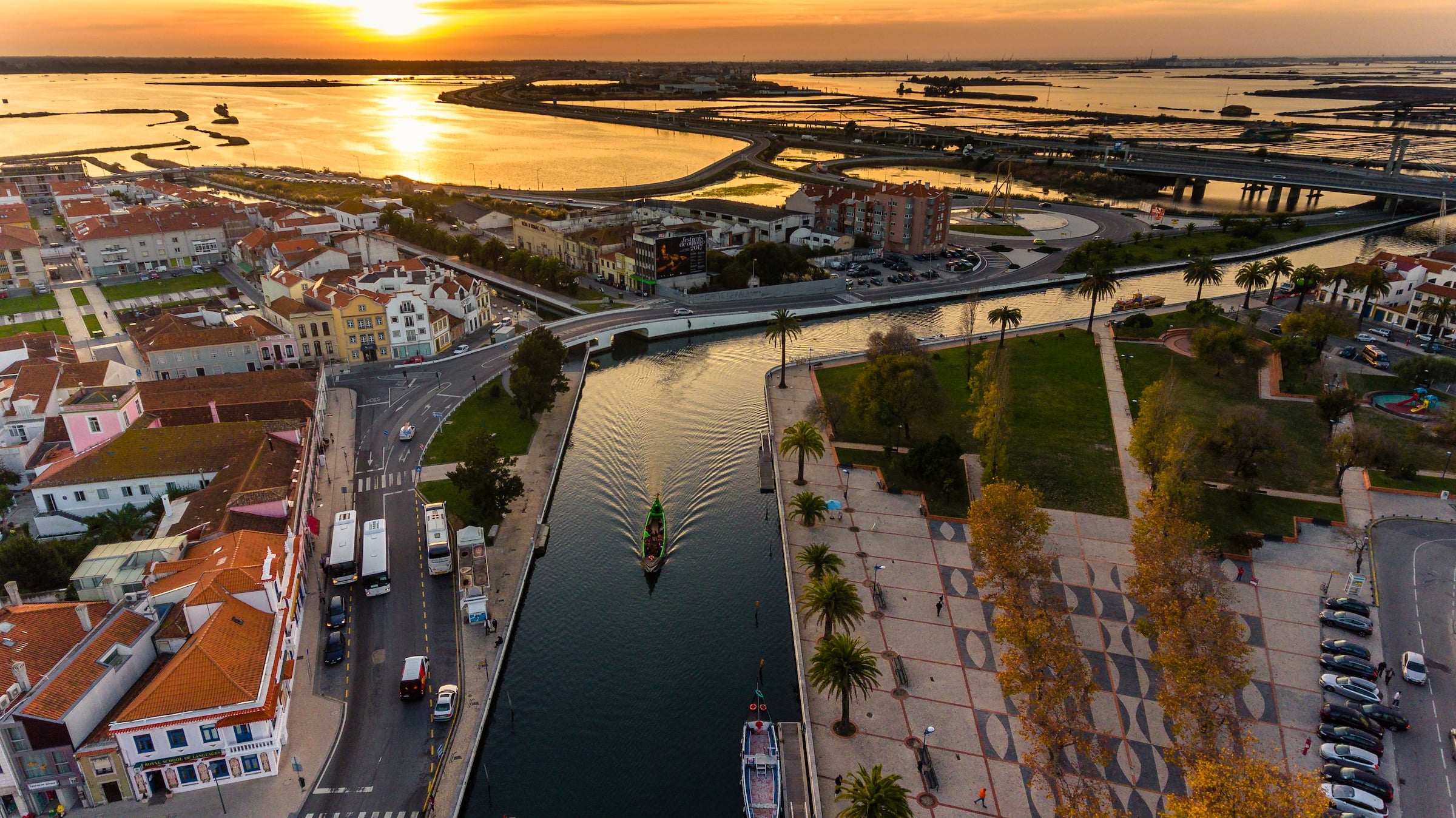
Begin beside Aveiro’s Canal Central, before the day becomes a collection of photographs. A painted bow slides past the pavement, café cups clatter somewhere behind you, and the water breaks the reflections of the buildings into wavering strips. Aveiro rewards this first unhurried look. Its canals are not simply attractive scenery: they connect the city to the Ria de Aveiro, the shallow coastal lagoon that has shaped livelihoods here for centuries.
Around Rossio and Rua João Mendonça, the city introduces another part of its character. Art Nouveau façades carry flowers, curved lines and decorative ironwork, evidence of the prosperity and changing tastes of the early twentieth century. The Museu Arte Nova, housed in the former Casa Major Pessoa, gives this architectural chapter an address. Even without going inside, pause over the building’s ornament. There is something wonderfully optimistic about so much care being lavished on a window, a balcony or a doorway.
The painted boats had a working life
A canal ride makes a natural next chapter, but the boats deserve a little explanation before boarding. The traditional moliceiro was built to gather moliço, aquatic vegetation harvested from the lagoon and used to fertilise agricultural land. Its shallow hull suited these waters, while its high, curved ends provided room for painted panels. Today, the boats carrying visitors through the urban canals have a different job, and motor power has largely replaced the older working methods.
Look closely at those panels. Alongside religious and historical subjects, you may spot jokes, social commentary and decidedly cheeky scenes. This is folk art with a sense of humour, not merely decoration. As the boat moves beneath bridges, the guide’s stories help reconnect the polished visitor experience with the physical work that once sustained the lagoon’s communities. If you prefer to stay ashore, a walk beside the Canal de São Roque offers another rewarding perspective, with former salt warehouses recalling the city’s trading past.
A small sweet with a long memory
Back on foot, turn towards the streets around Praça do Peixe, in the Beira Mar neighbourhood. The fish market building, opened in 1910, is a useful landmark among lanes where Aveiro feels more intimate. Walk without rushing to the next attraction. A tiled wall, a doorstep conversation or the smell of coffee can be as memorable as a grand façade.
This is the moment for ovos moles de Aveiro. Their rich filling of egg yolks and sugar is often enclosed in delicate wafer shells shaped like fish, shells or little barrels, linking the sweet to the city’s watery surroundings. Rooted in local convent confectionery, ovos moles also carry Protected Geographical Indication status. Buy a small portion from a specialist confectioner and eat it slowly: the wafer gives almost no resistance before the dense filling takes over. With an espresso, it becomes a brief, very Aveiro sort of pause rather than another item ticked off a list.
Browse our travel inspiration for ideas, or tell us what kind of day you have in mind.
Salt, an inlet and the road west
Before leaving the city, give the salt pans their place in the story. At the Ecomuseu Marinha da Troncalhada, an open-air site near the centre, the geometry of the salt workings helps explain an industry that brought Aveiro wealth. Traditional production depends on sun, wind and careful management of water. In the warmer working season, conditions may allow you to see the process more clearly; at other times, the landscape itself still tells the story.
The journey towards Costa Nova takes you across a landscape whose relationship with the ocean has never been straightforward. Silting once restricted the lagoon’s connection to the sea, damaging trade and living conditions. The opening of an artificial inlet in 1808 was a decisive change. Today, that passage lies beside Barra, north of Costa Nova. Travelling with Portugal Magik in a Mercedes-Benz vehicle, a local driver/guide can shape the day around the guests, allowing more time for these quieter lagoon stories or an earlier arrival by the coast.
Lunch between the lagoon and the Atlantic
At Costa Nova, begin on the lagoon side along Avenida José Estêvão. The striped houses are immediately familiar, yet their origins are more practical than their appearance suggests. The wooden palheiros were associated with fishing life, serving as storage for equipment before many were adapted for other uses, including holiday accommodation. The colourful façades seen today belong to that evolving history. They are buildings in a living village, so enjoy their details without treating doorways and windows as a stage set.
By now, lunch should feel earned. Choose a seafood restaurant and ask what is available that day rather than arriving with a fixed order. Caldeirada, a fish stew whose contents vary, is a satisfying expression of the coast; grilled fish offers a simpler route from sea to plate. Eels are another regional tradition, served fried or in stews around the lagoon. A glass of Bairrada white makes a fitting companion, connecting this maritime meal with the wine country inland.
One last walk beyond the stripes
After lunch, cross towards the Atlantic. Costa Nova occupies a narrow strip between lagoon and ocean, and the contrast is the day’s finest surprise. Behind you lie sheltered water and orderly façades; ahead are dunes, a broad sandy beach and surf. Follow the designated walkways to protect the dune vegetation, then stop somewhere that lets the horizon fill your view. Bring a light layer even when Aveiro felt warm. The Atlantic breeze can change the mood quickly.
There is no need to force another major stop into the afternoon. Walk a little, sit a little, and let the morning’s stories settle: vegetation gathered for fields, salt drawn from shallow water, fishing equipment stored in wooden huts. What first appeared to be a day of charming canals and striped houses becomes something more substantial. Aveiro and Costa Nova share a history of people finding ways to live with water. By the time you turn back, the colours are still beautiful, but now they mean something.
Plan your own day
Share your dates, group size and interests, and we will suggest a tailored plan with a local driver/guide.