
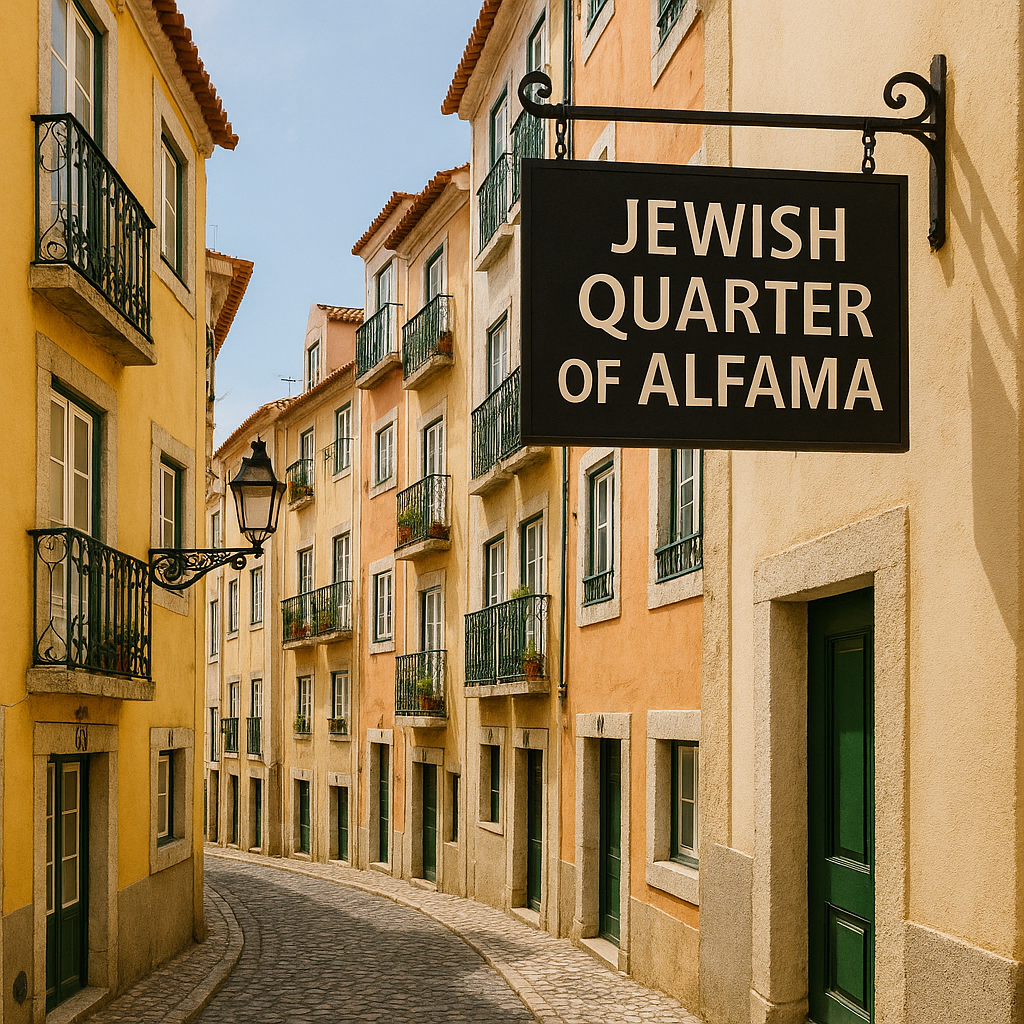
Lisbon holds layered Jewish history, from the active Shaare Tikva synagogue to the traces of medieval juderias scattered through the old city. This guide explains what remains and what has been lost.
A City With Centuries of Jewish Presence
Lisbon was home to one of the largest Jewish communities in Portugal before the expulsion decree of 1496 and the forced conversions that followed. The city's medieval quarters, particularly in the Alfama and surrounding areas, once contained the judiaria grande, a dense neighborhood where Jewish residents worked as merchants, craftsmen, and scholars.
Little physical fabric from that medieval period survives intact, since centuries of earthquakes, rebuilding, and urban change erased most original structures. The great Lisbon earthquake of 1755 in particular reshaped much of the lower city, including areas that had once held Jewish life.
Despite this, street names, archival records, and occasional archaeological finds continue to document where these communities lived and worked, giving visitors a sense of the scale of Jewish life in the capital before 1497.
Shaare Tikva Synagogue
Shaare Tikva, Lisbon's main synagogue, was established in the nineteenth century and remains an active place of worship for the city's Jewish community today. Its creation reflected the gradual return of open Jewish life to Portugal after centuries in which practice had been forced underground following the Inquisition.
The synagogue's design and setting differ from the structures that existed before the expulsion, since those earlier buildings were converted to other uses or destroyed long before Shaare Tikva was built. It stands instead as a marker of the modern reconstitution of Jewish communal life in the capital.
Visitors researching Jewish heritage in Lisbon should understand that Shaare Tikva is a functioning community institution rather than a historical ruin, and its continued use distinguishes it from the medieval sites discussed elsewhere in the city.
Tracing the Medieval Judiaria
Historians have identified several areas associated with medieval Jewish settlement in Lisbon, often referred to collectively as judiarias. These neighborhoods were defined in part by royal charters that regulated where Jewish residents could live and conduct business.
Because no synagogue building from that era survives above ground in a form clearly identifiable today, understanding this history relies heavily on documentary evidence, including royal and municipal records, rather than standing architecture.
Walking through the old quarters, visitors can appreciate the narrow streets and dense urban pattern that likely resembled the environment in which these communities once lived, even without a specific surviving building to point to as the medieval synagogue itself.
From Expulsion to Forced Conversion
In 1496, King Manuel I issued an edict ordering Jews to leave Portugal or convert, a decision driven in large part by a marriage alliance with Spain. In practice, mass forced conversions followed in 1497, creating a population of New Christians who continued, in many cases, to practice Judaism in secret.
This history is central to understanding Lisbon's Jewish heritage, because it explains the long gap between the medieval judiaria and the nineteenth-century emergence of synagogues like Shaare Tikva. For roughly three centuries, open Jewish religious life was effectively prohibited in Portugal.
The Inquisition, established in Portugal in 1536, intensified persecution of New Christians suspected of continuing Jewish practice, further shaping the cautious, often hidden nature of Jewish identity in the centuries that followed.
Visiting Lisbon's Jewish Sites Today
Travelers interested in this history typically combine a visit to Shaare Tikva with a walk through the historic quarters where medieval Jewish life once concentrated, supported by explanatory context since the physical remains are limited.
Understanding Lisbon in this way benefits from guidance that can connect scattered references across the city to the broader arc of Portugal's Jewish history, from medieval settlement through expulsion and into the modern community's reestablishment.
Because Lisbon's story intersects with other towns across the country, many visitors choose to see it as part of a longer route that also includes Porto, Belmonte, Tomar, and other sites with their own distinct heritage.
Planning a Broader Heritage Journey
Iberian Heritage Journeys offers private multi-day Jewish heritage travel across Portugal and Spain, with private heritage driver-guides who provide context at each stop along the way. Lisbon often serves as a natural starting point for these itineraries.
For travelers with limited time, a 3-day introductory itinerary can cover Lisbon and one or two nearby towns, while longer options such as the 6-day highlights itinerary, the 10-day complete immersion itinerary, or the 12-day Iberian journey allow for a fuller exploration of sites across both countries.
Genealogy research and citizenship or legal services are not provided as part of these journeys, which focus instead on historical and cultural travel.
Plan your Jewish heritage journey
Share your dates, interests and group size and we will suggest a tailored private itinerary with a local driver/guide, including heritage-focused visits. Access arrangements are confirmed before booking.