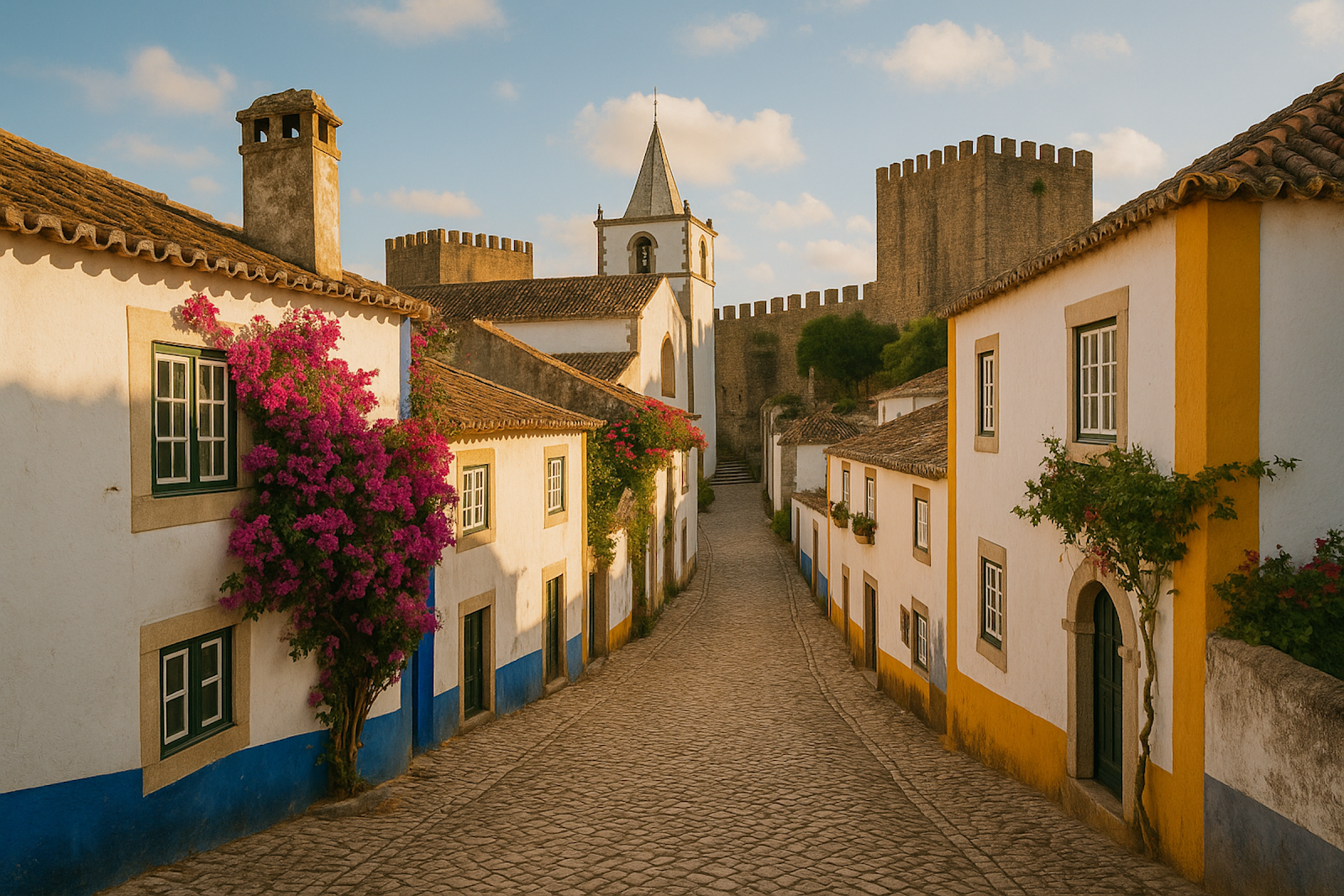
Follow Portugal north through royal streets, a medieval walled town, university courtyards and saltwater landscapes. This nine-day journey leaves room for the moments that outlast the monuments, especially an evening in Óbidos after the busiest hours have passed.
Day 1: Arrival in Lisbon, an Introduction by the River
Begin gently at Praça do Comércio, where Lisbon opens toward the Tagus and the scale of the waterfront gives a first impression of a capital long shaped by maritime trade. Continue into Baixa, rebuilt after the devastating earthquake of 1755, noticing how its orderly streets contrast with the hills rising on either side. At a café, order a pastel de nata and an espresso, then let the afternoon remain deliberately light rather than treating arrival as a sightseeing test. Portugal Magik’s private driver/guide handles the driving in a Mercedes-Benz vehicle and can shape the day around your arrival time and energy. Overnight in Lisbon.
Day 2: Lisbon, Monastery Stone and Maritime Stories
Spend the morning in Belém at the Jerónimos Monastery, commissioned under King Manuel I and closely associated with Portugal’s sixteenth-century maritime expansion, while allowing time to look rather than simply move through. Its carved cloister rewards attention to ropes, foliage and religious symbols, though the beauty also invites reflection on the wealth and imperial ambitions behind the building. Walk to the nearby Pastéis de Belém, whose bakery began selling its custard pastries in 1837, and taste one while the shell is still crisp. Return toward central Lisbon for an unhurried afternoon at Museu Nacional de Arte Antiga, where Portuguese painting adds another dimension to yesterday’s streets. Overnight in Lisbon.
Day 3: Sintra, Royal Rooms and a Return to Lisbon
Make Sintra a considered day trip rather than a race between hilltops, beginning at the Palácio Nacional de Sintra, whose twin conical kitchen chimneys rise above the town’s historic center. Inside, the Swan Room and Magpie Room offer a more intimate encounter with courtly life than a distant palace silhouette, while tiled surfaces reveal changing tastes across generations. Pause for a queijada, the small cheese tart associated with Sintra, before continuing to Monserrate, where a nineteenth-century palace sits within gardens planted with species from different parts of the world. Leave space to wander its shaded paths, with sensible shoes for gradients and damp stone. Overnight in Lisbon.
Browse our travel inspiration for ideas, or tell us what kind of day you have in mind.
Day 4: Óbidos, the Evening You May Remember Best
Travel north to Óbidos and enter through Porta da Vila, where a tiled chapel above the passage makes arrival feel unexpectedly ceremonial before the narrow streets draw you inward. Follow Rua Direita toward the castle, remembering that King Dinis gave the town to Queen Isabel in 1282, strengthening an association with Portuguese queens that lasted for centuries. After lunch, leave the busiest shopfronts behind and look for the quieter lanes, where whitewashed walls, exterior staircases and flowerpots give the medieval setting a lived-in scale. As afternoon softens, try a small glass of ginjinha, the sour-cherry liqueur, and linger over dinner rather than hurrying onward. Overnight in Óbidos, the journey’s most atmospheric pause.
Day 5: Alcobaça to Coimbra, Love Carved in Stone
Leave Óbidos after breakfast and stop at the Monastery of Alcobaça, founded in the twelfth century and one of Portugal’s great Cistercian monuments, where architectural restraint makes the ornate royal tombs especially arresting. Those of Pedro I and Inês de Castro recall a relationship entangled with dynastic politics and her murder in 1355; the carved details deserve more time than a quick retelling of the legend. Continue toward Coimbra, breaking for lunch around roast meat or a simple fish dish, with a glass of regional wine if you wish. Once settled, take an easy first walk through the lower town toward the Mondego riverfront rather than tackling every hill immediately. Overnight in Coimbra.
Day 6: Coimbra, Books, Bells and Student Traditions
Climb into Coimbra’s university quarter for the Paço das Escolas, where former royal buildings became part of an institution founded in 1290 and permanently established in this city in 1537. Make the Biblioteca Joanina the centerpiece, arranging the appropriate timed admission in advance and allowing its gilded woodwork and densely shelved volumes to hold your attention within the managed visit. Continue to the Sé Velha, whose fortress-like Romanesque exterior feels markedly different from the university’s ceremonial spaces, then descend through lanes shaped by centuries of student life. At lunch, look for chanfana, goat slowly cooked with red wine, a dish deeply associated with the wider Coimbra region. Overnight in Coimbra.
Want this route shaped around your own dates and pace?
Day 7: Aveiro and Costa Nova, Saltwater and Sweetness
Head north to Aveiro and begin beside the Canal Central, where the painted moliceiro boats recall work once done gathering aquatic vegetation from the lagoon for agricultural use. Walk into Beira Mar, the old fishing neighborhood, keeping an eye on tiled façades and the modest details that distinguish a working waterside town from a postcard. Taste ovos moles, Aveiro’s protected egg-yolk and sugar confection, often enclosed in thin wafer shells shaped like fish or barrels, before continuing to Costa Nova. Its striped houses developed from the area’s fishing culture, and a walk toward the Atlantic adds sea air to a day otherwise spent beside sheltered water. Overnight in Aveiro.
Day 8: Porto, Granite Streets and a First Glass of Port
Continue to Porto and start at São Bento station, where Jorge Colaço’s early twentieth-century tile panels turn a railway concourse into a vivid introduction to episodes of Portuguese history and rural life. Walk downhill toward Ribeira, allowing the narrow streets and steep changes of level to reveal the city gradually rather than reducing it to a sequence of viewpoints. Across the river in Vila Nova de Gaia, visit an established port lodge by prior arrangement to understand why wines from the Douro Valley historically matured here near the Atlantic. A guided tasting can clarify the difference between ruby and tawny styles before dinner built around grilled fish or roasted octopus. Overnight in Porto.
Day 9: Porto, a Final Morning Facing the Atlantic
Give the final day a different rhythm at Serralves, pairing its contemporary art museum with a walk through the estate’s gardens rather than adding another dense morning of historic interiors. Continue to Foz do Douro, where the river meets the Atlantic, and follow the waterfront long enough to appreciate how closely Porto’s identity remains tied to weather, shipping and the sea. For lunch, choose grilled fish and a glass of Vinho Verde, remembering that the name identifies a wine region rather than requiring every bottle to be fizzy. This tailored itinerary leaves the remaining hours open for a favorite shop, a café table or simply the pleasure of having nowhere urgent to be. Overnight in Porto, with onward travel planned for the following morning.
Plan your own day
Share your dates, group size and interests, and we will suggest a tailored plan with a local driver/guide.