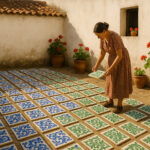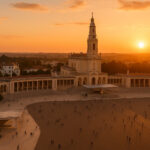
Spend a day following Lisbon’s azulejos from a convent museum to tiled cloisters and everyday streets. Along the way, discover how imported patterns became one of Portugal’s most expressive ways of telling stories.
Morning begins with a closer look
At first, you notice the blue. Then a painted sleeve, a ship’s rigging, a small face looking out from a wall. Lisbon’s azulejos reward this gradual adjustment of attention. What seems like decoration from across the street becomes, up close, a record of changing fashions, religious devotion, trade and ordinary city life. Give them a day, rather than a passing photograph, and they begin to connect places you might otherwise experience separately.
Start east of the historic centre at the Museu Nacional do Azulejo, housed in the former Madre de Deus convent. Queen Leonor founded the convent in 1509, and its surviving church makes an extraordinary setting for understanding how tiles work alongside carved wood, painting and architecture. Check current opening arrangements before settling the itinerary. With Portugal Magik, a local driver/guide can shape the day around the guests, using a Mercedes-Benz vehicle for the longer connections and leaving time for the details that catch your eye.
Before the blue, an imported language
One useful discovery comes early: azulejo does not derive from azul, the Portuguese word for blue. Its roots lie in Arabic, in a word associated with a small polished stone. Nor were Portugal’s early tiles predominantly blue and white. Look for geometric compositions in green, yellow, brown and white, with patterns that seem capable of continuing beyond the edges of the wall.
Following his visit to Spain in 1498, King Manuel I helped encourage the use of imported Hispano-Moresque tiles in Portugal. Seville was an important source, and the National Palace of Sintra still preserves remarkable examples from this period. Techniques such as corda seca and aresta kept different coloured glazes apart through lines or raised edges. Their intricacy belongs to an Iberian artistic world shaped by Islamic craftsmanship.
During the sixteenth century, tin-glazed earthenware techniques made it possible to paint more freely across a tile’s surface. Instead of assembling only repeating designs, artists could create figures, landscapes and elaborate scenes. Lisbon developed its own production, absorbing influences from elsewhere in Europe. The story is not one of an isolated national invention, but of borrowed methods becoming something deeply embedded in Portuguese life.
The city before the earthquake
The museum’s great moment is the Grande Panorama de Lisboa, a roughly 23-metre-long tile panel generally dated to around 1700. It shows Lisbon before the earthquake of 1755, spread along the Tagus with palaces, churches and waterfront activity. Resist the temptation to take one photograph and move on. Follow the shoreline slowly. This is a city portrait made before photography, with enough detail to turn looking into a kind of exploration.
By the late seventeenth and early eighteenth centuries, blue-and-white painting had become especially fashionable. Chinese porcelain and Dutch tile production helped shape European taste, while Portuguese painters developed ambitious narrative panels. Cobalt blue could describe clouds, masonry, folds of cloth and distant hills, all against the luminous white glaze.
That panorama changes the rest of the day. Once outside, Lisbon is no longer simply a collection of attractive façades. You have seen an earlier version of it, before destruction and rebuilding altered the centre. Tiles have preserved a view that stone alone could not keep intact.
Browse our travel inspiration for ideas, or tell us what kind of day you have in mind.
Lunch, then stories in the cloisters
Turn towards São Vicente and Graça for lunch. A neighbourhood restaurant is the right setting for bacalhau à Brás: shredded salt cod mixed with finely cut fried potatoes, onion and egg, usually finished with parsley and black olives. It is comforting rather than ceremonial, especially with a simple salad alongside. Follow it with a bica, Lisbon’s familiar espresso, before returning to the painted world.
At the Monastery of São Vicente de Fora, the tile-lined spaces offer another way of reading the eighteenth century. Among the best-known panels are scenes inspired by the fables of Jean de La Fontaine. Animals carry human faults into view: vanity, cunning, greed and misplaced confidence. In a monastic setting, these stories bring an unexpectedly worldly note.
Look at how a scene occupies the architecture. A painted border gives it weight; a doorway interrupts its rhythm; daylight changes the white glaze. Azulejos were not conceived only as pictures to hang on walls. They could organise an entire room, turning a walk through a cloister into a sequence of encounters.
When tiles stepped into the street
Later, head towards Largo do Intendente to see the historic Viúva Lamego building, whose richly tiled exterior dates from 1865. Its figurative decoration makes a striking contrast with the smaller repeating patterns found on residential buildings. Here, a façade becomes both a display of ceramic skill and a public advertisement for the work associated with the site.
During the nineteenth century, patterned tiles spread widely across urban exteriors. Industrial production helped make them more accessible, while their washable, weather-resistant surfaces offered practical advantages. Yet usefulness never fully explains the pleasure of these streets. Repetition gives a modest building texture, and a narrow strip of sunlight can transform an otherwise quiet wall.
Notice the repairs as well as the complete patterns. A mismatched replacement or an empty square reveals how vulnerable this heritage can be. Photograph tiles where they belong, and choose newly made ceramics from reputable shops rather than old tiles of uncertain provenance.
A final chapter beneath the pavement
End with a small surprise: the Lisbon Metro. At stations such as Parque, tile art moves decisively into the modern city. Maria Keil created work for many of the original stations opened in 1959, using pattern, colour and rhythm in spaces designed for everyday movement. Check station access before making a dedicated stop.
After convent walls, a vanished waterfront and moralising animals, a transport station feels like the right conclusion. Portugal’s tile tradition did not stop when the grand panels were finished. It found new surfaces and new audiences. By evening, even a simple tiled doorway deserves a second glance. The memorable souvenir is not necessarily something wrapped in paper, but the habit of looking closely.
Plan your own day
Share your dates, group size and interests, and we will suggest a tailored plan with a local driver/guide.