
Between Lisbon and Sintra, royal kitchens, forested ramparts and painted ceilings give a day its own unfolding story. Choose one principal visit, leave room for lunch, and let Portugal reveal itself at a human pace.
1. Pena Palace, where a king imagined another world
The first glimpse of Pena Palace through Sintra’s trees feels almost theatrical: yellow walls, red towers and stonework that refuses to belong to just one century. Ferdinand II, the German-born husband of Queen Maria II, transformed a former monastery into a Romantic retreat during the nineteenth century. For Americans who know Versailles or have toured the Loire, the difference is its woodland setting and exuberant mixture of architectural references. This was a royal project shaped by imagination as much as ceremony. Start your day here if that combination of landscape and personal history appeals more than a succession of gilded rooms.
Make the palace your morning’s main event, not the first square on a crowded checklist. Interior admission uses timed tickets, and reaching the palace from the park entrance involves an uphill approach. Sintra’s restricted roads also mean that arriving by car does not put you at the palace door. Portugal Magik’s Mercedes-Benz vehicles make the journey from Lisbon comfortable, while a local driver/guide can shape the day around the guests, allowing for walking ability, children’s curiosity and a proper lunch. Afterwards, descend towards town for a travesseiro, the flaky almond-filled pastry closely associated with Sintra.
2. The Moorish Castle, where the landscape tells the history
Across the wooded heights from Pena, the Moorish Castle offers a completely different encounter with the past. Its origins lie in the period of Muslim rule, generally dated to the eighth and ninth centuries, and it passed into Christian hands after Afonso Henriques took Lisbon in 1147. Here the memorable rooms have no ceilings: they are stretches of rampart, wind across the ridge and views over the town towards the Atlantic. Children can understand the defensive purpose of the site without a long explanation. Adults may find that the terrain makes Portugal’s medieval history more immediate than any display case could.
Choose this as the active centrepiece of the day, or pair it with Pena only if everyone enjoys sustained walking. The two belong to the same hilltop landscape, but visiting both is not effortless. Expect uneven stone, repeated steps and exposed wall walks; grippy shoes matter, and younger children need close supervision. Portugal’s welcoming atmosphere should not be confused with risk-free monuments. For couples or families used to driving between American attractions, there is real pleasure in leaving Sintra’s narrow roads and parking questions to someone else. Keep lunch in town unhurried rather than squeezing it between entrance times.
3. Sintra National Palace, where royal life comes into focus
In the centre of Sintra, two enormous white kitchen chimneys rise above the National Palace. They offer a wonderfully practical introduction to royal life: before contemplating dynasties, imagine feeding a court. Although the site has older roots, much of the palace visitors see reflects work under João I and Manuel I during the fifteenth and early sixteenth centuries. Inside, the Swan Room, Magpie Room and remarkable tilework make a visit feel like a sequence of discoveries rather than one vast ceremonial statement. The coats of arms beneath the domed ceiling of the Blazons Hall bring aristocratic Portugal into vivid view.
This is a strong anchor for travelers who would rather spend their energy looking closely than climbing a mountain. Its central location makes lunch and a pastry stop straightforward, though the historic interior still includes stairs and should not be assumed step-free. English is widely spoken in Sintra’s visitor-facing businesses, which helps first-time visitors feel at ease without removing the pleasure of trying a little Portuguese. At lunch, look for bacalhau à Brás, shredded salt cod with finely cut potatoes, egg and onion. Compared with an itinerary built around celebrated addresses in France or Italy, a palace visit and a neighborhood restaurant can make an appealing use of the day’s budget.
Browse our travel inspiration for ideas, or tell us what kind of day you have in mind.
4. Monserrate Palace, where an English story meets a Portuguese garden
Monserrate rewards the traveler who enjoys asking how a place came to look the way it does. The present palace was commissioned in the nineteenth century by Francis Cook, an English merchant and collector, with architect James Knowles Jr. Its Gothic, Indian and Moorish-inspired details sit within gardens shaped by international plant collecting. Long before Cook’s transformation, Lord Byron had visited the earlier estate and mentioned Monserrate in Childe Harold’s Pilgrimage. For Americans drawn to literary journeys and historic gardens, this is a particularly satisfying alternative to another royal residence: a story of taste, travel and wealth expressed through a Portuguese hillside.
Let the garden set the tempo. Paths descend through changing vegetation, with tree ferns, palms and plants from different parts of the world creating distinct moods. The palace’s intricate central hall then feels like a continuation of the landscape rather than a separate attraction. Allow for slopes and walking between the entrance and the building. Monserrate lies a short drive outside Sintra’s centre, but winding roads and traffic mean that map distances can mislead. It works especially well as an afternoon counterpart to the National Palace, with lunch between them, rather than as a hurried addition after both hilltop monuments.
5. Queluz National Palace, where the royal story turns towards Brazil
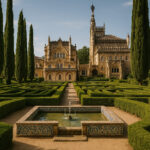
Queluz, between Lisbon and Sintra, offers another way to build the day: remain closer to the city and exchange forested heights for formal gardens. Developed during the eighteenth century for the future Pedro III, it became closely associated with Queen Maria I and court life. The gilded Throne Room supplies the expected spectacle, but the personal histories are more compelling. Pedro, who became Brazil’s first emperor and also briefly held the Portuguese crown, was born here in 1798 and died here in 1834. For American visitors, that transatlantic connection opens a useful conversation about the very different paths the Americas took towards independence.
Outside, seek out the tile-lined canal, where the court once enjoyed boating, and give the garden sculpture more than a passing glance. Queluz can stand alone as a substantial half-day excursion, leaving time for lunch back in Lisbon and a glass of Portuguese wine without anyone needing to drive afterwards. That is the closing thought worth carrying into any palace day: choose the story that interests you, not the largest number of gates you can enter. One remarkable residence, a good meal and time to talk about both often become the Portugal you remember.
Plan your own day
Share your dates, group size and interests, and we will suggest a tailored plan with a local driver/guide.