Perched high above the vast blue expanse of Lake Alqueva, the medieval village of Monsaraz offers a peaceful encounter with deep history, rustic flavors, and boundless horizons.
Rising Above the Golden Plains
The drive east through the Alentejo reveals a landscape defined by patience and space. Cork oaks stand scattered across rolling wheat fields, their stripped red trunks glowing warmly under the morning sun. Long before you reach the eastern frontier near Spain, a solitary ridge of schist rises abruptly from the plains. At its crown rests Monsaraz, an ancient walled settlement that has watched over the Guadiana River valley for millennia.
Traveling with a private driver guide from Portugal Magik allows this transition from Lisbon or Evora to unfold seamlessly. Sitting back in a quiet Mercedes-Benz, you can watch the rural rhythm of southern Portugal take over as modern highways yield to quiet country lanes lined with dry stone walls. Your driver can pace the morning around your preferences, perhaps pausing along the route to admire a solitary medieval bridge or a peaceful grove of ancient olive trees.
Walking the Schist Lanes of Monsaraz
Passing through the arched Porta da Vila, one immediately senses the defensive grit that shaped this hilltop bastion. The village consists of just a handful of narrow, pedestrian streets paved in uneven dark stone, framed by low houses covered in gleaming white lime. Bougainvillea spills over wrought iron balconies, while heavy wooden doors hint at centuries of quiet domestic life preserved behind fortress ramparts.
Monsaraz changed hands many times, moving from Moorish control to the Portuguese Crown in the twelfth century before being entrusted to the Knights Templar. Walking up the gentle incline of Rua Direita leads to the castle at the far edge of the village. Within its courtyard, an open arena made of schist once hosted community gatherings and traditional bullfights. From the ramparts, the view opens dramatically, revealing a vast body of water stretching toward the horizon.
The Blue Mirror of Alqueva
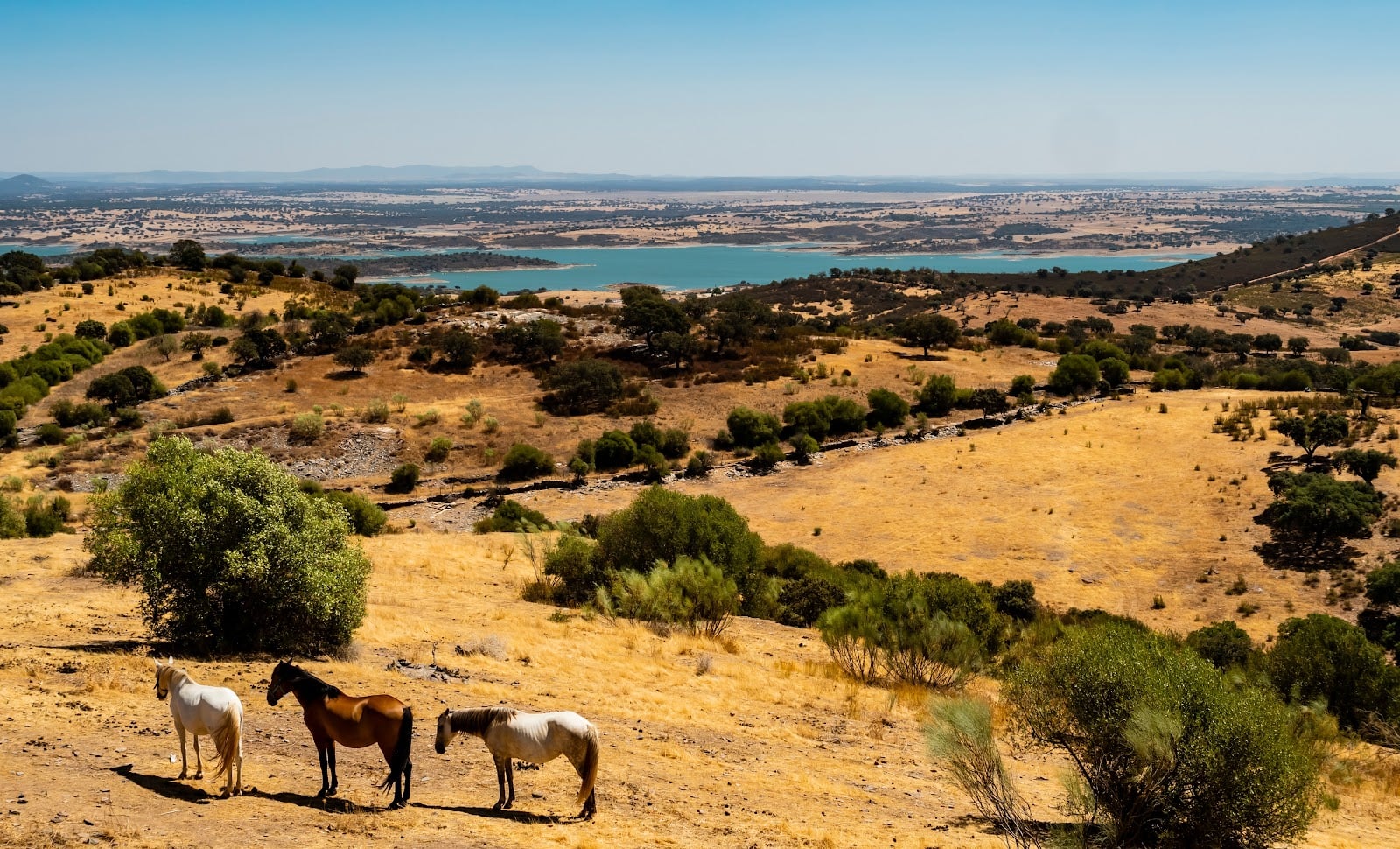
Looking out from the castle battlements, the sight of Lake Alqueva is startling in its scale. Completed in the early two thousands along the course of the Guadiana River, it formed the largest artificial reservoir in Western Europe. What was once an arid valley of olive trees and scrub oak is now an intricate network of serene inlets, peninsulas, and green islands reflecting the expansive southern sky.
The water has softened the frontier landscape without stripping it of its drama. On warm afternoons, the lake creates a gentle cooling breeze that rises to meet the ramparts of the village. The contrast between ancient medieval stone and the shimmering blue reservoir below gives Monsaraz an otherworldly presence, suspended between medieval warfare and modern tranquility.
Browse our travel inspiration for ideas, or tell us what kind of day you have in mind.
A Midday Feast of Alentejano Comfort
After a morning spent exploring defensive keeps and whitewashed chapels, the village restaurants beckon with rich regional aromas. Alentejo cuisine is unpretentious and deeply rooted in peasant traditions, relying on rustic bread, garlic, wild herbs, and locally cured meats. Sitting by a stone window inside a cozy tavern like Taverna Os Templarios or Sabores de Monsaraz, lunch becomes an unhurried celebration of the land.
Guests can savor dishes such as ensopado de borrego, a tender lamb stew poured over thick slices of country bread, or carnes de porco alentejana paired with coriander and clams. Pour a glass of local red wine made from native grape varieties like Trincadeira and Aragonez, cultivated in the nearby Reguengos de Monsaraz wine district. The intense fruit notes and earthy finish complement the robust flavors of cured sheep cheese served at the start of the meal.
Mysteries in the Surrounding Valley
Descending the winding road from the village toward the water, the valley reveals layers of human habitation that far predate medieval knights. This region holds one of the richest collections of megalithic monuments in the Iberian Peninsula. A short drive through the olive orchards brings you to the Menhir of Outeiro, an astonishing granite monolith standing nearly nineteen feet high, solitary and silent among the fields.
A few minutes farther stands the Cromeleque do Xerez, an unusual square arrangement of standing stones surrounding a central menhir. When the rising waters of the Alqueva reservoir threatened to submerge this ancient sanctuary in 2002, archaeologists carefully dismantled each granite block and reassembled the circle on higher ground near the Convent of Orada. It remains a striking reminder of the spiritual ties that have bound people to this land for over five thousand years.
Pottery of Sao Pedro do Corval and Quiet Horizons
Before concluding the day, your guide can easily detour to the nearby hamlet of Sao Pedro do Corval, recognized as one of the largest traditional pottery centers in Portugal. Here, dozens of family run workshops still operate traditional foot powered wheels and wood fired kilns. Visiting artisans like Olaria Pial allows you to watch local potters shape terracotta clay into plates, jugs, and serving platters painted with rustic motifs of olives, wildflowers, and rural village scenes.
As the afternoon light softens into amber across the olive groves, the return drive through the Alentejo feels deeply restorative. With your private driver managing every road and timetable, you are free to savor the memory of cool stone keeps, tranquil reservoir waters, and the timeless stillness that makes Monsaraz one of the most evocative places in southern Europe.
Plan your own day
Share your dates, group size and interests, and we will suggest a tailored plan with a local driver/guide.