Travel through Lisbon, Sintra, Cascais, Obidos and Nazare on a tailored five-day itinerary that leaves room for lingering lunches and small discoveries. The journey builds toward a memorable day beside the Atlantic, where fishing traditions give the famous waves a deeper context.
Day 1: Arrival in Lisbon, a Gentle Introduction
Begin in Lisbon with an arrival day that asks very little of you: settle into your hotel, change into shoes with good grip, and head toward Praça do Comércio, where the open riverfront makes a generous first impression after an overnight flight from America. The square occupies the site of the royal palace destroyed in the earthquake of 1755, and its orderly arcades introduce the rebuilding that reshaped the lower city; stand facing the Tagus for a moment before turning toward the narrower streets beyond. Continue into Alfama for a short walk among tiled façades, steep lanes and doorways where ordinary neighborhood life carries on, resisting the temptation to make this first afternoon an ambitious march between monuments when a shaded table might be more welcome. Lunch can be as simple as bacalhau à Brás, shredded salt cod folded with onions, fine potato sticks and eggs, followed by coffee; it is a satisfying introduction to the Portuguese habit of making something memorable from familiar pantry ingredients. Portugal Magik’s private driver/guide handles the driving in a Mercedes-Benz vehicle and can shape the pacing around your arrival and energy, leaving the evening free for an early dinner and an overnight stay in Lisbon.
Day 2: Sintra, a Palace Above the Trees
Leave Lisbon after breakfast for Sintra, where wooded slopes and cooler air change the mood of the journey, and give the day one clear centerpiece rather than trying to collect every palace on a hillside whose winding roads reward a more selective approach. At Pena Palace, commissioned by Ferdinand II in the nineteenth century around an earlier monastery, bright walls and an exuberant mixture of architectural styles reveal a royal imagination shaped by Romanticism, with terraces that feel suspended between the forest and the sky. Reserve the appropriate timed admission ahead, allow for the uphill approach and internal access arrangements, and accept whatever weather the mountain offers: low cloud can conceal the distant views while making the palace’s arches, courtyards and unexpected details all the more atmospheric. Back in the historic center, pause for a travesseiro, the flaky pastry associated with Sintra and filled with a sweet almond and egg mixture, then browse a few side streets without turning the afternoon into another sequence of queues and entrances. This is a day for noticing how landscape becomes theater, from the palace silhouetted above the trees to a pastry counter crowded with paper-wrapped parcels; return to Lisbon for dinner at your own pace and a second overnight in the city.
Day 3: Cascais, Royal Footsteps and Atlantic Air
Travel west to Cascais for a day at sea level, exchanging Sintra’s vertical drama for waterfront walking and the quieter pleasure of watching a working town accommodate beachgoers, local shoppers and visitors who have come simply to sit beside the water. Cascais became a fashionable summer retreat after King Luís I established his seasonal residence here in 1870, but its fishing identity remains part of the story, especially around Praia da Ribeira, where boats offshore keep the view from feeling like a purely decorative harbor scene. Walk to the Museu Condes de Castro Guimarães, housed in a turreted former residence completed around the turn of the twentieth century, for a different expression of coastal life, with decorative arts and books offering an intimate counterpoint to yesterday’s royal spectacle. Set aside a proper lunch for grilled fish, asking what is available that day rather than arriving with a fixed order, and pair it with a glass of Portuguese white wine if you wish, leaving time afterward for coffee and an unhurried waterfront stroll. Check into your Cascais hotel for the night instead of immediately retracing the road, and let the afternoon taper into a gentle evening when the day-trip crowds thin and the town’s streets become an appealing place to wander without a list.
Browse our travel inspiration for ideas, or tell us what kind of day you have in mind.
Day 4: Obidos, Inside the Walls
After breakfast, leave Cascais for Óbidos and plan to stay overnight, because this compact walled town reveals more when it is not squeezed between two longer visits: the real reward is the chance to see the same street in changing light. Enter through the Porta da Vila, where an eighteenth-century tiled chapel above the passage creates a ceremonial welcome, and continue along the cobbled lanes slowly enough to notice painted borders around doorways, climbing flowers and the practical business of people living within a much-photographed setting. At the Igreja de Santa Maria, pause over the connection to the young Afonso V and his cousin Isabel, whose wedding was celebrated here in 1441, a reminder that the town’s picturesque appearance overlays centuries of dynastic politics and royal patronage. Lunch might bring a warming bowl of soup followed by roast meat or fish, while a small glass of ginjinha afterward introduces the sour-cherry liqueur strongly associated with Óbidos; the chocolate cup is optional, not a requirement for enjoying the drink. Spend the later afternoon exploring at ground level if the exposed ramparts and uneven steps do not appeal, then stay overnight in Óbidos, where dinner and a final walk after many visitors depart can feel more rewarding than another hour of sightseeing.
Day 5: Nazare, the Day You Will Remember
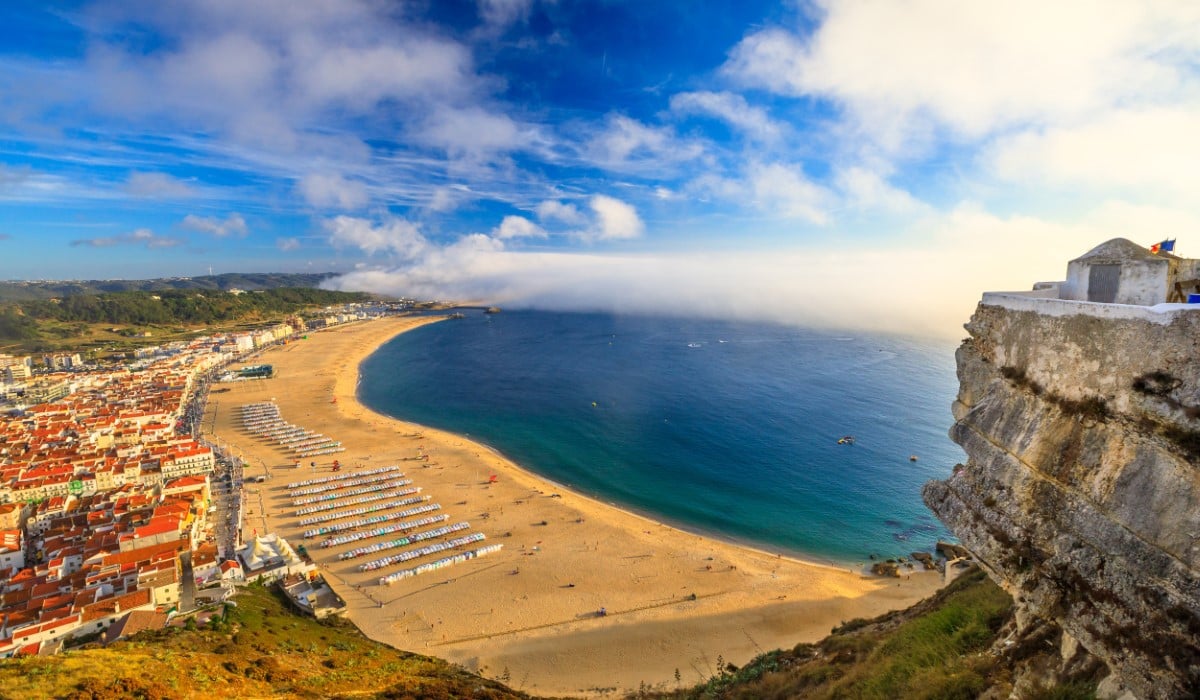
Make the short journey north to Nazaré for the itinerary’s most memorable day, beginning in Sítio above the beach, where the story of the sea is told not only through views but through a legend that has held the town’s imagination for centuries. According to that legend, the Virgin Mary saved the nobleman Dom Fuas Roupinho from riding over the cliff while pursuing a deer in 1182; hearing it beside the precipice gives the setting a human scale before the enormous Atlantic takes over again. Continue toward Praia do Norte to understand the waves made famous by big-wave surfing, remembering that the offshore Nazaré Canyon helps amplify suitable ocean swells, that the largest events are generally associated with autumn and winter conditions, and that spectacular surf is never an everyday certainty. Return to the lower town for a seafood lunch, perhaps caldeirada when available, a fish stew whose ingredients vary with the kitchen and catch, then look for the fish-drying racks along the beachfront, a tangible reminder that preservation and livelihoods long preceded the surf cameras. Your local driver/guide can adjust the stops to the weather and your appetite for walking, leaving room to watch the water rather than rush past it; return to Lisbon for the final overnight, carrying home a coastal story richer than a photograph of a wave.
Plan your own day
Share your dates, group size and interests, and we will suggest a tailored plan with a local driver/guide.