From Lisbon clifftops to northern headlands, discover eight dramatic ocean vantage points that capture the imagination of American travelers. Learn how scenic drives and local insights make photographing Portugal’s rugged coast effortless.
1. Cabo da Roca, where the continent yields to the open sea
Standing on the edge of Cabo da Roca, you look out across the same horizon that sixteenth-century navigators watched as their caravels departed the Tagus. As the westernmost point of continental Europe, its granite headland rises over four hundred feet above the crashing Atlantic swells. The iconic red-and-white lighthouse, established in 1772, provides a striking contrast against the dark cliffs and wildflower-covered slopes. For American travelers used to long road trips along the Pacific Coast Highway, the dramatic drop here feels remarkably raw and immediate, yet it sits barely forty minutes outside central Lisbon.
Because parking lots and narrow seaside lanes can quickly crowd during midday, arriving in a Mercedes-Benz vehicle with a knowledgeable local driver allows you to bypass the headaches of rental cars and GPS mishaps. Your local driver can shape the day around your pace, dropping you directly at the scenic path before the fog rolls in, leaving you free to capture clean panoramic shots without feeling rushed.
2. The Sitio at Nazare, overlooking legendary giants
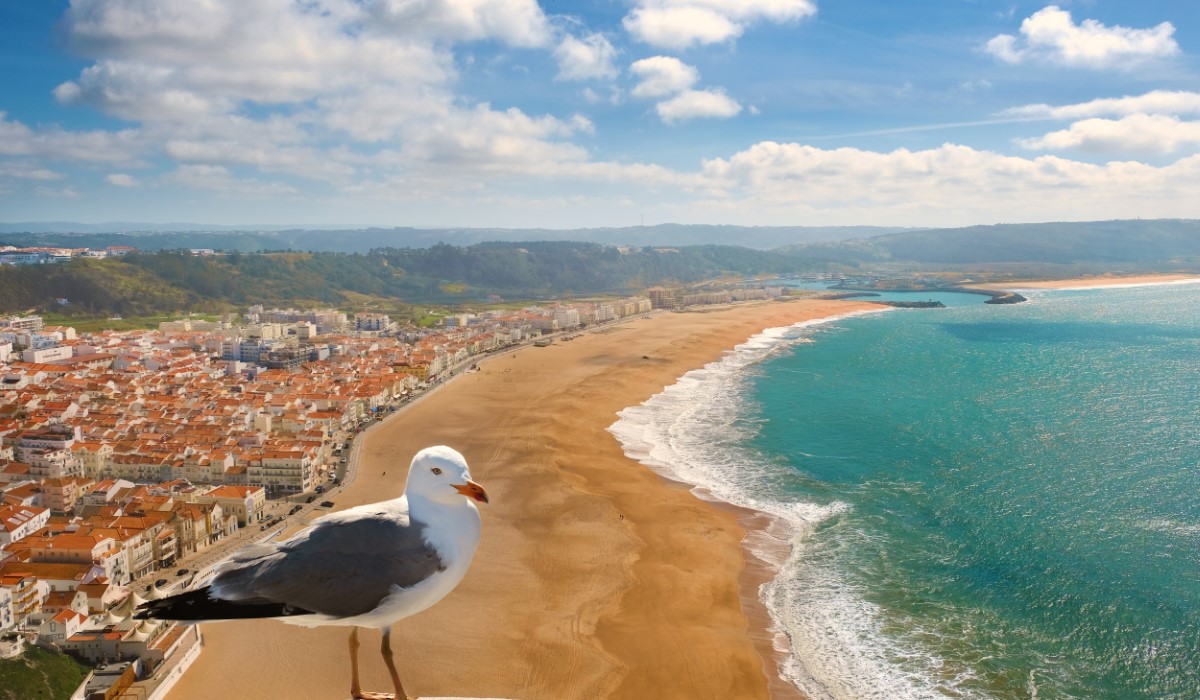
High on the promontory of Sitio, perched over three hundred feet above the golden crescent of Nazare town beach, lies one of the most celebrated viewpoints in maritime Europe. Photographers look north across the broad expanse of Praia do Norte, where the underwater Nazare Canyon channels immense ocean energy into some of the tallest surfable waves on earth. Even on calm summer afternoons, the sheer scale of the amphitheater is breathtaking, framed by the stone balustrades of the chapel of Nossa Senhora da Nazare and the historic fort of Sao Miguel Arcanjo.
After framing your photos of the deep blue water and whitewashed village below, a short stroll leads to local seafood taverns serving grilled sea bass, barnacles, and caldeirada fish stew. Portugal offers extraordinary value compared to coastal France or the Amalfi Coast, pairing world-class Atlantic vistas with fresh, unpretentious dining where English is warmly and widely spoken.
3. Cabo Espichel, dramatic sea cliffs and forgotten sanctuaries
Located on the southwestern tip of the Setubal Peninsula, Cabo Espichel feels like the edge of another world. The viewpoint sits on sheer, windswept limestone cliffs dropping hundreds of vertical feet straight into the foaming ocean. What makes this setting exceptional for photography is the juxtaposition of nature and austere human architecture. The eighteenth-century pilgrimage complex of Santuario de Nossa Senhora do Cabo stands isolated on the plateau, featuring arcaded pilgrim quarters and a solitary chapel facing the open horizon.
Just along the cliff edge, geological trails reveal fossilized dinosaur tracks preserved in the stone layers. American visitors consistently rank this among their favorite quiet discoveries because it remains uncrowded and peaceful, offering panoramic framing opportunities that feel completely removed from heavy tour bus traffic.
Browse our travel inspiration for ideas, or tell us what kind of day you have in mind.
4. Miradouro de Santa Luzia, watching the Atlantic tide enter the Tagus
While technically situated within historic Lisbon, the Miradouro de Santa Luzia captures the magnificent meeting of river and sea. From this tiled terrace in the Alfama district, you look past whitewashed church domes and terracotta rooftops toward the expansive Tagus estuary as it swallows Atlantic currents. The viewpoint itself is framed by classic blue-and-white azulejo tiles illustrating Lisbon before the 1755 earthquake and the conquest of the city from the Moors.
Morning light here is soft and forgiving on camera lenses, illuminating pink bougainvillea draping the stone pergolas. Having a private driver handle city drop-offs avoids Lisbon’s notorious cobblestone navigation, steep hill climbs, and scarce parking, letting couples and mature travelers simply walk onto the terrace and enjoy the morning breeze.
5. Boca do Inferno, the thunderous sea chasm of Cascais
Just outside the cosmopolitan seaside town of Cascais, the Atlantic has carved a massive archway and open cavern into the dark limestone cliffs known as Boca do Inferno, or the Mouth of Hell. During high tide and winter storms, ocean rollers crash into the opening with thunderous force, sending plumes of salt spray high into the coastal air. On sunny afternoons, the deep blue Atlantic frames the jagged rock formations, creating incredible contrast for close-up and wide-angle photography.
Cascais itself is a beloved retreat for American travelers seeking safe, walkable resort charm with royal history. A morning spent photographing the dramatic chasm flows naturally into a lunch of grilled sardines or garlic shrimp along the marina, backed by local Vinho Verde that costs a fraction of what one expects in comparable Spanish or Italian seaside towns.
6. Azenhas do Mar, whitewashed homes pinned to ocean cliffs
Few coastal vistas in Europe match the postcard perfection of Azenhas do Mar, situated along the Sintra coastline. Here, a cluster of whitewashed fishermen houses with red-tiled roofs clings dramatically to a vertical sea cliff above a natural ocean swimming pool and sandy cove. The viewpoint on the southern bluff provides the classic photo angle, capturing the entire village stacked against the sheer rock face as white Atlantic surf washes over the base.
Because the roads winding down from Sintra through Colares are winding and narrow, traveling with a private local guide ensures a relaxed ride through coastal pine forests. Your guide can easily adjust your itinerary to hit Azenhas do Mar just as the late afternoon sun casts a warm golden glow over the village walls.
7. Baleal Island, dual ocean horizons on the Silver Coast
Connected to the town of Peniche by a narrow sand causeway with breaking waves on either side, Baleal offers a unique perspective on the Atlantic. As you cross the causeway to the small rocky islet, you can photograph rolling surf breaks to the north and calm, turquoise waters to the south simultaneously. The weathered limestone ledges around the perimeter of Baleal feature deep crevices, tide pools, and sea stacks carved by relentless storms.
This stretch of the Silver Coast has become a favorite detour for American travelers moving between Lisbon and Porto. The driving distances between these coastal jewels are wonderfully manageable, allowing you to photograph wild ocean landscapes in the morning and settle into a historic monastery town or vineyard by mid-afternoon.
8. Foz do Douro, where river stillness meets Atlantic swell
At the western edge of Porto, the Douro River terminates directly into the ocean at Foz do Douro. The viewpoint along the Jardim do Passeio Alegre leads out toward the Felgueiras Lighthouse, a sturdy stone beacon built in the nineteenth century that stands directly in the path of crashing Atlantic breakers. Watching giant ocean swells slam against the stone pier while traditional granite mansions and palm trees line the boulevard behind you is an unforgettable photographic study in contrasts.
It is the perfect conclusion to a northern coastal route. Well-traveled guests appreciate how effortlessly Portugal combines dramatic natural elements with sophisticated comfort, excellent safety, and warm hospitality, providing memories and images that linger long after returning home.
Plan your own day
Share your dates, group size and interests, and we will suggest a tailored plan with a local driver/guide.