
From mist-cloaked royal hills to sunlit Roman ruins, discover the effortless day excursions from Lisbon that consistently win over American visitors.
1. Sintra, the mountain sanctuary of royal eccentricity
Sintra sits merely thirty minutes outside the capital, yet its microclimate of mossy boulders, dense ferns, and mountain fog feels entirely removed from southern Europe. American travelers often compare its forested slopes to the Pacific Northwest, punctuated by romantic nineteenth-century architecture. Pena Palace crowns the highest ridge with its audacious yellow and terracotta towers, commissioned by King Ferdinand II as a summer residence. Just down the lane, Quinta da Regaleira captivates with its subterranean Initiation Well, where stone spiral stairs descend deep into the earth amid Masonic symbolism.
Navigating Sintra on your own can test anyone’s patience due to tightly restricted mountain roads and scarce parking. Touring with a knowledgeable local driver allows you to bypass the logistical headache, stepping out of a climate-controlled Mercedes-Benz right near the palace gates. Afterwards, stop in the historic center for warm travesseiros, the local puff pastry filled with almond cream, served fresh from the oven at Casa Piriquita.
2. Cascais and Cabo da Roca, an oceanfront breath of fresh air
Following the Tagus River to where it meets the open Atlantic leads to Cascais, a former fishing village that gained global prestige when Portuguese royalty chose it as their summer playground in the late 1800s. American visitors appreciate the walkable, impeccably clean marina, pastel villas, and casual seaside charm that rivals the French Riviera without the intimidating pretension. English is spoken everywhere with genuine warmth, making it remarkably easy to sit along the pedestrian lanes and enjoy freshly caught sea bass grilled over open coals.
A short drive past wild dunes leads to Cabo da Roca, the westernmost point of continental Europe. Standing beside the stone monument on these sheer cliffs, watching ocean swells crash into the headland hundreds of feet below, delivers an undeniable sense of geographic drama. A private excursion allows you to weave through the coastal roads of the Sintra-Cascais Natural Park without the stress of navigating unfamiliar roundabouts.
3. Obidos, a fortified time capsule wrapped in stone
Rising above silver-green orchards an hour north of Lisbon, Obidos appears almost unchanged from its fourteenth-century heyday. Encircled entirely by intact crenelated walls, this hill town was traditionally gifted by Portuguese kings to their queens on their wedding days. Walking through the main gate, adorned with blue and white eighteenth-century glazed tiles, reveals narrow lanes lined with whitewashed cottages trimmed in cobalt and ochre.
American travelers love the small, manageable scale of Obidos, where you can easily stroll the length of the village in twenty minutes before settling into a tavern for traditional cherry liqueur, ginjinha, poured into miniature chocolate cups. Because the town is entirely car-free within its walls, having your driver wait near the lower aqueduct makes arrival and departure thoroughly seamless.
Browse our travel inspiration for ideas, or tell us what kind of day you have in mind.
4. Evora, where Roman columns meet whitewashed alleys
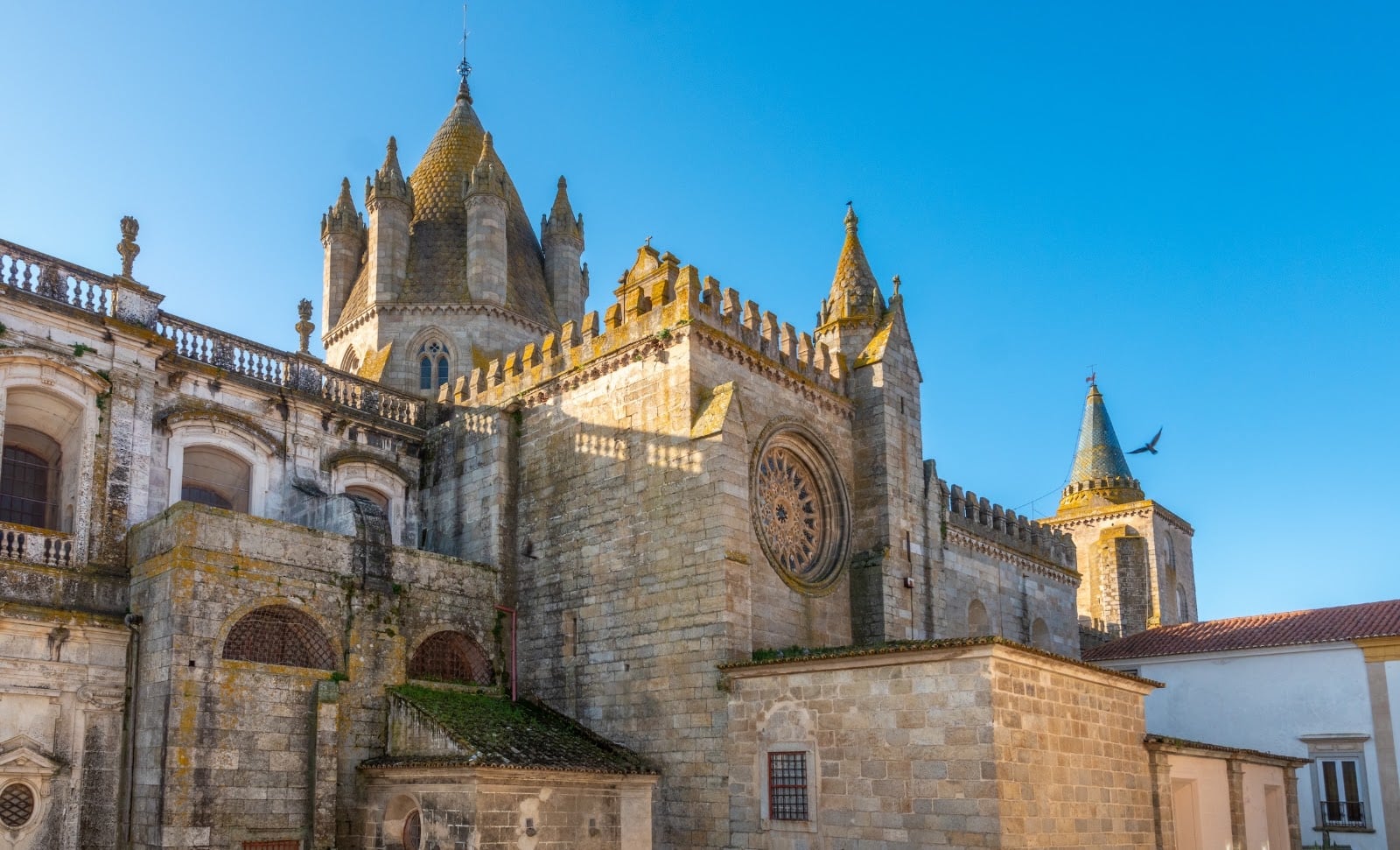
Heading east over the Vasco da Gama bridge brings you into the sun-drenched plains of the Alentejo, an agricultural heartland studded with ancient cork oaks and olive groves. Ninety minutes from Lisbon sits Evora, a UNESCO World Heritage city whose historic layers span two millennia. The Corinthian columns of the Roman Temple of Diana stand proudly in the main square, while nearby, the Church of Saint Francis houses the haunting Chapel of Bones, constructed by Franciscan friars in the seventeenth century as a meditation on human mortality.
For Americans comparing European destinations, Evora offers deep historical substance paired with exceptional culinary value. A relaxed lunch here means crusty Alentejano bread, sheep’s milk cheeses, acorn-fed Iberian pork tenderloin, and structured regional red wines made from Touriga Nacional and Trincadeira grapes. The pace of the region is deliberate and quiet, offering a deeply restful contrast to the energy of Lisbon.
5. Nazare, towering cliffs and old maritime traditions
Nazare has gained worldwide fame among Americans for the colossal winter waves at Praia do Norte, where the underwater Nazare Canyon amplifies Atlantic swells to record-breaking heights. Even outside big-wave season, the geography is staggering. The Sitio district, perched on a limestone promontory three hundred feet above the crescent bay, offers expansive views across the ocean and the town’s red-tile roofs below.
Down along the sandy beach, older women still wear the traditional seven woolen petticoats, tending wooden drying racks laden with mackerel and sardines. Lunch at a beachfront restaurant like A Tasquinha delivers steaming pots of caldeirada, a traditional fisherman’s stew rich with tomatoes, potatoes, bell peppers, and multiple varieties of ocean fish, served with honest hospitality.
6. Arrabida Natural Park and Azeitao, hidden coves and artisan cellars
Just forty minutes south of the capital across the 25 de Abril suspension bridge lies the Serra da Arrabida, where chalk cliffs draped in Mediterranean forest drop into clear, turquoise water. The coastline looks more like northern Sardinia than the Atlantic, offering calm, sheltered beaches like Portinho da Arrabida. Because mountain passes are narrow and summer access for private vehicles is heavily restricted, visiting with an experienced local driver ensures you see the best viewpoints without dead ends.
In the adjoining valley of Azeitao, artisanal traditions thrive. Visitors can tour working tile studios using sixteenth-century hand-painting techniques before stopping at centuries-old wine estates to sample the golden, sweet Moscatel de Setubal. Pair a glass with Queijo de Azeitao, a creamy, pungent sheep cheese curdled using wild cardoon thistles, and you have one of the finest food pairings in central Portugal.
7. Tomar, walking the ramparts of the Knights Templar
For travelers fascinated by medieval and Renaissance history, Tomar stands out as an extraordinary day trip eighty miles northeast of Lisbon. Founded in 1160 by Gualdim Pais, Grand Master of the Knights Templar, the Convent of Christ served as both an impenetrable stronghold and a monastic retreat. The centerpiece is the Charola, a rare sixteen-sided Romanesque rotunda modeled after the Holy Sepulchre in Jerusalem, decorated with gilded paintings and Gothic wood carvings.
The complex also showcases the pinnacle of Manueline architecture, most famously the intricate sixteenth-century Chapterhouse Window carved with maritime ropes, coral, and royal insignias celebrating Portugal’s Age of Discovery. Walking these stone corridors feels unhurried and remarkably uncrowded compared to major monuments in Italy or France, giving American visitors room to absorb the quiet majesty of the setting.
8. Batalha and Alcobaca, monuments of victory and royal devotion
A central loop north of Lisbon combines two of the most significant monastic sites in Europe, separated by only twenty minutes of green countryside. The Monastery of Batalha was constructed to fulfill a vow made by King John I following his victory against Castile at the Battle of Aljubarrota in 1385. Its soaring Gothic nave and open-air Unfinished Chapels exhibit limestone lace-work that shifts color as the afternoon sun moves across the stone.
A short drive south brings you to Alcobaca, a twelfth-century Cistercian abbey founded by Portugal’s first king, Afonso Henriques. In the transept rest the ornate marble tombs of King Pedro I and his beloved Ines de Castro, whose tragic fourteenth-century romance remains Portugal’s most enduring love story. Exploring these quiet cloisters reveals a country that honors its history with reverence, simplicity, and an openness that leaves American travelers eager to return.
Plan your own day
Share your dates, group size and interests, and we will suggest a tailored plan with a local driver/guide.