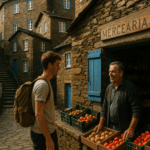
Perched above olive groves and river valleys, these historic high places offer timeless architecture, remarkable safety, and genuine hospitality without the crowds of southern Europe.
1. Monsaraz, where whitewashed walls overlook the Great Lake
Rising sharply above the plains of the Alentejo, Monsaraz feels suspended between earth and sky. American travelers accustomed to the congested hilltop roads of Tuscany often remark on the immediate sense of ease here. The entire village is pedestrian only, contained within weathered schist and lime walls that date back to the reconquest. Stepping through the arched Porta da Vila, you walk along slate stones polished smooth by centuries of footsteps, passing iron lanterns and flowering bougainvillea against chalk-white facades.
From the castle ramparts at the western tip, the view opens across the vast blue surface of Lake Alqueva, stretching all the way toward Spain. After exploring the quiet alleys, lunch at a traditional tavern means clay platters of roasted acorn-fed pork, wild asparagus scrambled with farm eggs, and a glass of deep Alentejo red wine from nearby Reguengos de Monsaraz. English is spoken with warm generosity, yet the atmosphere remains utterly genuine, free from the theatrical commercialism found in many other corners of Europe.
2. Marvao, an eagle nest fortress near the eastern frontier
Set nearly three thousand feet up in the Serra de Sao Mamede, Marvao is one of the most dramatically situated settlements in the Iberian Peninsula. The approach winds upward through chestnut groves and cork oaks before delivering you to a peaceful granite stronghold where clouds frequently drift below the parapets. For travelers who prefer not to navigate these steep, unfamiliar mountain switchbacks themselves, having a skilled local driver handling the route makes the ascent completely stress-free.
Inside the walls, pristine medieval houses display Gothic doorways and immaculate wrought iron balconies. The castle cistern remains intact, echoing softly under stone vaults, while the northern bastions look out across miles of untouched rolling plateau. A midday meal here often features rich lamb stew seasoned with coriander and garlic, paired with sheep milk cheeses from neighboring Nisa. The sheer tranquility of Marvao highlights why Americans find Portugal so profoundly restorative compared to faster-paced destinations.
3. Castelo de Vide, where thermal springs meet an ancient Jewish quarter
Just across the valley from Marvao sits Castelo de Vide, famous for its red-roofed townhouses stepping gracefully down the hillside and its abundance of natural spring fountains. The upper quarter preserves one of the best-kept medieval Jewish quarters in western Iberia. Narrow lanes called canadas are framed by pointed granite doorways, with wooden shutters painted in deep greens and mustard yellows, each doorstep decorated with potted geraniums and sweet basil.
Walking through the small fourteenth-century synagogue, now an informative museum, offers a moving glimpse into centuries of cultural heritage. Afterward, a stroll down to the town square leads to sun-dappled outdoor tables where you can enjoy local chestnut sweets and pastis de Castelo de Vide. The town feels intimately safe, welcoming, and easy to navigate on foot, making it an ideal stop for couples and families alike who appreciate deep historical texture.
Browse our travel inspiration for ideas, or tell us what kind of day you have in mind.
4. Sortelha, an unchanged world of granite boulders and forgotten legends
In the historic border country of Beira Alta, Sortelha stands as an astonishing survivor of the Middle Ages. Its houses are built directly out of enormous round granite boulders, blending so seamlessly into the natural landscape that it is hard to tell where the bedrock ends and human masonry begins. Entering through the arched gateway watched over by an eleventh-century keep, you step into an era untouched by neon signs or overhead cables.
The surrounding countryside is silent, wild, and dotted with olive trees and lichen-covered stones. Local dining centers on comforting regional traditions like slow-roasted kid goat and dark rye bread baked in communal wood ovens. For American visitors, Sortelha demonstrates the remarkable value of Portugal: world-class heritage and delicious regional cooking served with genuine warmth, at a fraction of the cost found in rural France or northern Italy.
5. Monsanto, the village sculpted beneath living stone
Voted Portugal’s most Portuguese village in the mid-twentieth century, Monsanto crowns an isolated granitic mountain that rises dramatically out of the plains. What captivates travelers here is how homes were constructed beneath, around, and inside monolithic rocks weighing hundreds of tons. Roofs sprout directly from granite clefts, and curved stone walls wrap around boulders that double as living room ceilings.
The climb up to the ruined Templar castle at the summit rewards you with a panoramic, bird’s-eye view across miles of pine woods and sparkling reservoirs. Along the steep pathways, local women still sing traditional songs with the adufe, a square Moorish frame drum crafted from goat skin. Having a dedicated driver and guide allows you to explore these steep village roads at your own measured pace, with comfortable air-conditioned transport waiting precisely when you are ready to move on.
6. Castelo Rodrigo, a quiet beacon along the pilgrimage route
High above the river plateaus near the Douro basin, Castelo Rodrigo has greeted travelers and pilgrims bound for Santiago de Compostela since the twelfth century. Its weathered walls still bear the scars of border battles, yet the village today is an oasis of calm, where almond trees blossom bright white and pink in early spring. Within its compact lanes, visitors find historical cisterns, a Manueline pillory, and the modest Church of Nossa Senhora do Rocamador.
The village is also a wonderful destination for food lovers. Small artisan shops tucked into restored stone storefronts offer tastings of candied almonds, wild lavender honey, and olive oils pressed from ancient groves below the ridge. Because English is spoken with ease by the local shopkeepers and vintners, striking up conversations about regional traditions feels completely natural and effortless.
7. Almeida, a star-shaped bastion of military engineering
While many hilltop villages grew organically around a medieval tower, Almeida was engineered into a magnificent twelve-pointed star fortification during the seventeenth and eighteenth centuries. Surrounded by massive earthworks, deep dry moats, and bombproof tunnels, the village sits elevated on a high plateau, hidden from view until you pass through the double-arched stone gates. It remains one of the finest surviving examples of Vauban-style military architecture in Europe.
Inside, wide, orderly cobbled streets lead to quiet plazas lined with whitewashed military quarters and tiled manor houses. The subterranean historical museum, set inside former powder magazines, tells the dramatic story of the Peninsular War with remarkable detail. Walking along the grassy perimeter walls in the late afternoon breeze offers an expansive sense of open horizon rarely found in crowded tourist hubs.
8. Piodao, the amphitheater of schist hidden in the Serra do Acor
Tucked into the folds of the central mountains, Piodao resembles a Nativity scene carved into the hillside. Its distinctive architecture relies entirely on dark schist stone, offset by bright blue wooden window frames and doors, a color choice originally born from isolation when only blue paint was available to villagers. The town tiers upward in steep terraces, crossed by winding staircases and crystal-clear mountain streams.
At the base of the village, near the pristine white parish church, small cafes serve traditional chestnut liqueur and tigeladas, a baked egg custard cooked in glazed earthenware bowls. Reaching Piodao requires traveling deep into the mountain valleys, and having a professional driver at the wheel turns what could be a demanding drive into a scenic, restful journey through terraced orchards and pine forests. Portugal’s high villages offer rich history, exceptional food, and peaceful lanes, creating the kind of memories that stay with you long after returning home.
Plan your own day
Share your dates, group size and interests, and we will suggest a tailored plan with a local driver/guide.