Follow the Lima River from an old market town to the Atlantic, with time for medieval stories, a proper Minho lunch and the last light on the water. These six stops make a rewarding day beyond Porto without turning northern Portugal into a checklist.
1. Ponte de Lima’s old bridge, where soldiers feared losing their memories
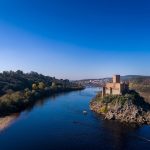
Leave Porto after breakfast and head north to Ponte de Lima, roughly an hour away by road, depending on traffic. Start beside the river rather than inside a museum. The long stone bridge preserves a Roman section alongside its medieval construction, and the water beneath it carries an unusually good story. According to the ancient account associated with this crossing, Roman soldiers mistook the Lima for the Lethe, the river of forgetfulness. Their commander, Decimus Junius Brutus, crossed and called them by name to prove that his memory remained intact.
Figures on opposite banks recall the episode today. For children, it makes ancient history immediately understandable; for adults, it gives a quiet river view unexpected depth. Walk as far across the bridge as feels comfortable, remembering that stone paving can be uneven. This is the first pleasure of the day: a substantial historical encounter without the scale or bustle of a major European monument.
2. Largo de Camoes, for a town square and a distinctly northern lunch
A few steps from the bridge, Largo de Camões gathers Ponte de Lima around a fountain, café tables and handsome old façades. The town received its charter from Teresa of León in 1125, before Portugal became an independent kingdom. Yet its appeal is not simply its age. Sit over coffee and watch the square conduct its ordinary business. Shops, church bells and conversations give the history a present tense, something Americans sometimes miss when European itineraries move only between ticketed sights.
Make lunch the day’s anchor. Arroz de sarrabulho, a local specialty, combines rice with meats, blood and seasoning, often accompanied by rojões, pieces of pork. It deserves an honest description before anyone orders. Those who prefer something simpler can look for roast meat or bacalhau dishes, depending on the menu. A Loureiro-based Vinho Verde makes a regional introduction. For travelers comparing costs with France or Italy, a traditional restaurant here is worth considering, although value depends on the establishment and the order.
3. Bertiandos, where the Minho reveals its quieter landscape
A short drive west brings you to the protected wetlands of Lagoas de Bertiandos e São Pedro de Arcos. This is a different northern Portugal from the terraced Douro photographs: wet woodland, lagoons, pasture and paths where the attraction is observation rather than spectacle. Stop at the interpretation center when open, check current trail conditions and choose a short walk rather than committing automatically to a longer circuit. Birdlife and vegetation change with the season, so there is no need to promise a particular sighting.
After lunch, even a modest stretch outdoors can reset the day. Families gain room to look and wander; couples find a gentle interval between towns. A local driver/guide can shape the day around the guests, shortening this stop in wet weather or allowing more time when walking is the priority. That flexibility matters more than collecting every landmark, especially when different generations are traveling together.
Browse our travel inspiration for ideas, or tell us what kind of day you have in mind.
4. Santa Luzia, for the moment the river meets the ocean
Continue west toward Viana do Castelo, allowing roughly half an hour from the wetlands area in ordinary traffic. Above the city, the Sanctuary of the Sacred Heart of Jesus on Mount Santa Luzia offers the day’s great geographical revelation. The Lima, which seemed so intimate at Ponte de Lima, now opens toward the Atlantic. Below lie the city, the river mouth and a long sweep of coast. The sanctuary looks older than it is: construction began in 1904, with a design drawing on Romanesque and Byzantine forms.
The broad view is reason enough to come; climbing higher inside need not be part of the visit. For Americans who enjoy hill towns in Italy or overlooks in Spain, this has a familiar emotional pull but a distinctly Atlantic setting. Arriving by road also avoids making a steep uphill walk compulsory. Wind, cloud and visibility will determine whether this is a brief pause or the afternoon’s longest stop.
5. Praca da Republica, where Viana’s maritime confidence survives in stone
Down in Viana do Castelo, Praça da República rewards attention at street level. Its sixteenth-century fountain, former town hall and Misericórdia building make a compact introduction to a city shaped by maritime trade. Look up at the carved figures and arcaded façade of the Misericórdia rather than rushing straight through. Nearby streets hold goldsmiths’ windows displaying the filigree associated with the Minho, including the heart-shaped pendants that have become one of Portugal’s most recognizable jewelry forms.
This is a good place for an unhurried café stop, with a bola de Berlim if a bakery has them available. English is commonly spoken in visitor-facing businesses, though less consistently in small neighborhood establishments; a greeting in Portuguese is always useful. Keep ordinary precautions with bags and phones, as in any European town. The ease here comes from the compact center and time to explore, not from pretending that every pavement is level or every street is traffic-free.
6. Cabedelo, for an Atlantic ending rather than another monument
Finish across the river at Cabedelo, where dunes and a broad sandy beach face the Atlantic. Access paths bring you toward the shore, and windsurfers or kitesurfers may be out when conditions suit. This is a place to watch the weather and water, not to assume calm swimming. Bring a light layer even on a warm day, and keep to designated dune crossings. If sunset falls late, enjoy the afternoon light instead of stretching the return merely to satisfy an itinerary.
Portugal Magik’s private tours in Mercedes-Benz vehicles let the journey home become part of the rest, without anyone needing to navigate unfamiliar roads after a full day. Allow around an hour back to Porto, subject to traffic and your destination. What remains is not six separate attractions but one connected story: a river crossed by Romans, a town sustained by its table, and a coast still looking outward.
Plan your own day
Share your dates, group size and interests, and we will suggest a tailored plan with a local driver/guide.