From medieval fortifications to quiet whitewashed hamlets surrounded by olive groves, these Alentejo destinations offer the restorative pace and rich regional dining that well-traveled Americans often crave.
1. Evora, where Roman columns meet quiet monastery cloisters
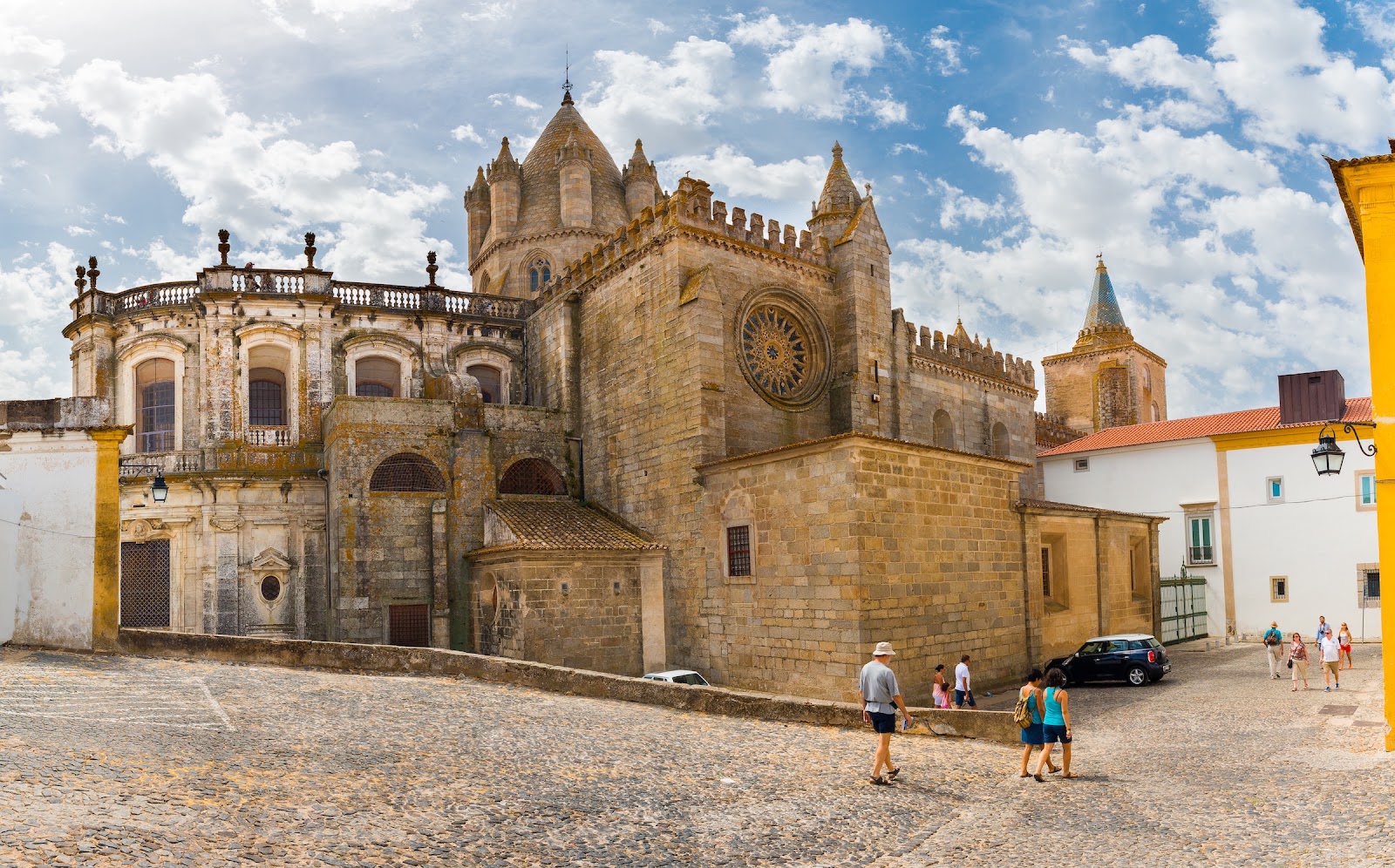
For American travelers accustomed to the bustling density of Florence or Seville, Evora arrives as an immediate breath of fresh air. Within its ancient ring of walls, the streets are paved with smooth granite stones, leading gently up to the Roman Temple of Diana. The Corinthian columns stand open to the southern sky, framed by whitewashed houses with mustard-yellow borders that ward off summer heat. English is spoken warmly across the town, from the museum desks to the neighborhood bakeries selling queijadas de Evora, delicate cheese pastries that carry centuries of convent tradition.
Spending a full morning here does not require checking off an exhaustive list of crowded monuments. Instead, visitors wander through the Cathedral of Santa Maria and linger in the eerie quiet of the Capela dos Ossos at the Church of Saint Francis. Stepping out into Praca do Giraldo, life slows to the rhythm of small porcelain cups of espresso and crisp glasses of Antao Vaz white wine. Because Portugal Magik provides private Mercedes-Benz touring, guests bypass the stress of navigating tight stone alleys or locating parking outside the gates, leaving all logistical details in capable hands while they explore on foot.
2. Monsaraz, a cliffside redoubt overlooking golden water
Perched high above the Guadiana river basin near the Spanish border, Monsaraz looks like an illustration from a history text. The entire village consists of just a few parallel lanes paved in rough slate, completely closed to outside vehicle traffic. From the ramparts of its fourteenth-century castle, the view stretches across olive plantations toward the shimmering blue expanse of the Alqueva reservoir, the largest artificial lake in Western Europe. Americans who feel weary of modern highway noise often find that Monsaraz provides the quietest afternoon of their journey.
A local driver and guide can shape the day around the guests, timing arrival so that visitors stroll the battlements when the afternoon sun warms the schist walls. Lunch in a village tavern introduces the deep richness of the region, including porco preto, the acorn-fed black pork served alongside migas, a savory bread stuffing infused with garlic and olive oil. Compared to the steep pricing of equivalent panoramic villages in Tuscany or Provence, a generous meal paired with a velvety regional red wine offers astonishing value.
3. Marvao, an eagles nest high above the Serra de Sao Mamede
Tucked into the northern reaches of the region near Castelo de Vide, Marvao sits nearly three thousand feet above sea level. Nobel laureate Jose Saramago famously noted that from Marvao, one can see the whole earth. The granite citadel blends so naturally into the bedrock that walls and mountain cliffs appear as a single formation. American travelers love Marvao because it remains exceptionally peaceful, surrounded by chestnut woods rather than tourist buses, offering clean mountain air and unbroken horizons.
Walking the high castle parapets feels like stepping into private history, where gardens of rosemary and boxwood thrive inside ancient military courtyards. Descending into the village lanes reveals immaculate doorways adorned with flowering geraniums and Gothic pointed arches. Having a private Mercedes-Benz vehicle waiting at the lower portal allows travelers to reach this remote mountain aerie smoothly, avoiding the winding mountain driving that often deters independent motorists.
Browse our travel inspiration for ideas, or tell us what kind of day you have in mind.
4. Estremoz, the white marble capital of southern Portugal
Estremoz is a town built of stone that gleams under the bright southern sun. Nearly everything here, from the curbs and doorstep steps to the towering keep of the thirteenth-century castle, is carved from local marble. On Saturday mornings, the vast central square fills with one of the most celebrated markets in the country, where farmers sell sheep cheeses, cured hams, and wild asparagus alongside traditional painted clay figurines known as bonecos de Estremoz. For American collectors and culinary enthusiasts, it is an authentic glimpse of countryside commerce.
The upper town remains profoundly peaceful throughout the week. Guests can climb the marble tower where Queen Saint Isabel once resided, gazing out over rolling plains lined with red clay soil and meticulously tended vineyards. The surrounding wine sub-region produces some of the most cellar-worthy reds in the country, rich with Touriga Nacional and Alicante Bouschet. Dinners here showcase tender roasted lamb paired with hearty local crusts, proving that unpretentious food and warm service define regional hospitality.
5. Arraiolos, where tapestry looms echo across castle grounds
Famous since the Middle Ages for hand-stitched wool tapestries, Arraiolos is an easy, picturesque stop just north of Evora. The village rises up a conical hill topped by one of the few completely circular castles in Europe, dating to the reign of King Dinis. Inside the village center, women still work along small wooden frames in open doorways, pulling wool threads through linen canvases using traditional cross-stitches that reflect Persian and Moorish influences. American travelers find the craft captivating, appreciating the chance to observe authentic heritage that has never been commercialized into a show.
After visiting the Castle of Arraiolos for a panoramic view across the surrounding plains, a short walk brings travelers to the small municipal museum dedicated to the embroidery tradition. Stopping at a corner cafe introduces pastel de toucinho, a rich regional almond pastry that pairs perfectly with afternoon coffee. The town is safe, compact, and easily walked in an hour, making it an ideal pause during a relaxed day through the countryside.
6. Vila Vicosa, royal marble grandeur on quiet avenues
Vila Vicosa holds an astonishing architectural treasure: the Ducal Palace of the House of Braganca. The enormous facade, clad entirely in local rose and white marble, faces a vast plaza planted with orange trees and dominated by an equestrian statue of King Joao IV. For Americans who love European court history, this town delivers regal scale without the crushing lines encountered at Versailles or the estates outside Madrid. Visitors can walk through preserved apartments, the royal armory, and a cavernous kitchen filled with polished copper cookware.
Beyond the palace walls, the town settles into a quiet cadence along wide avenues paved in distinctive black and white patterns. The local convent of Chagas de Cristo holds centuries of stories, while nearby restaurants serve ensopado de borrego, a comforting lamb stew poured over day-old country bread. A professional driver ensures the transition between these grand historic sites and the quiet backroads is effortless, keeping the focus entirely on relaxation.
7. Castelo de Vide, whitewashed fountains and Jewish quarter history
Nestled against the verdant slopes of the Sao Mamede hills, Castelo de Vide is celebrated for its abundant natural springs, blooming gardens, and remarkable medieval heritage. The town’s Judiaria, or Jewish quarter, remains one of the best preserved in the country. Small, whitewashed houses climb steeply toward the castle, their Gothic doorways carved with protective symbols. Inside an unassuming small building sits a fourteenth-century synagogue, now an intimate museum preserving the memories and resilience of the community.
Travelers love wandering down the Rua das Espingardas to drink cold water from the Renaissance fountain in the Praca Nova, where locals gather to share neighborhood news. The surrounding countryside produces exceptional olive oils with bright, peppery notes that elevate simple dinners of fresh grilled codfish and wild greens. With its cool mountain breezes and gentle pace, Castelo de Vide represents the quiet, authentic soul that thoughtful American travelers travel across the Atlantic to find.
Plan your own day
Share your dates, group size and interests, and we will suggest a tailored plan with a local driver/guide.