
Journey from quiet convent cloisters to coastal ceramic studios on a day dedicated to Portugal iconic glazed tiles.
Morning Light in the Cloister of Madre de Deus
The morning began where the city noise falls away into quiet limestone arches. In the eastern quarters of Lisbon sits the Convent of Madre de Deus, founded in 1509 by Queen Leonor. Stepping inside, the air feels cool, scented faintly with beeswax and stone. This former convent houses the National Tile Museum, a sanctuary dedicated entirely to the ceramic art that defines Portuguese architecture. Walking through its corridors, you begin to understand that these painted surfaces are not merely decoration. They are narrative archives, preserving centuries of cultural crossroads.
The earliest panels here reflect the Moorish origins of the craft. The word azulejo itself traces back to al zillij, the Arabic phrase for polished stone. When King Manuel I visited Seville in 1498, he was captivated by the geometric ceramic mosaics of Andalusia and brought the technique back to his kingdom. Standing before sixteenth-century panels of geometric green, amber, and white reliefs, you see how early artisans used raised ridges to prevent glazes from running together in the kiln. These tactile surfaces caught the morning light across the convent walls, revealing an artistic tradition in its infancy.
The Rise of Cobalt Blue Across Portugal
Climbing to the upper levels of the convent leads you directly into the golden age of the craft. By the late seventeenth century, trade routes with the East brought Chinese porcelain into Lisbon ports, igniting an enduring European love affair with blue and white palettes. Portuguese nobility and religious orders commissioned vast narrative scenes depicted in deep cobalt on milky tin glaze. The museum houses a breathtaking panoramic panel depicting Lisbon prior to the great earthquake of 1755, measuring nearly eighty feet in length. It captures church spires, caravel sails, and daily life along the Tagus before the catastrophe transformed the capital.
Having a knowledgeable driver guide from Portugal Magik allows you to delve deeper into these stories without looking at your watch or searching for transit connections. Your guide can shape the day around your personal interests, lingering before allegorical panels depicting hunting scenes or pointing out whimsical details left behind by anonymous master painters who added their own humor to grand religious commissions.
Midday Flavors by the Arrabida Foothills
Leaving Lisbon by mid morning, the journey headed south across the 25 de Abril suspension bridge, the Mercedes-Benz vehicle gliding quietly over the river towards the Setubal Peninsula. The coastal landscape opened into green hills covered in umbrella pines, cork oaks, and vineyards of Castelao grapes. By lunchtime, the car pulled up to a family run tasca near Azeitao, where the ocean and rural farmland meet on the plate.
Lunch arrived simply and generously: grilled sea bass caught that morning off Sesimbra, accompanied by boiled new potatoes, fragrant olive oil, and bitter turnip greens. A crusty loaf of sourdough bread and a wheel of creamy Queijo de Azeitao, a raw sheep milk cheese curdled with wild thistle flowers, anchored the table. Over small glasses of chilled white wine from the nearby Palmela hills, conversations turned naturally to the clay beneath our feet, the very soil that supplies the region ceramic workshops.
Browse our travel inspiration for ideas, or tell us what kind of day you have in mind.
Artisans of Azeitao and the Living Craft
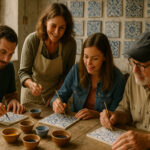
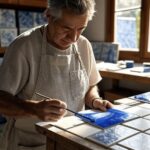
In the afternoon, the route turned toward the quiet village lanes of Azeitao, home to workshops where historical techniques remain vibrant. At Sao Simao Arte, the atmosphere is alive with the rhythmic tapping of brushes and the warmth of working kilns. Here, master artisans paint tiles completely by hand, utilizing the traditional majolica method introduced to the Iberian Peninsula during the Renaissance.
Watching a painter work is an exercise in patience. Each tile begins as a slab of local clay, trimmed and dried before receiving an opaque raw glaze bath. The artist paints directly onto this dusty, unfired surface using natural pigments suspended in water. Because the porous glaze absorbs the liquid instantly, corrections are impossible; every brushstroke must be deliberate and confident. Only when the tile enters the kiln at over a thousand degrees Celsius does the dull gray wash transform into luminous, permanent cobalt blue.
Palace Walls and Timeless Courtyards
A short drive through shaded lanes brought us to the gates of Quinta da Bacalhoa, one of Portugal most significant Renaissance estates. Built in the late fifteenth century as a royal country retreat, the manor showcases the profound integration of tile work into architectural gardens. Terraces border tranquil reflection pools, where walls are adorned with early sixteenth-century panels illustrating classical myths like Susanna and the Elders, among the oldest dated figurative tiles in Portugal.
Walking beside the quiet boxwood hedges, the tile panels reflect softly in the estate water basin. Here, the azulejos served practical purposes alongside their aesthetic beauty, protecting damp stone foundations against the Atlantic climate while cooling shaded galleries during hot summer afternoons. Each painted surface tells a story of maritime discovery, religious devotion, and classical philosophy, etched in earth and fire.
Evening Return Across the Tagus
As late afternoon deepened into gold, we settled back into the vehicle for the relaxed ride back toward Lisbon. The quiet comfort of the car provided a welcome pause to reflect on the sweep of history witnessed between the convent cloisters and countryside studios. Your driver guide can pause at Miradouro do Cristo Rei along the southern bluffs, offering a sweeping view of Lisbon rooftops glistening across the wide river mouth under the setting sun.
Crossing back into the capital, ordinary street scenes take on fresh meaning. A corner grocery store adorned with Art Nouveau floral ceramics, a church facade washed in brilliant blue panels, and an aged apartment doorway lined with yellow trim are no longer just pretty details. They are the living chapters of a craft that has survived earthquakes, empires, and changing fashions, quietly preserving Portugal soul one tile at a time.
Plan your own day
Share your dates, group size and interests, and we will suggest a tailored plan with a local driver/guide.