
Tiles are to Portugal what silk is to China or marble is to Italy: not just an art form, but a national emblem. Across Lisbon, Porto, and towns in between, azulejos shimmer on churches, palaces, fountains, and even humble houses, telling stories in blue and white glaze. For centuries, these hand-painted tiles have chronicled Portugal’s history — from maritime discoveries to biblical tales, floral motifs, and geometric Moorish patterns.
For travelers, admiring tiles on façades is enchanting. But stepping inside a workshop, picking up a brush, and painting your own tile guided by a master artisan? That transforms admiration into personal connection. To live even one day in the life of an azulejo artisan is to join a centuries-old lineage of Portuguese craftsmanship.
At Portugal Magik Private Tours, we often arrange private tile-painting experiences for our guests. As one client from New York reflected after her workshop: “I expected to bring home souvenirs. Instead, I brought home something I created — a piece of Portugal with my own hand.”
Here is what such a day looks like: an immersive journey into artistry, heritage, and discovery.
Morning: Entering the Atelier
The day begins on a quiet Lisbon street. From the outside, the atelier looks modest — a small wooden door, a tiled façade, perhaps a discreet sign. But step inside, and the space feels like another world. Sunlight filters through tall windows, catching motes of dust that float above shelves stacked with ceramic blanks. The air carries a mix of scents: chalky clay, mineral pigments, and the faint metallic tang of kilns cooling after a late-night firing.
The artisan greets you warmly. Often, these teachers are not just skilled painters but guardians of tradition, trained for decades in techniques passed down through apprenticeships. They welcome you to their world, where time slows and brushstrokes matter.
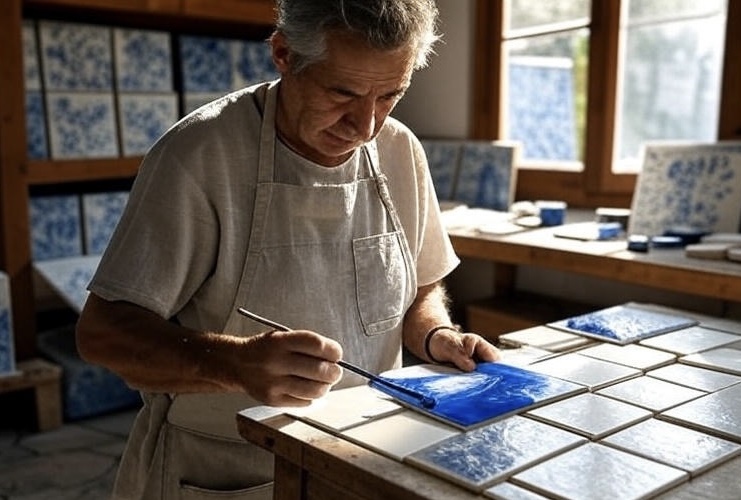
The workshop is set: a wooden table with a blank square tile, brushes of varying thickness, bowls of powdered pigments in cobalt blue, emerald green, and ochre. The artisan pours coffee or tea, shares stories of Lisbon’s tile heritage, and soon, the room feels less like a class and more like stepping into a family’s studio.
Learning the Craft
The lesson begins not with paint but with stories. The artisan shows examples: a 17th-century tile with floral arabesques, an 18th-century baroque scene depicting saints and angels, a geometric panel inspired by Islamic patterns. Each design carries meaning, connecting to Portugal’s layered history of influences — Moorish, Renaissance, baroque, romantic.
You learn that colors once had status: cobalt blue was imported at great cost from Persia, green represented fertility, yellow the divine light. Designs often repeated in symmetrical patterns, creating rhythm and harmony across walls.
With this context, the artisan places a tracing paper with patterns beside you, offering options: will you try a historic motif, or design your own? Some guests choose tradition; others let creativity guide them. Either way, the moment feels intimate — like being invited into a secret language of symbols.
Creating Your Own Tile
Now comes the moment of transformation. The artisan demonstrates: dipping a brush into pigment, applying it in confident, fluid strokes. On raw ceramic, the colors appear muted, dull even — but you are told not to worry. Once fired, they will bloom with brightness.
You begin to paint. At first, hands tremble, the lines uneven. But soon the rhythm takes over. The process is meditative — a quiet focus where time seems to dissolve. Mistakes happen, but the artisan reassures: “Tiles are not meant to be perfect. Their charm is in the human touch.”
As the tile takes shape, a strange pride wells up. What began as blank clay now carries your mark, your interpretation of Portugal’s centuries-old tradition. By the end of the session, your tile feels like more than art — it feels like memory crystallized.
Firing and Finishing
Once painted, the tile is placed carefully aside, ready for the kiln. Here lies the magic: the firing process, where muted pigments transform under intense heat. Blues emerge rich and deep, yellows glow like sunlight, greens shimmer like gardens.
The artisan shows you finished examples, explaining how the glaze seals not only color but story. Your tile will undergo this same transformation, ready to be collected later or shipped safely home.
Guests often describe this moment as one of awe. To see dull brushstrokes reborn as luminous colors feels like alchemy — a reminder that artistry is as much science as it is soul.
Cultural Reflection
Stepping back from the workbench, you realize what you have touched. Portugal’s tile tradition is not just art; it is history told in ceramic. In monasteries, azulejos narrated biblical stories for congregations who could not read. In palaces, they celebrated discoveries, victories, and myth. On ordinary homes, they decorated and protected walls from the Atlantic climate.
Your tile, modest though it may be, connects to this same continuum. To paint it is to join the lineage of artisans who, across centuries, left their brushstrokes for future generations.
Afternoon in Lisbon: From Workshop to Streets
After the workshop, many of our guests spend the afternoon exploring Lisbon’s tiled landmarks with their private guide. It feels different now — you see the brushstrokes on convent walls, the glaze on fountains, the symmetry of panels, and you understand the labor and artistry behind them.
A visit to the National Azulejo Museum often follows, where you can admire entire panels spanning centuries, appreciating them now with a painter’s eye. From there, a walk through Alfama or Chiado reveals tiled façades that seem to glow brighter because you know their secrets.
Why This Experience Resonates
For luxury travelers, a private tile workshop offers something rare: intimacy. Unlike museums or sightseeing, this is hands-on heritage. It is slow, deliberate, tactile — a pause in the pace of travel where you create rather than consume.
It also offers the most meaningful of souvenirs: a piece of Portugal made by you. Guests often tell us that, years later, their painted tile sits on a mantelpiece or as a framed artwork in their home — a reminder not only of Portugal, but of the creative moment they lived here.
Other Visitors are reading now:


Portugal Magik’s Role
At Portugal Magik Private Tours, we arrange these experiences exclusively and seamlessly. Guests travel in comfort in our fleet of luxury Mercedes-Benz vehicles, guided by English-speaking driver-guides who know the city intimately. Workshops are booked privately with master artisans, avoiding crowds and ensuring full attention.
We often combine the experience with cultural explorations — tile museums, antique shops, architectural tours — creating a complete journey into Portugal’s ceramic soul. Most of our guests choose multi-day tours, where tile workshops are just one chapter in a broader story of discovery that may include Michelin-starred dining, Douro Valley wine estates, and historic palaces.
Conclusion: A Tile That Tells Your Story
At the end of the day, as you hold your painted tile — still muted, awaiting its transformation in the kiln — you realize you are not just taking home a souvenir. You are taking home a story. A brushstroke of Portugal, painted by your own hand, carrying the memory of a day spent as an artisan.
This is the essence of cultural luxury: not extravagance, but intimacy. Not simply seeing Portugal, but living it.
Book Your Portugal Experience:
-
Explore our bestseller tours: Multi-Day Tours
-
Best Private Day Tours Around Lisbon: Private Day Tours
-
Read Top Guests Reviews: Reviews
-
Contact Us: Contact
-
Or simply fill in the form below to request your custom itinerary.