High above the River Mondego, Portugal’s ancient university city guards centuries of scholarly ceremony, secret library treasures, and soulful street songs.
The River Crossing into Ancient Scholarship
Morning light hits Coimbra from across the River Mondego, turning the pale limestone facades of the hillside into shades of butter and warm bone. As your Mercedes-Benz vehicle glides smoothly across the Santa Clara bridge, the entire skyline stacks upward like an amphitheater toward a single crowning point: the ancient Royal Palace that became the University of Coimbra. This is not merely a university town; it was the capital of medieval Portugal during the twelfth century, home to kings, crusaders, and poets whose verses helped carve the language itself.
Arriving here feels noticeably different from stepping into Lisbon or Porto. The streets are steep and narrow, carved through centuries of collegiate pride and intellectual rebellion. Traveling with a local driver and guide allows you to navigate these vertical lanes without the exhaustion of the climb. Your host drops you near the crest of the hill at the Porta Férrea, shaping the day around your personal interests while your vehicle handles the steep logistical hurdles quietly in the background.
Stepping Through the Iron Gate of Paco das Escolas
Passing beneath the monumental Porta Férrea brings you into the Paço das Escolas, the immense courtyard where Portuguese scholars have gathered since King Dinis first founded the institution in 1290, later transferring it permanently to this royal hilltop palace in 1537. Stone flags stretch out toward a panoramic parapet overlooking the Mondego valley below, where the river winds lazily through poplars and willow groves.
All around you, the past remains alive in daily ritual. Students hurry between lecture halls wearing the traditional traje acadêmico, their dark wool suits paired with long black capes that swirl in the hill breeze. If you look closely at the hem of a cape, you might spot small vertical tears. By university tradition, each tear represents a sweetheart or a conquered challenge, cut with teeth or a small blade during nocturnal serenades. The distinctive look of these capes famously inspired J.K. Rowling when she lived in northern Portugal and began imagining the wizarding robes of her fictional academy.
Gold Leaf and Night Guards in the Joanina Library
At the western edge of the courtyard stands the Biblioteca Joanina, widely recognized as one of the most astonishing baroque libraries ever constructed. Built in the early eighteenth century under King João V, the building was designed not merely to store knowledge, but to announce the global reach of Portuguese empire through Brazilian gold, rosewood, and oak. Stepping inside requires crossing a threshold of heavy teak doors into an environment of almost reverent silence.
Three great rooms open one after the other, adorned with gilded chinoiserie carvings, rich green and red lacquer work, and trompe l’oeil ceilings that seem to lift the roof toward heaven. Over sixty thousand leather-bound volumes rest on shelves of dense oak, an intentional choice of timber that naturally deters wood-boring beetles. Yet the library’s most famous guardians are even more unconventional. A colony of tiny pipistrelle bats has lived behind the gilded bookcases for centuries, emerging every night to feast on insects that might otherwise damage the precious vellum pages. Each evening, staff members cover the magnificent rosewood reading tables with heavy green leather cloths to protect the wood from the bats, removing them each morning before visitors arrive.
Browse our travel inspiration for ideas, or tell us what kind of day you have in mind.
Echoes of the King and the Crypt of Santa Cruz
A short walk down the hill through the historic university quarter leads to the Sala dos Capelos, the ceremonial Great Hall of Acts where doctoral degrees are still defended before a panel of professors in colored silk hoods. Above the hall, the eighteenth-century university clock tower houses a bell affectionately nicknamed ‘A Cabra’ (The Goat), whose chime once signaled the nightly curfew for students, commanding them back to their lodgings across the old town.
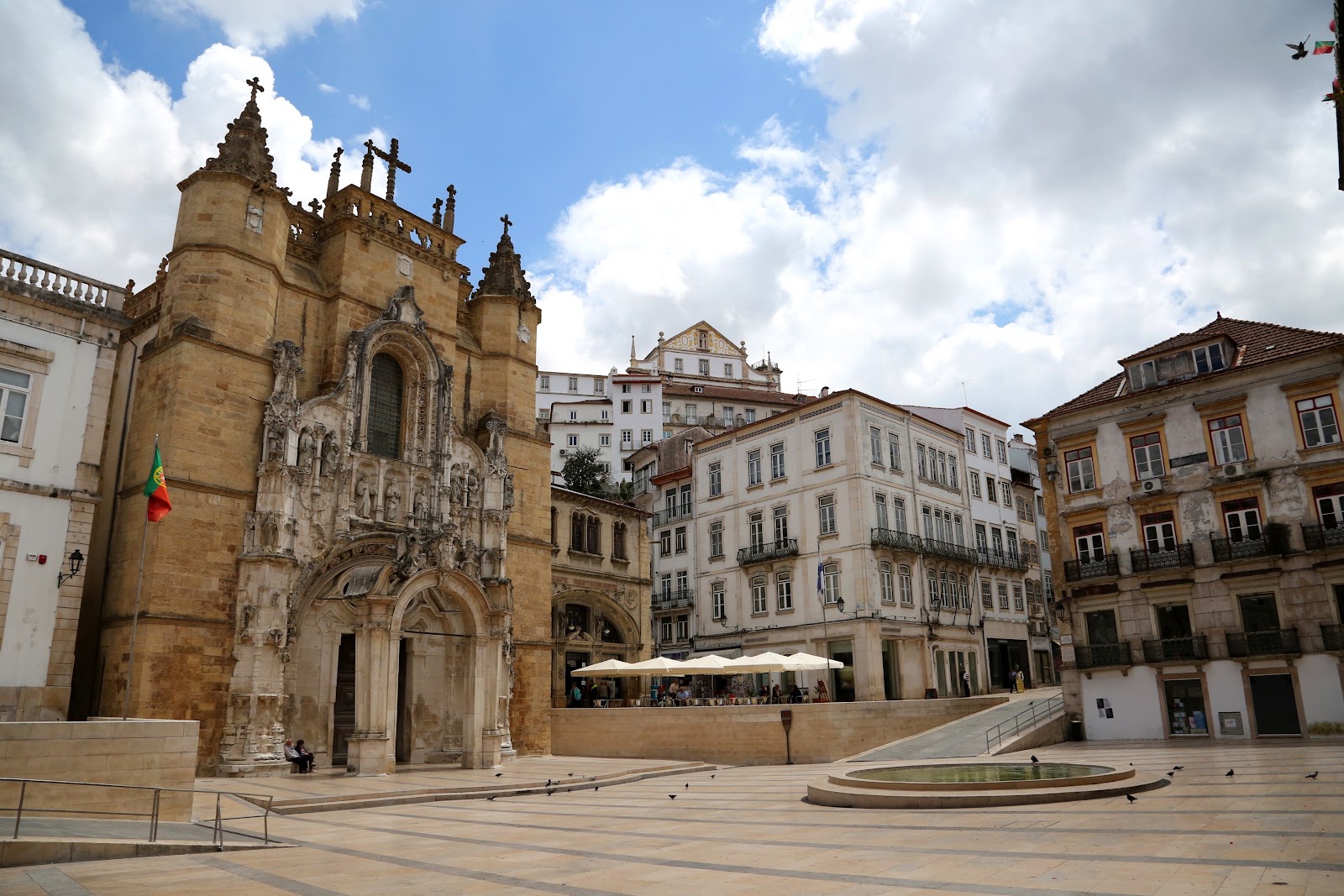
Walking further downward through the maze of stone steps and arches, you pass the Old Cathedral, Sé Velha, a formidable Romanesque fortress church built in the twelfth century with crenellated walls that once defended the Christian frontier. Below, in the lower town, stands the Monastery of Santa Cruz. Founded by Augustinian canons, this quiet sanctuary houses the intricately carved stone tombs of Afonso Henriques and Sancho I, the first two kings of Portugal, resting beneath vaults of delicate Manueline stonework.
Midday Flavors and the Sweetness of the Convent
After hours immersed in medieval corridors and baroque gold, Coimbra invites you to pull up a chair at a quiet table. In the winding alleys near Praça do Comércio, traditional taverns serve dishes that sustained generations of hungry scholars. A plate of chanfana, tender goat slow-cooked for hours in terracotta vessels with rich red wine, garlic, and bay leaves, embodies the hearty, unhurried cooking of central Portugal.
Dessert carries its own ecclesiastical history. At a traditional pastelaria along Rua Ferreira Borges, sample a Pastilha de Santa Clara or a sweet, almond-filled arrufada. These convent pastries were perfected by the nuns of the nearby Santa Clara monastery, who used leftover egg yolks after whites were employed to starch church linens and clarify regional wines. Having a private driver and guide means you never need to rush through lunch; they can easily adjust the schedule to let you linger over an espresso and a warm pastry while listening to the midday bells.
A Serenade Along the Riverbank
Before departing, cross the river to the Quinta das Lágrimas, the romantic estate where Prince Pedro and the noblewoman Inês de Castro met in secret during the fourteenth century, their tragic love story forever immortalized by the national poet Luís de Camões. Springs still flow through the gardens, carrying fallen red leaves that folklore claims are stained with the tears of Inês.
Late in the afternoon, the unmistakable chords of the Portuguese guitar ring out from stone arches near the Quebra Costas stairway. Unlike Lisbon’s fado, which is sung in taverns by both women and men, Coimbra’s fado belongs traditionally to the university’s scholars, sung exclusively by men in academic dress as a bittersweet farewell to youth, romance, and the river. As you return to the quiet comfort of your Mercedes-Benz vehicle for the journey onward, the final notes of the twelve-string guitar linger in the memory, sealing a day spent among the deepest roots of Portuguese identity.
Plan your own day
Share your dates, group size and interests, and we will suggest a tailored plan with a local driver/guide.