Spend a day following the fishing village beneath Cascais’s seaside elegance, from the working waterfront and narrow old streets to a lunch shaped by the Atlantic. Its most memorable stories begin where the sand meets the town.
Morning Begins at Praia da Ribeira
Begin beside Praia da Ribeira, also known as Praia dos Pescadores, before lunch tables become the waterfront’s main attraction. The beach sits directly against central Cascais, with the town hall nearby and the sheltered bay opening beyond the sand. Small fishing boats share the view with pleasure craft. Look past the restaurant umbrellas and handsome facades, and the geography explains the settlement: a protected landing place, access to Atlantic fishing grounds, and streets close enough to carry the catch inland.
Cascais received its town charter from King Pedro I in 1364, centuries before it became a fashionable seaside address. Fishing was central to its livelihood, alongside maritime trade and agriculture in the surrounding countryside. Today, this is no untouched village preserved under glass. It is a busy coastal town that still carries its older working identity. Give the bay a few quiet minutes. The fishing story becomes clearer when you stop expecting it to look like a postcard from another century.
The Village Behind the Waterfront
From the bay, turn into the old centre around Rua Afonso Sanches and the lanes leading towards Igreja de Nossa Senhora da Assunção. The distances are short, but the pleasure lies in not taking the most direct route. White walls, tiled fronts and balconies narrow the view; then a gap between buildings returns a sudden patch of sea. These streets make more sense on foot than through a window, with time to notice a doorway or step aside for someone carrying shopping home.
Near the parish church, the Museu do Mar Rei D. Carlos offers the day’s most useful pause. Its displays connect marine life with the people who worked these waters, including the fishing community’s boats, tools and traditions. The name also introduces King Carlos I, whose interest in oceanography brought scientific attention to the Portuguese coast. Check current opening arrangements before planning the visit. If the museum is closed, the waterfront remains a starting point for talking about fishing, although its objects and photographs add valuable human detail.
When the Court Came to the Fishing Town
Continue towards the Citadel, whose fortifications mark the southern side of the central waterfront. Cascais mattered strategically because of its position near the entrance to the Tagus and the maritime approach to Lisbon. Its defensive buildings belong to that larger coastal history, not simply to the town’s later life as a holiday destination. Seen from here, the bay becomes both a workplace and a place that needed watching.
In 1870, King Luís I established his summer residence in the Citadel palace. The court’s seasonal presence helped transform Cascais, drawing aristocratic families and encouraging the seaside culture that still shapes its reputation. The railway connection to Lisbon followed in 1889, making the coast more accessible. Yet royal summers did not erase the fishing town. For a visitor, the interest lies in that overlap: nets and courtly routines, practical boats and summer houses, all occupying the same small stretch of shore. Pause beside the walls and look back towards Praia da Ribeira. You have walked only a little way, but crossed several chapters.
Browse our travel inspiration for ideas, or tell us what kind of day you have in mind.
Lunch Should Taste of the Coast
Return towards the old centre for lunch rather than treating it as an interruption between sights. Ask what fish is available that day and how it will be prepared. Grilled robalo, sea bass, or dourada, gilthead bream, are familiar choices on Portuguese coastal menus, commonly served with boiled potatoes and vegetables or salad. Availability alone does not prove a fish was caught locally, so ask about its origin if that matters to you.
In the warmer months, grilled sardines are a particularly fitting order when in season. There is nothing ceremonial about eating them: expect bones, smoky skin and a meal that rewards patience. Another possibility is arroz de marisco, a brothy seafood rice often served for sharing. Check the stated portion size before ordering. A glass of Portuguese white wine suits the table, but the essential ingredient is time. Stay long enough for the meal to become part of the day’s memory, rather than merely its fuel.
Beyond the Harbour’s Shelter
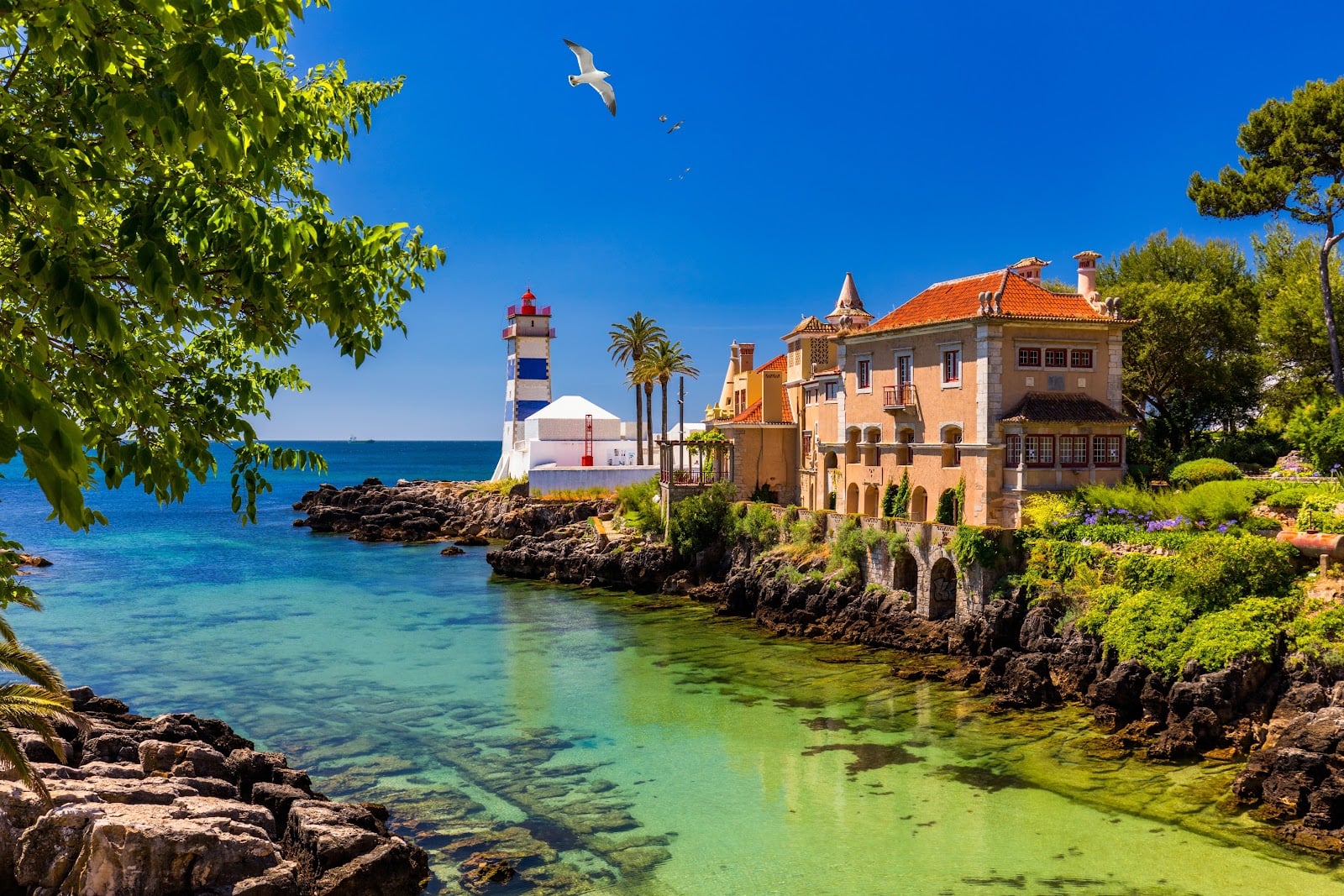
After lunch, follow the coast past the Citadel towards Santa Marta. The striped lighthouse and the small inlet beside Casa de Santa Maria offer a different scale of scene: rocks, clear water when conditions allow, and buildings set close to the shoreline. Nearby, the Museu Condes de Castro Guimarães occupies an early twentieth-century residence whose tower seems designed to catch every passing glance. Even without entering, this stretch shows how dramatically Cascais’s architecture changed after the arrival of fashionable summer living.
Continue to Boca do Inferno if the group feels like a longer walk, or make this the short driving portion of the afternoon. Here, the sheltered bay gives way to exposed Atlantic rock, with a sea arch and a collapsed coastal cavern. The contrast matters. Fishing depended not only on knowing where fish might be found, but on judging weather and water. Stay behind the barriers and let the conditions dictate the experience. On a calm afternoon, the site may murmur rather than roar.
Back to the Bay Before Leaving
End where you began, beside the central bay, perhaps with coffee or an ice cream before departure. The light has moved across the facades, and the beach now feels familiar. After the museum, the Citadel and the open coast, those small boats carry more meaning than they did in the morning.
With Portugal Magik, a local driver/guide can shape the day around the guests, allowing more time for maritime history, a leisurely lunch or shorter walks, with a Mercedes-Benz vehicle for the journeys between stops. What makes Cascais memorable is not how much you fit in. It is the chance to recognise the fishing town within the seaside destination, and to leave with its bay still clearly in mind.
Plan your own day
Share your dates, group size and interests, and we will suggest a tailored plan with a local driver/guide.