Discover northern Portugal where the nation was born and Roman history meets Baroque stone. From the granite ramparts of Guimaraes to the sacred terraces of Braga, here is how one unforgettable day unfolds.
Morning Sunlight on the Ramparts of the First Capital
The morning air in the Minho province carries a distinct crispness, especially when granite towers rise against an Atlantic sky. Guimaraes greets you not merely as an old town, but as the origin point of a nation. On the ancient battlements, a painted inscription still reminds every passerby that Portugal was born here. Walking past the high stone walls of Guimaraes Castle, where the first king, Afonso Henriques, took his earliest steps, the history feels personal rather than distant.
Just below the keep sits the Church of Sao Miguel do Castelo, a simple Romanesque chapel where legend says the monarch was baptized. Steps away stands the Palace of the Dukes of Braganza, its brick chimneys piercing the skyline. Inside, Flemish tapestries hang beside heavy chestnut ceilings fashioned like overturned ships. Traveling with Portugal Magik means a local driver and guide can shape the day around your pace, letting you pause longer under the ramparts or bypass crowded corners so you can hear the birds sing in the surrounding gardens.
Cobblestones and Convent Sweets in the Heart of Guimaraes
Descending from the castle hill brings you into the heart of the historic quarter, a UNESCO World Heritage site that manages to remain entirely residential. In Largo da Oliveira, timbered townhouses frame an open medieval square anchored by the fourteenth-century Gothic shrine commemorating the Battle of Salado. Locals greet one another from wrought-iron balconies lined with blooming geraniums and freshly laundered linen.
A walk along Rua de Santa Maria reveals layers of centuries in door frames, carved coats of arms, and worn paving stones. This street leads past old convents where centuries of culinary history survive. Stepping into a neighborhood pastelaria reveals the legacy of the nuns: torta de Guimaraes, a pastry filled with spaghetti squash, ground almonds, and sugar syrup, and the rich doucha, baked with sweet egg yolks. Paired with a fresh bica, it is the northern palate captured in a single, golden bite.
A Minho Lunch at the Table of Tradition
By midday, northern hospitality calls for a long, unhurried meal. In this part of the country, lunch is treated as an event. A wooden table fills quickly with warm cornbread from nearby villages, cured mountain hams, and sheep milk cheeses. For the main plate, regional cooking shines through rojões à moda do Minho, seasoned pork chunks browned in lard and accompanied by chestnuts and blood sausages, or tender roast kid served beside garlic-roasted potatoes.
Every course finds its match in a glass of crisp Vinho Verde. Unlike the sweet blends often found abroad, a local Alvarinho or Loureiro poured here is pale, aromatic, bone-dry, and vibrant with mineral notes drawn straight from the granite soils. The wine cuts cleanly through the richness of the meat, leaving you revitalized and ready for the road toward Braga.
Browse our travel inspiration for ideas, or tell us what kind of day you have in mind.
The Granite Stairways of Bom Jesus do Monte
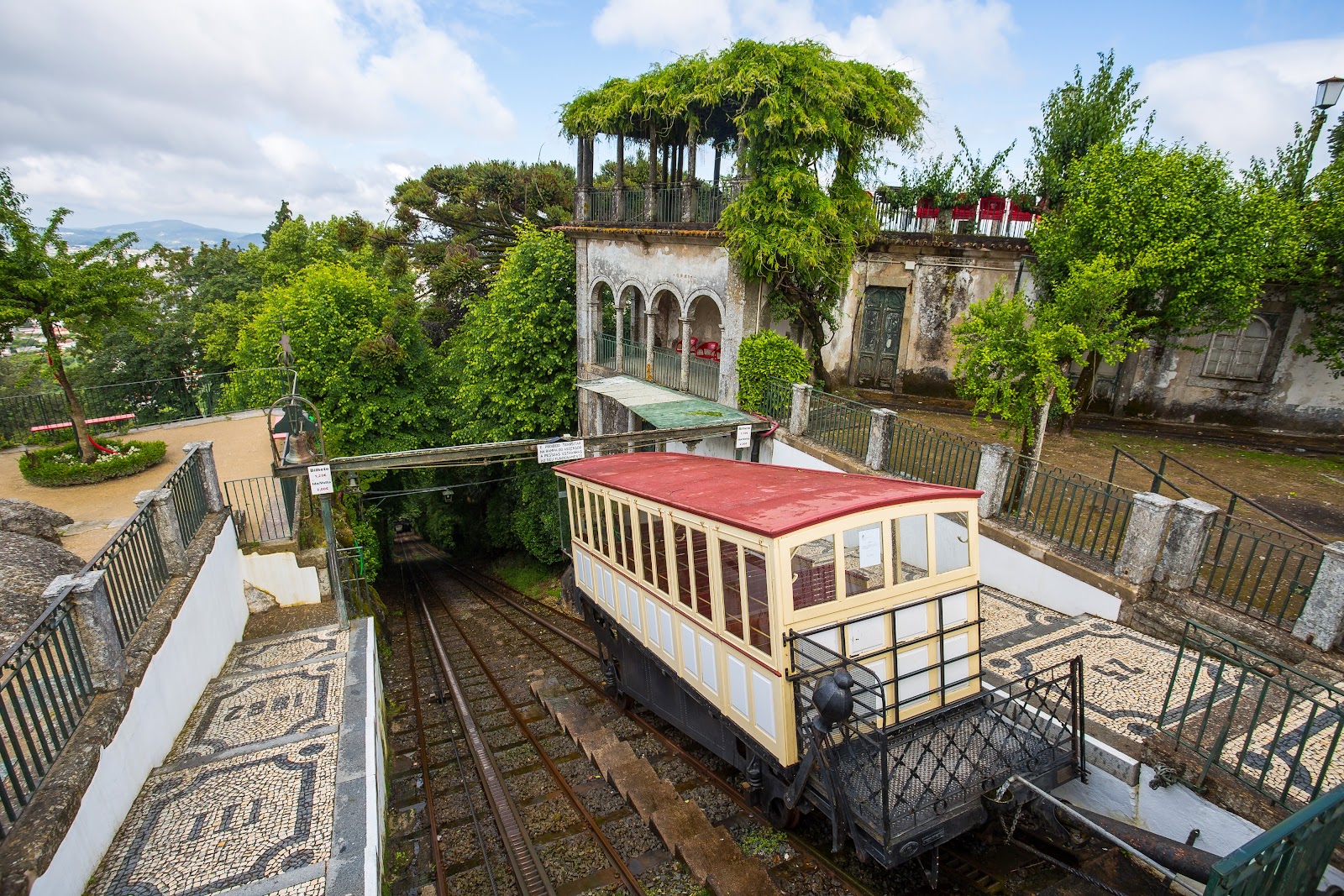
A short and relaxing ride across rolling green valleys brings you to the outskirts of Braga, where Mount Espinho rises above the plain. Here sits Bom Jesus do Monte, one of the most striking sacred sanctuaries in southern Europe. The great neoclassical church crowns an extraordinary zigzagging staircase of dark granite, wrapped in brilliant whitewash and framed by thick woodlands.
Walking down or ascending the stairs reveals the symbolism of the Way of the Cross, along with fountains dedicated to the five senses. Water pours from stone eyes, ears, and mouths, accompanied by the scent of eucalyptus and pine drifting on the breeze. Standing on the grand terrace at the summit, the entire Minho landscape spreads out below in patches of emerald vineyards, stone cottages, and distant mountain ridges.
Braga and the Oldest Bells in the Kingdom
From the sanctuary hill, you enter the bustling heart of Braga, Portugal’s ecclesiastical capital and one of its oldest settlements, founded by Emperor Augustus over two millennia ago. The Portuguese have an old saying that something is older than the Cathedral of Braga, and standing before its heavy Romanesque entrance, you understand why. Construction began well before Portugal was even recognized as an independent kingdom.
Stepping inside the Se de Braga brings immediate quiet. The cathedral houses centuries of architectural shifts, from intricate Gothic tombs to the staggering twin Baroque pipe organs carved from gilded wild wood. Nearby, the pedestrian avenues of the historic center hum with modern university life, where students sit outdoors along the manicured lawns of the Garden of Santa Barbara, framed by the medieval palace walls.
Evening Reflection on the Road South
As dusk begins to settle over the Minho, the granite facades of Braga turn warm amber beneath street lamps. Having a dedicated driver guide on hand allows the return journey south to become an effortless transition rather than a chore. You sit back in total comfort in your Mercedes-Benz vehicle, reviewing photos of castle ramparts, sacred steps, and medieval arches while the rolling hills slide gently past the window.
What lingers most from this northern journey is the powerful sense of identity. In Guimaraes, you encounter the courage of a young kingdom taking its first steps, while in Braga, you witness the quiet devotion that built monumental beauty across centuries. Together, these two cities reveal the enduring heart of northern Portugal, genuine, steadfast, and impossible to forget.
Plan your own day
Share your dates, group size and interests, and we will suggest a tailored plan with a local driver/guide.