Roman columns, a bread-thickened lunch and prehistoric stones tell the story of a day in Évora and its surrounding plains. Beyond the city walls, cork oaks and open horizons give those stories room to settle.
The country opens beyond the window
The first memorable sight may be a tree. Somewhere on the road east from Lisbon, the buildings loosen their hold and a cork oak stands apart from its neighbours, its spreading crown shading a small patch of ground. Then another appears, and another. This is the montado, a landscape shaped by generations of grazing, cork harvesting and patient management. Where bark has been stripped, the trunks show reddish brown against the pale grass. The Alentejo begins to feel less like a destination than a change in attention.
For a day with Portugal Magik, the journey in a Mercedes-Benz vehicle is part of that transition from capital to countryside. A local driver/guide can shape the day around the guests, allowing more time for Roman history, a leisurely lunch or a walk among ancient stones. Évora is roughly 130 kilometres from Lisbon by road, so an early departure leaves the morning available for its streets before the strongest heat, particularly in summer.
A square that belongs to everyday life
Begin in Praça do Giraldo, where café tables, arcades and the fountain draw the eye before any monument demands attention. The square takes its name from Geraldo Sem Pavor, Gerald the Fearless, associated with the Christian capture of Évora in 1165. Yet its pleasure is not entirely historical. Order a coffee, listen to cups meeting saucers and watch the city conduct its morning business. Évora’s historic centre has been a UNESCO World Heritage Site since 1986, but it remains a place where people shop, work and stop to greet one another.
From here, follow Rua Cinco de Outubro uphill towards the cathedral. Whitewashed walls carry yellow borders; doorways offer brief glimpses into darker interiors. Shops display cork goods and regional produce, although the streets themselves are worth more attention than the souvenirs. The climb is modest but the paving can be uneven. Comfortable shoes make it easier to notice a carved doorway or a patch of shade rather than concentrate on every step.
Roman columns and a cathedral skyline
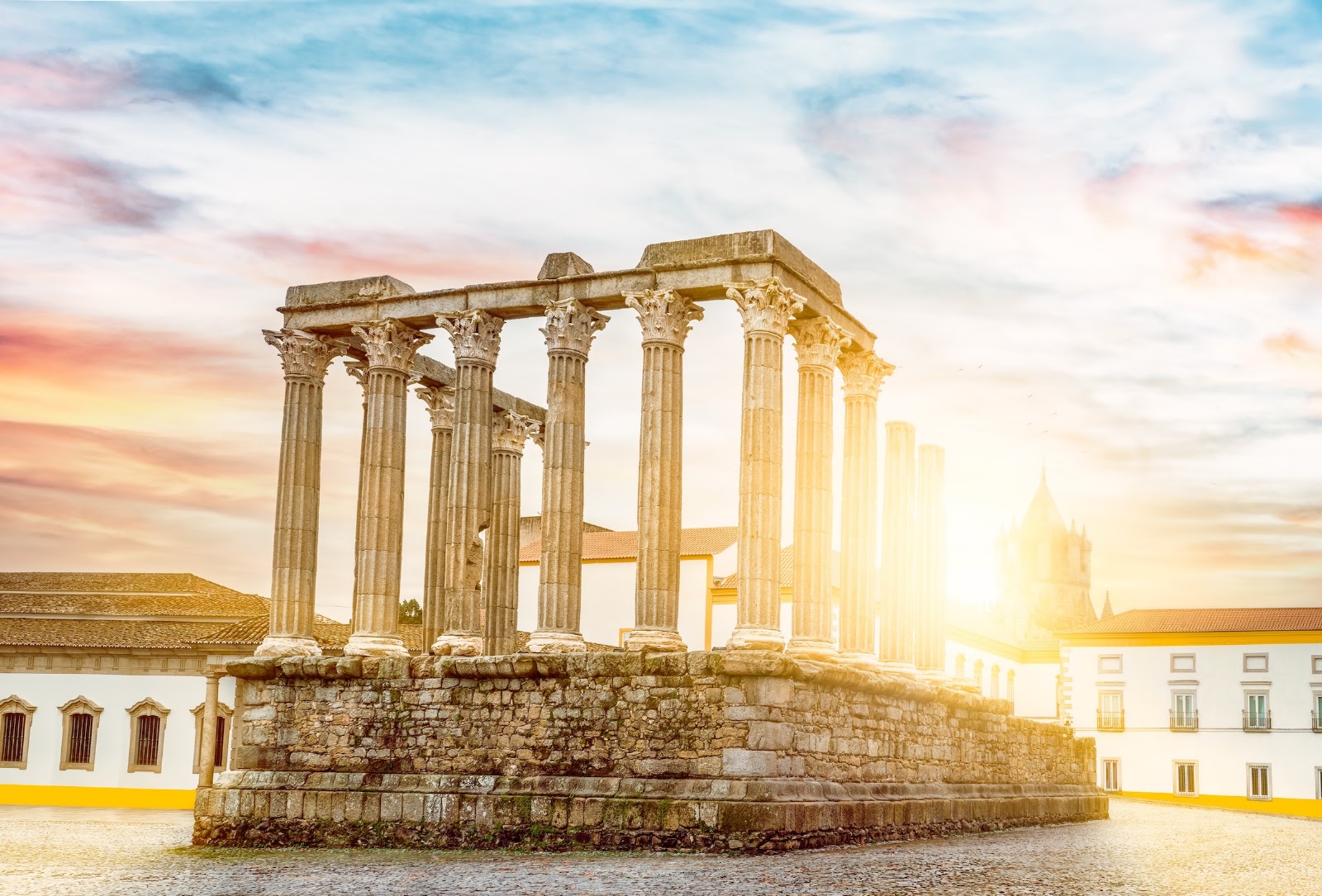
Near the top of the city, the Roman Temple appears with a surprising lack of ceremony: ancient columns standing beside streets and buildings that continued to change around them. Dating to the first century AD, it belonged to the Roman city’s monumental centre and is generally associated with the imperial cult. Its familiar nickname, the Temple of Diana, is not supported by archaeological evidence. Granite columns and marble capitals provide enough wonder without an invented goddess attached to them.
The temple also survived because later inhabitants found uses for it, including incorporation into a building used as a meat market. That practical afterlife is a good Évora story: the past was not always admired, but it was repeatedly occupied. Nearby, the cathedral, begun in the late twelfth century, brings a different scale and gravity. Its architecture bridges Romanesque and Gothic traditions. If the roof route is open and the steps suit your group, the view explains the city beautifully, with tiled roofs gathered below and the countryside extending beyond them.
Browse our travel inspiration for ideas, or tell us what kind of day you have in mind.
Lunch tastes of the land outside
By lunchtime, the plains have become more than scenery. Their bread, olive oil, herbs and livestock arrive at the table. Alentejo cooking has a genius for making bread central rather than incidental. Açorda alentejana commonly brings together garlic, coriander, olive oil, hot water and bread, often with an egg. Unlike the thicker preparations called açorda elsewhere in Portugal, this regional version is usually closer to a fragrant broth poured over slices.
Migas offer another expression of bread, worked with fat and seasonings into a substantial accompaniment, often served with pork. Depending on the menu, look for black pork, lamb dishes or a sheep’s milk cheese from the region. A glass of Alentejo wine belongs comfortably here, but there is no need to turn lunch into a tasting exercise. Ask what suits the food and leave time to eat slowly.
For something sweet, sericaia is an egg-rich dessert associated with the Alentejo, especially Elvas, where it is traditionally partnered with preserved plums. Availability varies, so let the day’s menu have a say.
A quiet encounter with mortality
After lunch, walk towards the Church of São Francisco and its Chapel of Bones. Created by Franciscan friars in the sixteenth century, the chapel uses human bones and skulls to confront visitors with the brevity of life. Above the entrance, the Portuguese inscription tells those arriving that the bones within await theirs. It is direct, unsettling and entirely intentional.
This is not a stop to treat as a curiosity cabinet. The remains were arranged as a religious meditation on mortality, and a few quiet minutes are more appropriate than a hurried photograph. Families may prefer to discuss the subject before entering, or simply spend their time in the church instead. Afterwards, the nearby public garden provides a welcome return to trees, benches and ordinary afternoon sounds. The contrast makes the chapel’s message linger without allowing it to dominate the day.
Older stories among the cork oaks
For the final chapter, leave the city for the Cromlech of Almendres, near Guadalupe, west of Évora. This remarkable group of standing stones developed through several phases during the Neolithic period, thousands of years before the Roman temple. Their precise functions remain debated. What survives is a gathering of rounded monoliths on a gentle slope, some bearing carvings that are not immediately easy to distinguish.
Check current access conditions before setting out. The approach involves rural tracks, and the ground around the stones is uneven; heat, rain and mobility needs can change whether this is the right ending. When conditions suit, walk slowly between the viewpoints and let the setting do some of the explaining. Cork oaks frame the stones, and the horizon opens beyond them.
On the return towards Lisbon, the day’s images begin to overlap: marble capitals, bread soaking up coriander broth, the dark interior of a chapel, stone warmed by afternoon sun. Évora gives history a human scale. The Alentejo plains provide the long view.
Plan your own day
Share your dates, group size and interests, and we will suggest a tailored plan with a local driver/guide.