
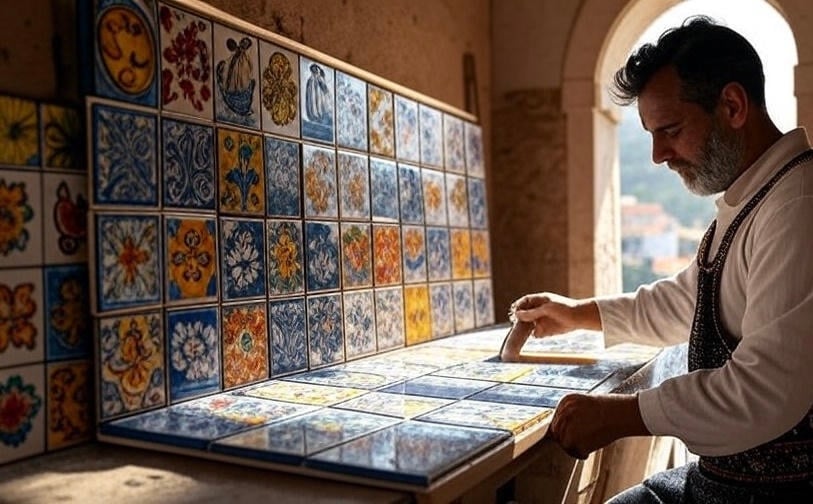
Tiles are one of Portugal’s most enduring cultural legacies. For centuries, azulejos have adorned convents, palaces, fountains, and everyday houses, shimmering in shades of cobalt blue, green, and golden ochre. To the casual observer, they are decorative — but for those who take a closer look, each tile carries a profound story.
Behind every panel of tiles lies a journey that begins humbly with clay, shaped by hand, fired, glazed, painted, and finally assembled into breathtaking works of art. For travelers who wish to understand Portugal deeply, following this journey is one of the most illuminating experiences the country offers.
At Portugal Magik Private Tours, we often introduce our guests to this process through private visits to ateliers, factories, and museums. What begins as curiosity about the beautiful façades of Lisbon often transforms into fascination with the artistry that has endured for over five centuries. To watch a tile evolve from raw earth to palace wall is to witness history come alive in your hands.
Here is that story — the journey of a Portuguese tile.
1. Clay: The Foundation of Art
The story begins with earth. Portuguese tile artisans traditionally sourced red or buff clay from the banks of rivers like the Tejo. The clay is heavy, sticky, and raw, but in it lies potential.
In workshops, the clay is kneaded, purified, and rolled into slabs. In centuries past, artisans would press it into wooden molds, smoothing the surface by hand. Today, though machinery helps, many studios still preserve the hand-molding tradition, ensuring irregularities that give each tile its character.
This first stage is humbling: from simple clay comes the foundation of masterpieces that will endure centuries. It is a reminder that Portugal’s greatest works of art begin not with gold or marble, but with earth itself.
2. Shaping and Drying
Once molded, the clay tiles are left to air-dry, often for several days. In the bright Lisbon sun, artisans would arrange them in rows, carefully turning them to prevent warping. This patience is crucial — rushing the drying risks cracks later in the kiln.
The dried tiles, still porous and fragile, are known as “biscuit” tiles. At this stage, they are pale, chalky squares that show no hint of the brilliance to come. But artisans already see their potential.
It is often at this stage that visitors to workshops feel a shift in perspective: what looks like a simple blank will soon carry color, story, and life.
3. The First Firing
The dried tiles are placed in kilns — traditionally wood-fired, now often gas or electric — for their first firing. At around 900°C, the clay hardens into terracotta. This transformation is irreversible: from soft earth, the tile becomes stone-like, ready to carry glaze and pigment.
The sound of tiles clinking as they are stacked, the warmth of the kiln, the anticipation of artisans — it feels almost ritualistic. Travelers who witness this process often describe it as the moment when art begins to take shape.
4. The White Canvas: Glazing
Once fired, tiles are coated in a thin layer of glaze, usually a tin-based white enamel. This transforms the terracotta surface into a luminous, smooth canvas. Without this glaze, the tile could not carry the brilliance of pigment.
Holding a glazed tile feels like holding possibility. Its surface is cool, smooth, and reflective. Artisans liken it to preparing parchment for an illuminated manuscript — the stage is set for storytelling.
5. Drawing the Design
The next step is the most creative: the design. Historically, master painters or architects would prepare elaborate sketches known as cartoons. These were transferred onto tiles using stencils, pricking holes, and dusting with charcoal.
In workshops today, travelers are often invited to choose a design: geometric Moorish-inspired motifs, floral Renaissance patterns, or figurative baroque scenes. Each design is a fragment of Portugal’s layered history.
This stage underscores an important truth: azulejos are not mere decoration. They are narrative. They carry stories of saints, kings, navigators, and gardens of paradise.
6. Painting with Pigments
Now comes the heart of the process: painting. Artisans use mineral-based pigments — cobalt for blue, copper oxide for green, iron for red or brown, antimony for yellow. Mixed with water, these colors appear muted, almost grey on the tile’s surface.
The painter’s hand is steady, deliberate. Fine brushes outline figures, broader strokes fill backgrounds. For travelers, this is often the most mesmerizing stage to witness. The artisan paints with centuries of tradition guiding each movement, yet with freedom to add individuality.
Many guests at Portugal Magik workshops describe painting their own tile as meditative. One client from London said: “It felt like a conversation between my hand and history. Every stroke connected me to Portugal in a way I never expected.”
7. The Second Firing: Transformation
The painted tiles are returned to the kiln for a second firing, often reaching 1000°C. This is the moment of transformation. What appeared dull emerges radiant. Blues deepen into ocean hues, yellows glow like sunlight, greens shimmer with life.
Travelers lucky enough to witness a tile being removed from the kiln often gasp. The metamorphosis is magical — alchemy born of fire. The artisan smiles knowingly; for them, this moment has repeated countless times, yet it never loses its wonder.
Other Visitors are reading now:



8. Assembly: From Tile to Panel
Individually, a tile is art. But collectively, tiles become something greater. Artisans arrange them into panels, aligning edges to form vast narratives. In palaces and convents, panels might span entire walls, depicting biblical scenes or maritime voyages.
Travelers who step into Lisbon’s National Azulejo Museum or Porto’s São Bento train station see the scale of this artistry: thousands of tiles forming grand murals. Yet each one began as a lump of clay shaped by hand.
This assembly stage is where the humble square becomes Portugal’s voice on the world stage — storytelling through ceramic.
9. From Atelier to Palace Walls
Finally, the tiles are installed. In the 16th century, azulejos covered convents and palaces to both decorate and regulate temperature. In the 18th century, entire narratives adorned walls, blending art and architecture. Even today, contemporary architects incorporate tiles into cutting-edge projects, proving their timeless relevance.
For travelers, visiting these sites after witnessing the workshop process feels transformative. Standing before a palace panel, you see not just the image but the journey: clay, glaze, pigment, fire, and the artisan’s hand behind every square.
Why This Journey Matters
For luxury travelers, following the life of a tile offers more than knowledge. It offers connection. It transforms a decorative surface into a living heritage. It turns admiration into respect, curiosity into awe.
Azulejos embody what cultural luxury truly is: authenticity, artistry, and intimacy. They are not mass-produced souvenirs, but the patient work of artisans whose skills are as relevant today as they were 500 years ago.
Portugal Magik: Curating the Experience
At Portugal Magik Private Tours, we specialize in making this journey tangible for our guests. We arrange private visits to factories like Sant’Anna and Viúva Lamego, ateliers such as Oficina do Azulejo, and institutions like the Fundação Ricardo Espírito Santo Silva. Guests can witness each stage — from raw clay to painted panels — and even paint their own tile, becoming part of the process.
These experiences are seamlessly woven into multi-day itineraries. A morning spent painting tiles may be followed by an afternoon exploring Sintra’s palaces or Lisbon’s tiled convents. Travel is in comfort, guided by expert driver-guides, ensuring that discovery is at once educational, enjoyable, and relaxed.
Conclusion: A Journey of Clay and Fire
The story of a Portuguese tile is the story of Portugal itself: humble beginnings, transformation through fire, and enduring beauty that tells tales for centuries. To follow its journey from clay to palace walls is to witness artistry at its most human and most transcendent.
For travelers, it is more than observation. It is participation — an invitation to step into the artisan’s world and leave with understanding, memory, and sometimes even a tile painted with your own hand.
Portugal’s azulejos are not just history on walls. They are living heritage, waiting for you to experience their journey.
Book Your Portugal Experience:
-
Explore our bestseller tours: Multi-Day Tours
-
Best Private Day Tours Around Lisbon: Private Day Tours
-
Read Top Guests Reviews: Reviews
-
Contact Us: Contact
-
Or simply fill in the form below to request your custom itinerary.