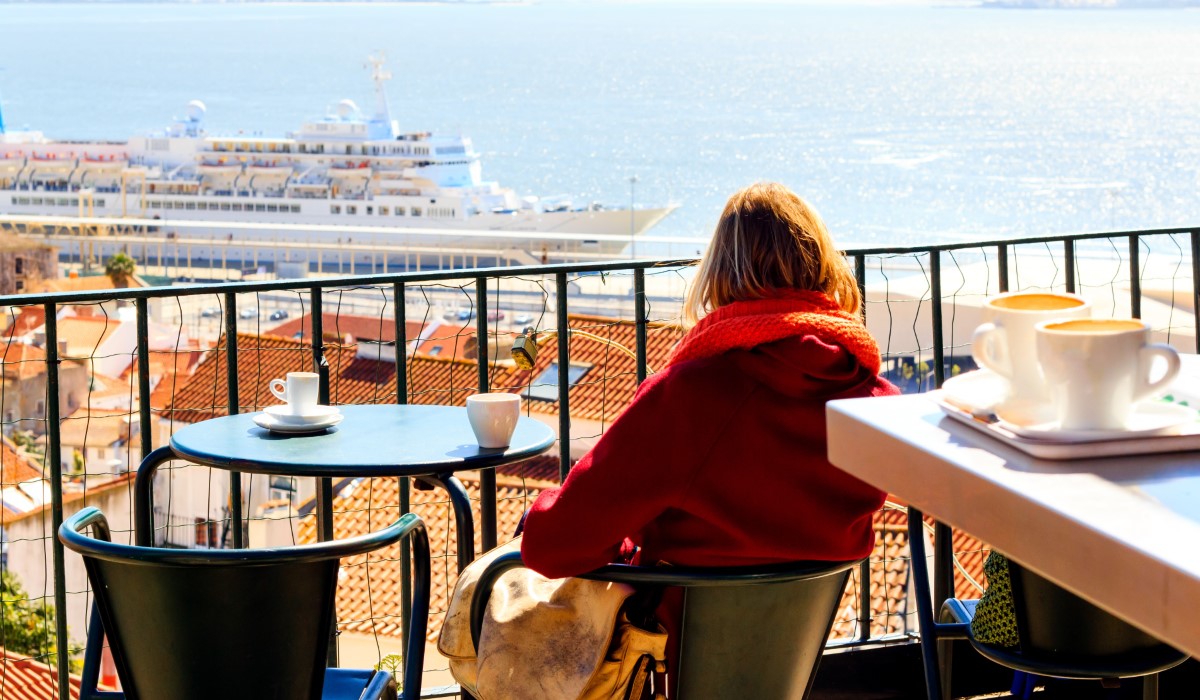
Follow Lisbon from a hilltop morning to an evening above the Tagus, with a yellow tram ride and an Alfama lunch along the way. Between the viewpoints, the city’s everyday stories become the best part of the journey.
Morning above the rooftops
Begin at the Miradouro da Senhora do Monte, before the day’s ambitions become a list. From this high perch in Graça, Lisbon gathers itself into a panorama: the castle on its hill, the orderly streets of the Baixa below, and the Tagus broadening towards the Atlantic. Roof tiles catch the morning light. Somewhere downhill, a tram bell sounds, though the tram itself remains hidden between buildings.
Beside the viewpoint stands a small chapel dedicated to Nossa Senhora do Monte. Its association with São Gens reaches back through Lisbon’s religious traditions, and a stone chair inside is linked to an old belief concerning safe childbirth. The chapel may not be open when you visit, but its presence gives this much-photographed terrace another identity. Long before cameras arrived, people climbed here carrying hopes rather than itineraries.
This is a good place to decide what kind of day you want. A local driver/guide from Portugal Magik can shape the day around the guests, using a Mercedes-Benz vehicle between suitable access points and leaving time for the walks, viewpoints and tram ride that interest them most.
Graça, where the city comes close
Walk downhill towards the Miradouro da Graça, also known as the Miradouro Sophia de Mello Breyner Andresen, honouring the Portuguese poet. Beside the church and former Augustinian convent, the terrace faces the castle and central Lisbon. Compared with Senhora do Monte’s sweeping distance, this view feels more intimate. You can begin to distinguish the buildings you will pass later and understand why a short distance on the map can demand a considerable climb.
Take a seat for coffee before continuing. An espresso is often ordered as a bica in Lisbon; a pastel de nata adds crisp pastry and warm custard to the pause. There is no need to turn breakfast into a hunt for a celebrated address. A neighbourhood café, the clink of cups and a few minutes watching people start their working day belong to the city just as much as its monuments.
Around Largo da Graça, pay attention to the street as well as the skyline. Groceries, doorbells, deliveries and tram tracks share a surprisingly small amount of room. The neighbourhood is not a backdrop awaiting visitors. Its daily negotiations are part of what makes the walk memorable.
A yellow tram with a working life
Lisbon’s electric tram service began in 1901, replacing an earlier era of horse-drawn trams. The compact traditional cars still used on several routes suit streets whose gradients and tight bends would challenge larger vehicles. The famous 28E connects districts including Graça, Alfama and Estrela on its usual route, though works and operating changes can affect the service. Check the day’s arrangements before building your plans around a particular stop.
If queues and space allow, board around Graça for the journey towards Portas do Sol. The pleasure lies in small details: polished wood, the driver’s concentration, a curve that brings a tiled façade suddenly close. This is public transport, not a sightseeing carriage reserved for visitors. Let passengers get off first, keep the doorway clear and offer your seat to someone who needs it.
Keep valuables secure in the crowded car, and resist the temptation to spend the whole ride filming. Sometimes the better memory is simply the bell followed by a brief glimpse down a steep side street. If the tram is packed, walk this stretch instead. Watching a yellow car negotiate the neighbourhood can be as satisfying as squeezing aboard.
Browse our travel inspiration for ideas, or tell us what kind of day you have in mind.
Two terraces and a city rebuilt
At Largo das Portas do Sol, the view opens across Alfama towards the river, with the towers of São Vicente de Fora and the dome of the National Pantheon helping to orient the eye. The square’s name recalls a gateway in Lisbon’s medieval walls. Below, the district appears almost impossibly layered: roofs overlap, stairways disappear, and a street that seems obvious from above becomes elusive once you enter it.
Nearby, the Miradouro de Santa Luzia offers a different frame. Its tiled walls, garden and pergola make the river feel like part of a courtyard. On the exterior wall of the church, azulejo panels depict Praça do Comércio before the 1755 earthquake and the Christian conquest of Lisbon in 1147. They reward a closer look before the inevitable photograph over the parapet.
The earthquake, tsunami and fires of 1755 transformed Lisbon, particularly the lower city. Alfama retained much of its older, irregular street pattern, while the Baixa was rebuilt with a more ordered plan. From these terraces, that contrast begins to make sense. Later, walking from narrow lanes into broad downtown streets, you will feel the history under your feet.
Lunch below the postcard
Descend into Alfama slowly, wearing shoes with a reliable grip on polished stone. Choose lunch by the menu and the welcome rather than the promise of a view. Bacalhau à Brás, made with shredded salt cod, finely cut fried potatoes, onions and eggs, is a comforting choice. Grilled sardines belong especially to the warmer months and Lisbon’s June festivities; their availability should follow the season, not an expectation created by postcards.
After lunch, leave room for an unhurried walk towards the cathedral and the Baixa. If bread, olives or cheese arrive before you order, remember that these starters are generally charged if eaten. Ask when unsure. Such ordinary details help a day flow comfortably, allowing your attention to return to a tiled doorway or a conversation across an upstairs window.
Evening at Santa Catarina
Continue through Chiado towards the Miradouro de Santa Catarina for the day’s final lookout. Known locally as Adamastor, after the sculpture of the mythical figure from Luís de Camões’s Os Lusíadas, the terrace looks towards the Tagus and the 25 de Abril Bridge. The river takes over here, replacing the morning’s intricate roofscape with a wider horizon.
Stay as the light softens, without making sunset another appointment to conquer. Somewhere behind you, trams continue their rounds and cafés prepare for evening. You have seen Lisbon from above and from a wooden seat close to its walls. What remains is not simply a collection of views, but the connection between them: a bell, a steep lane, a shared table and the river returning at every turn.
Plan your own day
Share your dates, group size and interests, and we will suggest a tailored plan with a local driver/guide.