In Monsaraz, a morning among whitewashed lanes opens into an afternoon beside Alqueva lake and an evening beneath the Alentejo sky. Between them lie stories of borderlands, bread, ancient stones and a valley transformed by water.
Morning on the road from Évora
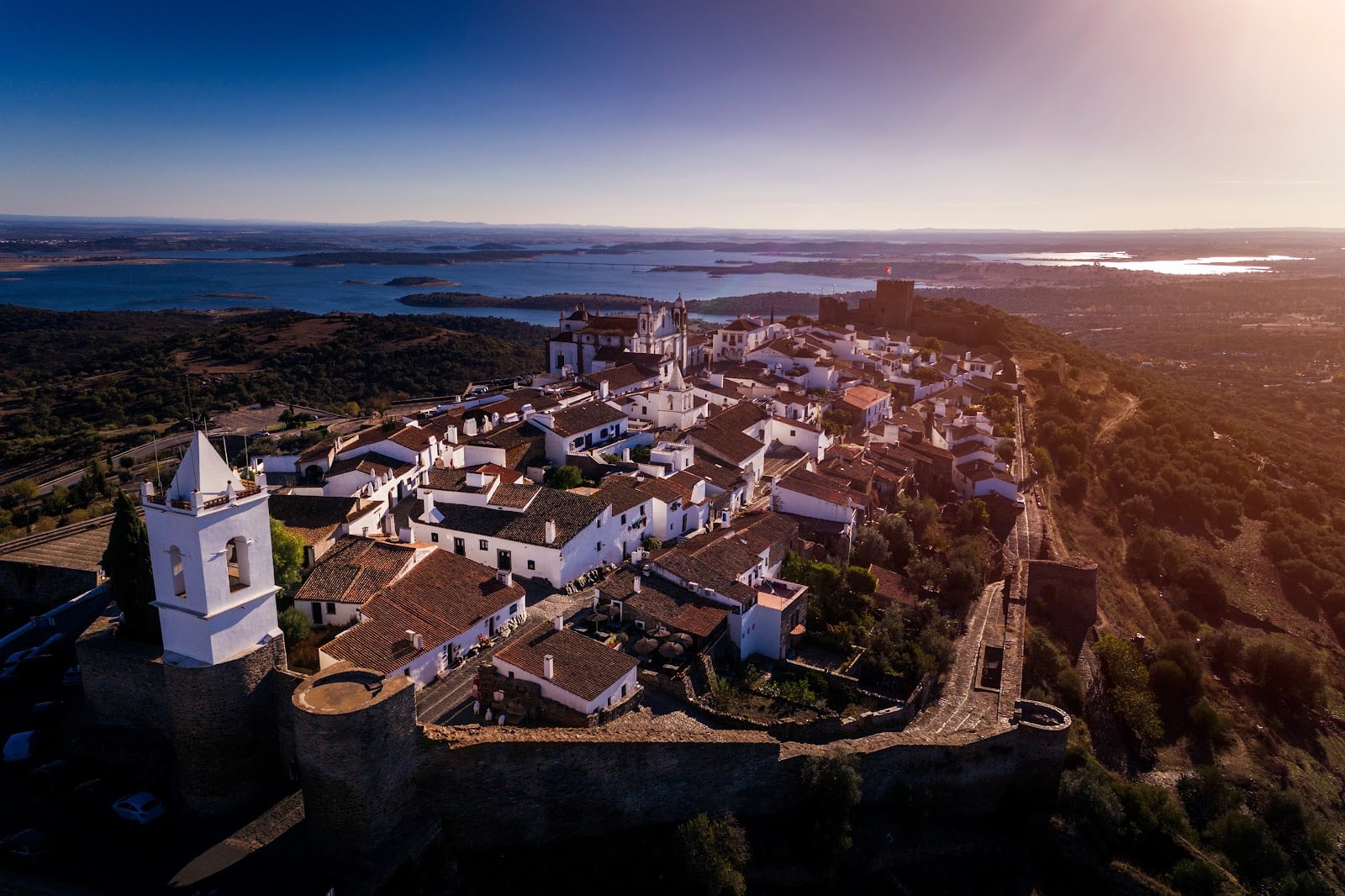
Leave Évora after breakfast, while the light still falls gently across the Alentejo. Eastward, the landscape loosens into pasture, olive groves and cork oaks, some showing the reddish trunks left by a recent harvest of bark. Around Reguengos de Monsaraz, vineyards join the view. Then the village appears on its ridge: a compact crown of walls and pale houses, high enough to make the surrounding country seem almost impossibly wide.
This is a day best begun without trying to collect too many stops. With Portugal Magik, the journey in a Mercedes-Benz vehicle gives the countryside its place in the experience, rather than treating it as the space between attractions. A local driver/guide can shape the day around the guests, allowing more time for history, a lingering lunch or the lakeshore. Starting in Évora also leaves room for a late finish if the stars are part of your plans.
Inside the walls, a village of small details
Enter through the Porta da Vila and let your eyes adjust from the open road to narrow lanes. Monsaraz rewards close looking: a stone door surround, a pot beside a threshold, the sudden flash of blue water between buildings. The uneven paving asks for comfortable shoes and an unhurried step. People still live here, so the pleasure is in walking attentively, not treating every doorway as a photograph waiting to happen.
In the main square, the Igreja de Nossa Senhora da Lagoa stands near the pillory, bringing religious and civic authority into the same small space. The present church largely dates from the sixteenth century. Nearby, the former council building preserves the medieval fresco commonly called the Good and Bad Judge. When access permits, it is worth seeking out: justice and corruption appear not as abstract ideas but as human conduct, painted for a community that understood both.
That is one of Monsaraz’s most engaging stories. Behind the picturesque walls was a working town, with disputes to settle, reputations to defend and rules to enforce.
A castle above a much younger lake
Continue towards the castle at the southern end of the village. Monsaraz was taken from Muslim rule in 1232 during the reign of Sancho II, and its fortifications developed as this became an important frontier stronghold. From the accessible viewpoints, the reason for choosing this ridge is immediately clear. Roads, fields and approaches lie exposed below; the Spanish border is close, beyond the water and the folds of country.
Yet the enormous lake that now seems inseparable from the view is very recent. The Alqueva dam’s gates closed in 2002, beginning the filling of a reservoir on the Guadiana that transformed the valley. Its water supports irrigation and electricity generation, while also creating new possibilities for recreation. The change carried a human cost too: the old village of Luz was submerged, and its residents moved to a newly built village. Knowing that story gives the beautiful panorama another layer. This is not simply an ancient landscape preserved unchanged.
Browse our travel inspiration for ideas, or tell us what kind of day you have in mind.
Lunch belongs to the Alentejo
By lunchtime, the stone lanes can hold considerable heat, especially in summer. Find a table in the village or nearby, reserving ahead when possible, and give the meal proper space. Alentejo cooking makes memorable use of modest foundations: bread, olive oil, garlic, coriander and whatever the land or season provides. A basket of local bread is not decoration. It introduces the ingredient that holds much of the region’s food together.
Look for açorda alentejana, in which bread meets a fragrant broth of garlic, coriander and olive oil, often with a poached egg. Migas turn bread into a more substantial accompaniment, frequently served with pork. Depending on the kitchen and season, there may be ensopado de borrego, a lamb stew served over bread. These are alternatives to explore, not a checklist to order all at once.
A wine from the Reguengos de Monsaraz area keeps the meal rooted in its surroundings. For dessert, sericaia, the Alentejo’s cinnamon-topped egg pudding, is worth considering if it appears on the menu.
Ancient stone, then an afternoon by the water
Below the village, make time for the Menhir of Outeiro, a prehistoric standing stone more than five metres tall. Its scale is startling in the open countryside. There is no need to supply an elaborate explanation for something whose original purpose remains uncertain. Walk around it, notice how its outline changes, and consider how many generations have encountered this same stone before the castle, the vineyards or the reservoir existed.
Then descend towards the Praia Fluvial de Monsaraz, at the Centro Náutico de Monsaraz. Here the lake becomes something more immediate than a blue shape beneath the ramparts. The shore brings reeds, small waves and the sound of people enjoying the water. In the bathing season, a swim may suit the afternoon, subject to current conditions and local safety guidance. Otherwise, a walk and a quiet seat are enough. Bring sun protection and water: the exposed lakeside feels very different from the village’s shaded lanes.
Stay long enough for the sky
As evening approaches, the ridge regains its definition. White walls warm in the lowering sun, and the lake’s inlets become darker shapes between the hills. An early supper nearby gives the day a gentle pause before its final chapter. If you intend to stay out after dark, arrange the return journey beforehand and bring an extra layer, even when the afternoon has been hot.
Alqueva is known for its dark skies, and the Observatório do Lago Alqueva, near Monsaraz, offers guided astronomical observation sessions that should be booked ahead. Clouds, moonlight and the season influence what can be seen; no particular celestial display belongs to an itinerary. On a clear evening, however, looking through a telescope adds a new scale to everything encountered that day. The medieval walls, the prehistoric stone and the young reservoir remain nearby, but the last story belongs to a sky much older than them all.
Plan your own day
Share your dates, group size and interests, and we will suggest a tailored plan with a local driver/guide.