Spend a day among the whitewashed lanes of Monsaraz, the deep flavors of the Alentejo and the wide waters of Alqueva. Here, a medieval hilltop and a modern lake tell surprisingly different stories about the same landscape.
Morning on the Road to the Hill
The approach to Monsaraz is part of the pleasure. Leaving Évora after breakfast, you travel east through an Alentejo landscape of cork oaks, olive trees and fields that change character with the season. Spring brings green growth and wildflowers; by late summer, the ground has turned the color of toast. Eventually, a narrow crown of white houses appears on a ridge. From below, Monsaraz looks compact enough to hold in your hand.
Allow roughly an hour for the journey from Évora, without stops. This makes a generous day possible without spending most of it on the road. With Portugal Magik, the journey takes place in a Mercedes-Benz vehicle, and a local driver/guide can shape the day around the guests, whether that means more history, a longer lunch or time beside the water. The climb through the village itself is best approached slowly, with comfortable shoes for the uneven stone paving.
Before heading uphill, pause at the Menhir of Outeiro, a prehistoric standing stone near the village of Outeiro. Rising more than five meters, it makes an arresting first encounter with the region’s deeper past. Its precise original purpose remains uncertain. That uncertainty is worth keeping: long before castles and vineyards, people were already marking this landscape with monuments whose meanings we can only partly recover.
Through the Gate, Into Another Scale of Time
Leave the vehicle outside the walls and enter through Porta da Vila. Inside, the scale changes immediately. Narrow streets run between whitewashed houses, dark stone frames the doors, and a pot of flowers can become the brightest thing in view. Come early enough and there is room to notice ordinary details: a broom against a wall, a shutter opening, the way sunlight reaches one side of a lane before the other.
Monsaraz was taken from Muslim rule in 1232 during the reign of King Sancho II. Its commanding position mattered in a frontier landscape where watching the surrounding country was a practical necessity. Later medieval fortifications strengthened that role. Today, the walls frame photographs, but their original purpose was less gentle. Looking down the steep slopes makes the defensive logic easy to understand.
Follow Rua Direita toward the parish church of Nossa Senhora da Lagoa and the village pillory. Inside the church, when open, look for the carved tomb of Gomes Martins Silvestre, a medieval merchant associated with Monsaraz. The figures on its sides turn a name into a human story of status, mourning and remembrance. This is a village best read through such details rather than hurried through as a single scenic viewpoint.
A Painted Warning and a Changed Horizon
One of Monsaraz’s most revealing historic treasures is the fresco commonly called The Good and Bad Judge, preserved in the former council and court building. Check current access before making it central to the visit. The painting contrasts just authority with corrupt judgment, offering a blunt lesson about public responsibility. After the beauty of the streets, its moral directness is bracing. Medieval life had its own arguments about who could be trusted.
Continue to the castle at the southern end of the village. Its enclosure, later adapted as a bullring, adds another layer to the story of a place repeatedly put to new uses. From the elevated viewpoints, the eye travels across fields and scattered settlements toward the water. Take care on steps and exposed stone surfaces, particularly in heat or wet weather.
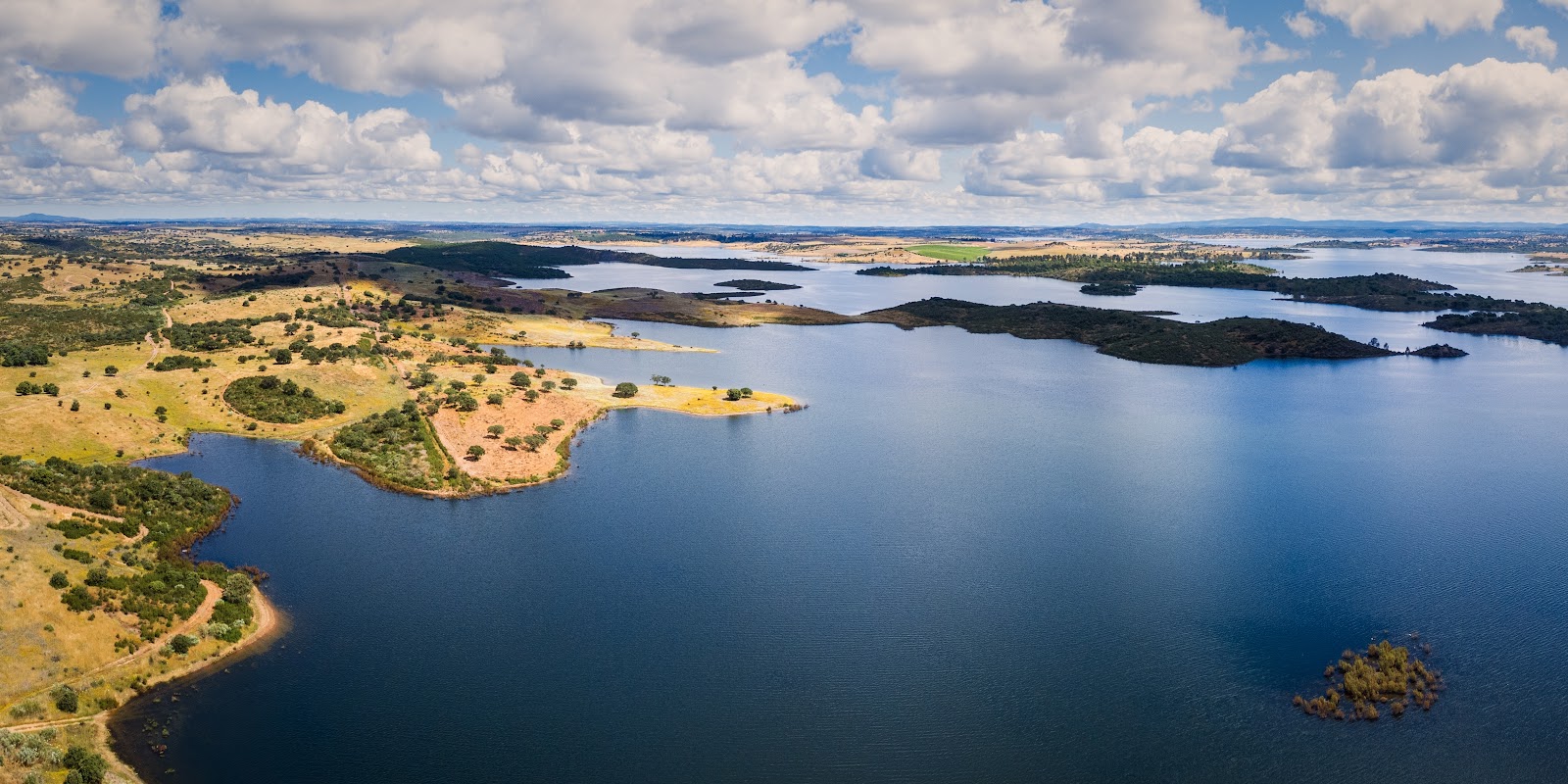
The lake can look as though it has always belonged here. In fact, the Alqueva reservoir began filling after the dam’s gates closed in 2002. Created on the Guadiana River, it transformed the landscape and supports irrigation, water supply and electricity generation. What you see from Monsaraz is therefore a meeting of very different ages: medieval masonry in the foreground, a profoundly altered modern landscape beyond.
Browse our travel inspiration for ideas, or tell us what kind of day you have in mind.
Lunch with an Alentejo Appetite
By lunchtime, the village’s stone streets have gathered warmth and the thought of sitting down becomes persuasive. Choose a restaurant in Monsaraz or nearby, reserving ahead during busy periods. A terrace is appealing in mild weather, but on a hot afternoon an indoor table can be the happier choice. The view will still be there after lunch.
Alentejo cooking gives bread an importance that visitors sometimes find surprising. Açorda alentejana brings together bread, garlic, coriander, olive oil and hot water, often with a poached egg. Migas turn bread into a more substantial accompaniment, frequently served with pork. Lamb stew, ensopado de borrego, is another regional classic, with bread soaking up the savory broth. Order according to the day’s menu rather than expecting every traditional dish to appear.
If available, finish with sericaia, the region’s airy egg dessert scented with cinnamon, sometimes accompanied by a preserved Elvas plum. A glass of wine from the Reguengos de Monsaraz area ties the meal to the surrounding vineyards. There is no need to turn lunch into a tasting exercise. One well-chosen dish and an unhurried conversation suit this day perfectly.
Down to the Water at Alqueva
After lunch, descend toward the Centro Náutico de Monsaraz and the nearby river beach. The change in perspective is striking. From the castle, Alqueva seemed like a map of blue inlets and islands. At the shore, it becomes water moving against the bank, bright reflections and the welcome possibility of taking off your shoes.
In the bathing season, the designated beach offers a place to swim, subject to local conditions and posted guidance. Outside summer, the shore still rewards a stroll or a quiet pause. Bring sun protection and water, and check seasonal facilities rather than assuming everything operates year-round. This is the afternoon’s breathing room, not another sight to complete.
Let the Day Finish After Sunset
As evening approaches, decide whether to return uphill for the changing light or remain near the lake. Monsaraz’s white walls soften toward dusk, while the water loses its glitter and becomes a darker, quieter presence. The morning’s standing stone and the castle now feel connected by something beyond dates: each asked you to stop and look carefully.
For a final chapter, arrange an astronomy session in advance at the Observatório do Lago Alqueva near Monsaraz. The region is known for its dark skies, although visibility always depends on weather and moonlight. Staying for the stars means planning a late return, especially if your base is farther away than Évora. On a clear night, the reward is a fitting change of scale: after a day spent reading human history in stone and water, you look up.
Plan your own day
Share your dates, group size and interests, and we will suggest a tailored plan with a local driver/guide.