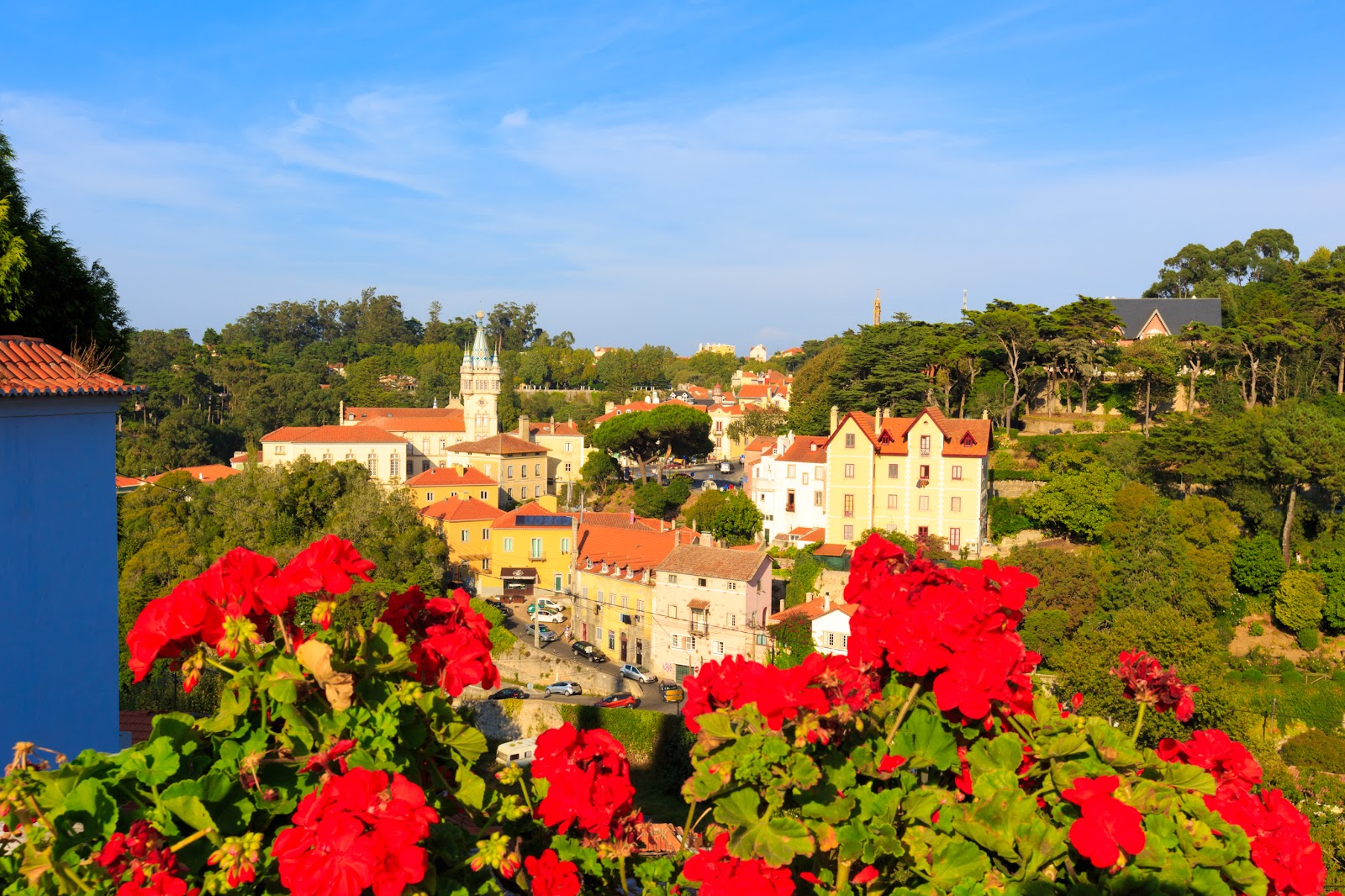
Beyond Sintra’s palace gates, another day unfolds among cork-lined cells, sandy vineyards and Atlantic cliffs. Follow it from a morning pastry to the western edge of mainland Europe.
Begin with something small
Let the palaces keep their towers this morning. In Sintra’s historic centre, begin instead with a coffee and a queijada, the little cheese tart whose thin pastry shell gives way to a sweet filling scented with cinnamon. At Queijadas da Sapa, a longstanding Sintra name with roots in the eighteenth century, this is a fitting introduction to a place often remembered only for its grand buildings. There is pleasure in giving your full attention to something that fits in your palm.
Outside, the mountain determines the mood. Cloud can settle over the wooded slopes while Lisbon enjoys sunshine, and the air often feels distinctly cooler. Bring a light layer, even when the morning begins brightly. Today’s route follows that changeable landscape from the old town into the forest, then through wine country towards the coast. With Portugal Magik, a local driver/guide can shape the day around the guests, allowing more time for a woodland visit, a wine conversation or lunch by the Atlantic.
A convent built around restraint
The Convent of the Capuchos offers the day’s most striking change of scale. Founded in 1560 by Dom Álvaro de Castro, this Franciscan house makes an almost startling counterpoint to Sintra’s royal residences. Here, granite boulders become part of the architecture, doorways demand attention, and cells seem barely large enough to accommodate a solitary life. Cork was used to line parts of the interiors, providing insulation against the mountain’s damp and cold.
Move slowly through the spaces rather than treating them as a collection of curiosities. Their smallness tells a serious story about an ideal of poverty and withdrawal from worldly comfort. The friars remained until the suppression of religious orders in Portugal in 1834. What stays with you may be neither a date nor an architectural detail, but the relationship between stone, trees and shelter. Wear shoes with a reliable grip: the uneven surfaces and narrow passages deserve care, particularly after rain.
Colares, where the vineyard begins in sand
Descending towards Colares, the forest gradually gives way to villages, garden walls and agricultural land. The region’s best-known wine story begins beneath the surface. In its traditional sandy vineyards, vines were planted deep enough to reach the underlying clay, with the sand helping protect them from phylloxera, the pest that devastated European vineyards in the nineteenth century. These conditions allowed ungrafted vines to survive where so many others could not.
Ramisco is the signature red grape of the Colares appellation, while Malvasia de Colares produces its distinctive whites. Neither needs a grand speech to be interesting; the landscape supplies the context. Adega Regional de Colares, the cooperative founded in 1931, is a meaningful place to explore that story, with visits and tastings best arranged ahead. Ask about the work involved in maintaining vines close to the ground against Atlantic winds. Suddenly, a glass of wine becomes a record of patient labour rather than simply an accompaniment to lunch.
Browse our travel inspiration for ideas, or tell us what kind of day you have in mind.
Lunch with the ocean in earshot
Continue through Almoçageme to Praia da Adraga, where the road ends in a pocket of coast framed by cliffs and dark rock formations. After the enclosed world of the convent and the cellar, the openness feels almost theatrical. Walk onto the sand if conditions permit, then let lunch provide a proper pause. Restaurante da Adraga, beside the beach, is an established option for fish and seafood; booking ahead is sensible, especially on weekends and in summer.
Choose according to the day’s catch and the menu rather than arriving with a fixed order. Grilled fish with boiled potatoes and vegetables suits the setting beautifully. If available, ameijoas à Bulhão Pato bring clams together with olive oil, garlic and coriander, with bread useful for the juices. Ask how whole fish is priced before ordering, since it is commonly sold by weight. There is no need to hurry through the meal. The afternoon has room for another conversation and a final look at the water.
Where the land finally runs out
From Adraga, turn south towards Cabo da Roca. The landscape becomes more exposed as you approach the westernmost point of mainland Europe. The lighthouse stands above high cliffs, and the monument carries the words of Luís de Camões: “Onde a terra se acaba e o mar começa.” Where the land ends and the sea begins. Few geographical facts feel quite so immediate when you are standing in the wind.
This is not a place that needs an elaborate activity. Follow the designated paths, keep well back from cliff edges and let the view establish its own scale. Wind can be strong, and low cloud may obscure the horizon; the headland is compelling without a clear sunset. The lighthouse first entered operation in 1772, adding a practical maritime purpose to this symbolic edge of the continent. Beneath the famous phrase lies a working coast, shaped by navigation, weather and the need to find a safe passage.
The things that come home with you
On the return journey, the day’s places begin to connect. Cork at the convent, sand around the vines, granite above the sea: each has influenced how people lived here. Sintra’s celebrated buildings are only one expression of a landscape that has also asked for humility, persistence and a healthy respect for the weather.
Portugal Magik’s Mercedes-Benz vehicles make a comfortable base between these contrasting stops, particularly when a sea breeze has followed you back from the headland. Plan around current opening times, arrange the winery visit and leave some breathing room between reservations. The memory worth carrying home is not a completed checklist. It might be the scent of damp woodland, the first taste of Ramisco or a piece of bread dipped into the last of the clam juices while the Atlantic sounded just outside.
Plan your own day
Share your dates, group size and interests, and we will suggest a tailored plan with a local driver/guide.