Above the Nabão River, Tomar holds a remarkable story of warrior monks, royal ambition and reinvention. Spend a day following it from the castle walls to a shaded riverside table, with time for the town between.
Morning on the hill
Approach Tomar in the morning and the castle makes the first introduction. Its walls rise above a town of pale buildings and terracotta roofs, with the Convent of Christ gathered inside them. From below, the whole hill looks defensive. Once you enter, it becomes something more surprising: a place of painted saints, intricate stonework, quiet cloisters and centuries of changing purpose.
From Lisbon, allow roughly two hours by road, depending on traffic and your starting point. With Portugal Magik, the journey in a Mercedes-Benz vehicle offers a comfortable transition from the capital to central Portugal. A local driver/guide can shape the day around the guests, allowing longer for the convent, a leisurely lunch or gentler walking through town.
Start on the hill while your curiosity and legs are fresh. There are slopes, steps and uneven surfaces here, so comfortable shoes matter more than a carefully coordinated outfit. Before going inside, pause by the fortifications. This is where Tomar’s story begins to feel tangible.
The men who built a frontier stronghold
In 1160, Gualdim Pais, master of the Knights Templar in Portugal, founded Tomar’s castle. The kingdom was still young, and its boundaries were being contested during the Christian advance into Muslim-held territory. These walls were not scenery. They belonged to a network of strongholds intended to defend territory, support settlement and secure routes through the country.
The Templars were a religious military order, originally established to protect Christian pilgrims in the Holy Land. In Portugal, they became important allies of the monarchy. Standing beneath the castle towers, it is worth imagining the practical life behind the romantic name: horses needing water, stores being counted, messages arriving and men watching the surrounding land.
Their story did not end here when the order was suppressed in 1312. King Dinis secured papal approval for the Order of Christ in 1319, preserving much of the former Templar property within a new Portuguese institution. Tomar later became its headquarters. That distinction matters: the convent tells the story of the Templars, but also of the order that inherited their place.
A church unlike the one you expected
The Charola, the original Templar oratory, is the emotional centre of a visit. Its sixteen-sided exterior encloses an octagonal central structure, with an ambulatory around it. The design belongs to a tradition inspired by sacred buildings in Jerusalem. Even before you study the details, the arrangement changes how you look: your eyes circle, rise and return to the centre.
Then the colour takes over. Painted figures, gilded carving and biblical scenes fill a space whose decoration was greatly enriched in the early sixteenth century. It is tempting to imagine everything you see as the work of the first knights, but much of this splendour belongs to later patrons. Tomar rewards that kind of careful looking, separating the medieval structure from the ambitions layered onto it.
Beyond the Charola, the convent unfolds through different architectural periods. The Renaissance Great Cloister feels measured and airy after the church’s intensity. Give yourself time to cross it slowly. The Convent of Christ, inscribed on UNESCO’s World Heritage List in 1983, is better experienced as a sequence of changing spaces than as a checklist of rooms.
Browse our travel inspiration for ideas, or tell us what kind of day you have in mind.
Reading the famous window
The Chapter House Window deserves its reputation, though photographs rarely convey the weight and density of its carving. Created by Diogo de Arruda around 1510, during the reign of Manuel I, it turns stone into ropes, vegetal forms, knots and maritime imagery. The cross of the Order of Christ and royal symbols place the work firmly within the world of its patrons.
This is Manueline architecture at its most exuberant. Portugal’s overseas expansion supplies part of the context, and the Order of Christ was closely connected with that history. Prince Henry the Navigator served as its governor in the fifteenth century. Still, there is no need to force a single explanation onto every carved tendril. Some of the pleasure lies in noticing how insistently the stone seems to twist and grow.
Before leaving, find a moment to look back across the complex. A frontier castle became the setting for an institution connected to royal power and oceanic ventures. The buildings make that transformation visible without making it simple.
Lunch below the battlements
By lunchtime, come down into the town rather than rushing onward. Around Praça da República and the surrounding streets, Tomar returns to a human scale: café tables, shop doors and the occasional clatter of plates. The statue of Gualdim Pais stands in the square, facing the town whose beginnings are tied to his name.
Look for a traditional restaurant serving regional Portuguese food. Depending on the menu and season, roast kid, bacalhau or river fish may offer a satisfying lunch. If lamprey appears during its winter and early spring season, it is a distinctive regional choice, often prepared with rice, though its rich flavour is not for everyone.
For something sweet, ask a pastry shop about fatias de Tomar, the town’s egg-rich speciality, traditionally steam-cooked and soaked in sugar syrup. They are soft, intensely sweet and best approached without haste. A small coffee alongside provides a welcome contrast.
An afternoon beside the Nabão
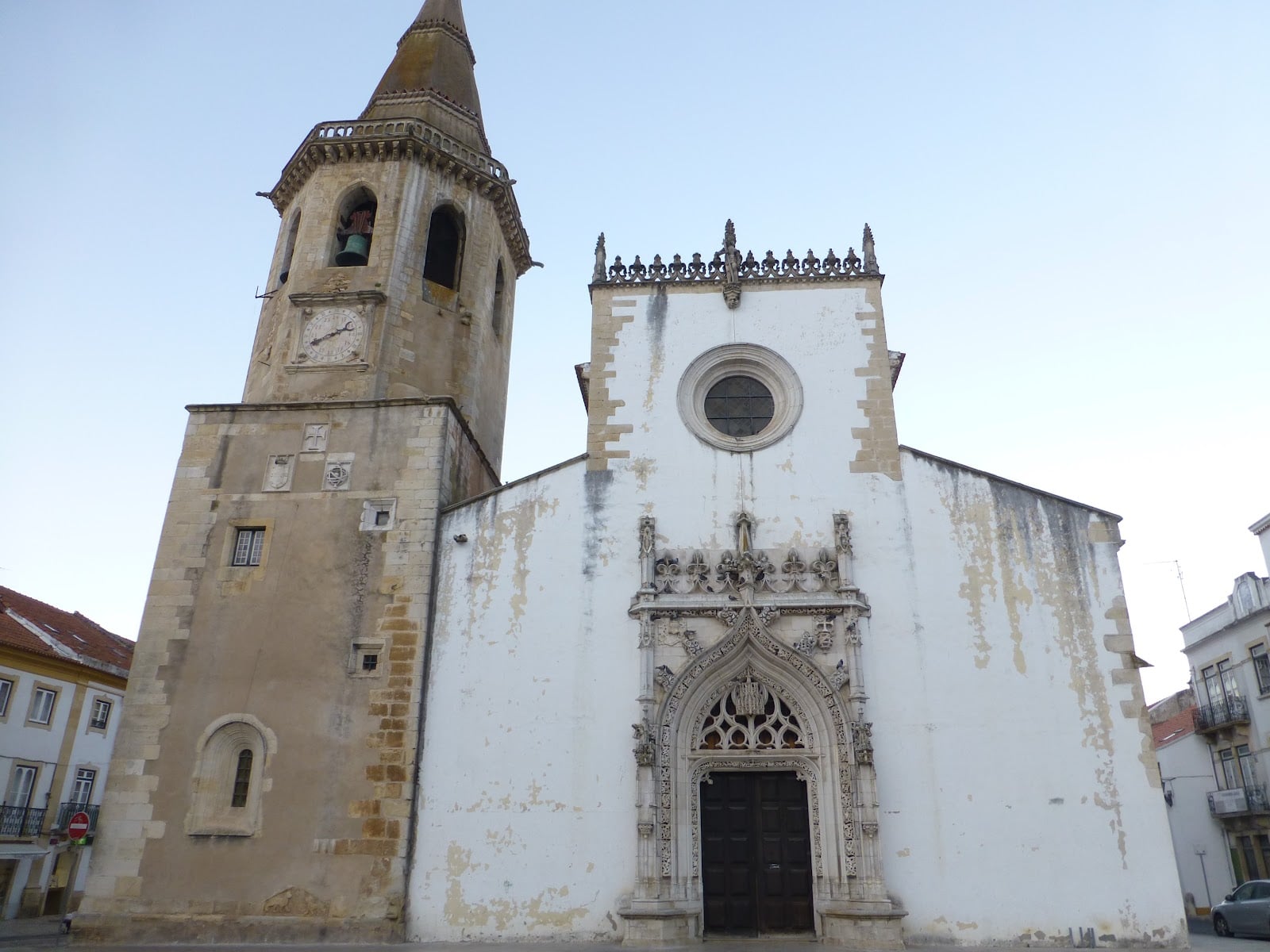
After lunch, step into the Church of São João Baptista on Praça da República if it is open. Its Manueline doorway offers another encounter with the decorative language you saw on the hill, now within the everyday setting of a town square. Continue along Rua Serpa Pinto towards the river, letting ordinary Tomar share the afternoon with its monuments.
The Nabão provides a gentle finish. Walk towards Parque do Mouchão, where trees and riverside paths replace stone corridors. The large wooden waterwheel recalls the river’s long working life. Across the water, the town feels less like a medieval stronghold and more like somewhere people have made a home for generations.
There is no need to add another distant stop. Let the day end with the castle above you and the river nearby. Tomar stays in the memory through such contrasts: a formidable wall, a painted chapel, a syrup-soaked sweet and an afternoon that leaves room to talk about them.
Plan your own day
Share your dates, group size and interests, and we will suggest a tailored plan with a local driver/guide.