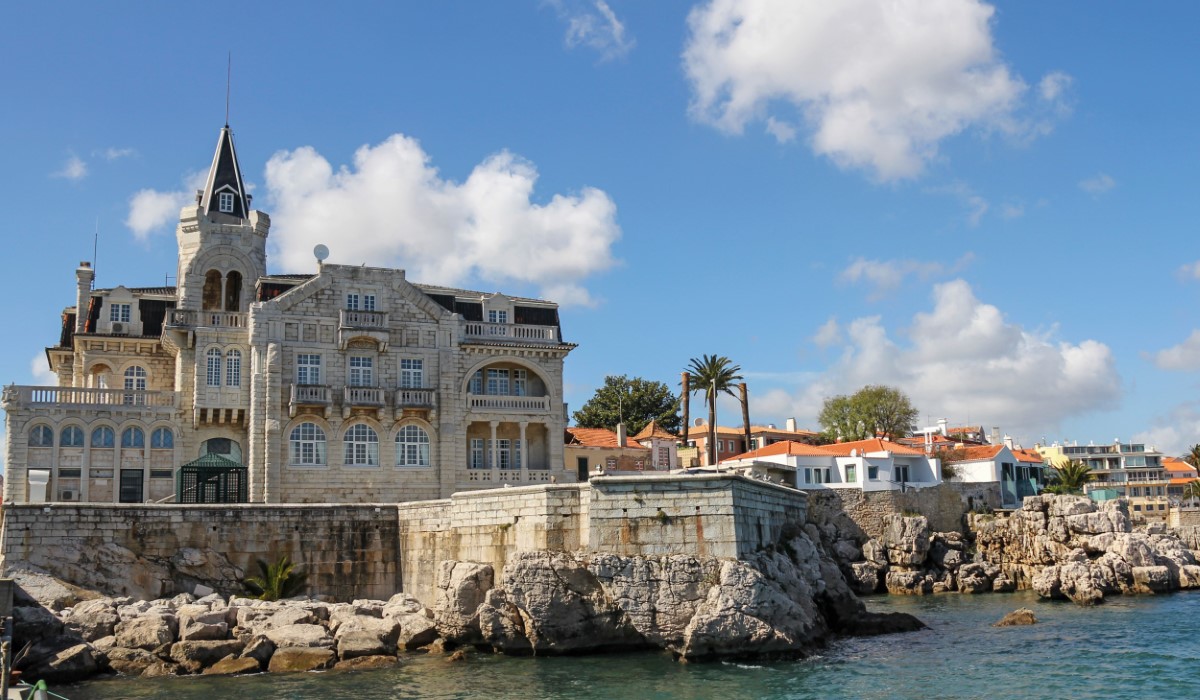
A day from Lisbon to Cascais reveals why Portugal makes such a welcoming introduction to Europe: memorable history, Atlantic tables, manageable distances and room to enjoy it all.
1. The first morning feels welcoming rather than overwhelming
Begin on an ordinary morning in Lisbon, with a small coffee and a view of Praça do Comércio opening toward the Tagus. The square occupies the site of the royal palace destroyed in the earthquake of 1755. Its arcades and orderly proportions belong to the rebuilding that followed, when central Lisbon acquired the grid travelers still navigate today. Before the day has properly started, there is already a story beneath your feet. Yet there is nothing complicated about the immediate pleasure: find a table, order breakfast and watch the city get moving.
For Americans making their first European trip, that combination matters. English is widely spoken in Lisbon’s hotels, restaurants and visitor attractions, although a greeting of bom dia is always worth learning. Portugal is generally a safe destination for visitors, with sensible precautions still necessary: watch bags in busy squares and on crowded trams. The welcome feels accessible without making the place feel familiar in every detail.
2. European history comes with human stories
Continue west to Belém, where the Jerónimos Monastery gives the morning a different scale. Commissioned by King Manuel I in the early sixteenth century, it is one of Portugal’s great examples of Manueline architecture, with elaborate carved stonework shaped by religious and maritime imagery. Vasco da Gama’s tomb stands in the church. His voyage to India links this quiet riverside district to a much larger history of trade, navigation and empire, including conquest and exploitation. It is a place for looking closely, not simply collecting a photograph.
Nearby, Pastéis de Belém has been making its celebrated custard pastries since 1837, following a recipe associated with the former monastery. The crisp pastry and warm custard make an approachable pause after the stone and solemnity. For families, that change of rhythm is especially useful. For couples comparing Portugal with France or Italy, it demonstrates something equally appealing: major history and an everyday pleasure can sit comfortably within the same morning.
3. A change of scenery does not require changing hotels
From Belém, the day can follow the waterfront west toward Cascais. Lisbon and Cascais are roughly 30 kilometers apart, although the exact distance and journey time depend on your starting point and route. The coastal road passes through places such as Oeiras, Carcavelos and Estoril, with the broad river mouth gradually giving way to open Atlantic views. This is not an invitation to add every possible stop. The pleasure is that a capital city and a seaside town can share one unhurried day.
That compact geography appeals to Americans accustomed to long domestic journeys, and to travelers who would rather unpack once than move hotels repeatedly. A local driver/guide can shape the day around the guests, allowing more time at the monastery or a later lunch by the water. With Portugal Magik’s Mercedes-Benz vehicles, the journey between places also becomes a comfortable interval, without navigating unfamiliar roads, finding parking or negotiating Cascais’s narrow central streets yourself.
Browse our travel inspiration for ideas, or tell us what kind of day you have in mind.
4. Lunch delivers the Portugal you came to taste
By lunchtime, settle into Cascais rather than racing onward. Look for a restaurant serving grilled fish, and ask what is available that day. Dourada, or sea bream, might arrive with boiled potatoes and vegetables; robalo is sea bass. Sardines are especially associated with the warmer months, rather than a promise for every season. A plate of amêijoas à Bulhão Pato brings clams with garlic, olive oil and coriander, usually with lemon alongside. The dish takes its name from the nineteenth-century writer Raimundo António de Bulhão Pato.
For the wine, a white from the Vinho Verde region offers a useful introduction, but do not assume every bottle is sweet or noticeably fizzy. Styles vary, and an Alvarinho can have considerable depth. Americans comparing European destinations often appreciate how easily a Portuguese meal can feel rooted in its surroundings. There is no need for an elaborate tasting menu: good fish, an interesting bottle and enough time to finish the conversation can be the occasion.
5. Comfortable pacing leaves room for everyone
After lunch, walk toward Praia da Ribeira, the small beach beside the center of Cascais, where fishing boats help explain the town’s beginnings. Its later transformation into a fashionable seaside retreat gained momentum when King Luís I established a summer residence at the citadel in 1870. That royal connection remains part of the town’s identity, but the afternoon need not become another formal history lesson. Look back at the waterfront, browse a side street or stop for coffee.
For retirees and multigenerational families, this is a practical advantage rather than a minor detail. Central Cascais offers relatively level waterfront walking, while Lisbon’s steep hills and polished paving can demand more care. Comfortable shoes still matter, particularly when stone surfaces are wet. Nobody needs to prove anything by climbing another staircase. A satisfying first European day can contain a monastery, a coastal journey and a generous lunch, with enough energy left to enjoy the evening.
6. Value is measured in the day, not just the bill
Back in Lisbon, dinner can remain simple: perhaps bacalhau à Brás, made with shredded salt cod, finely cut fried potatoes, onions and eggs. Portugal can offer appealing value compared with prominent visitor districts in France, Italy and Spain, particularly for neighborhood dining and Portuguese wines. That is not a universal rule. Central hotels, sought-after restaurants and peak-season travel can be expensive, and Spain offers strong value in many places too. Comparing equivalent locations and standards is more useful than assuming one country is always cheaper.
For Americans choosing a first European destination, the deeper value lies in how much a manageable day can hold. Lisbon supplied history, Belém supplied pastry and perspective, and Cascais supplied the sea. There was time to ask questions and sit still. That may be Portugal’s most persuasive introduction: not everything you could possibly see, but enough memorable moments to make you want another day.
Plan your own day
Share your dates, group size and interests, and we will suggest a tailored plan with a local driver/guide.