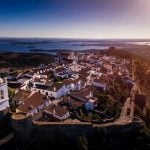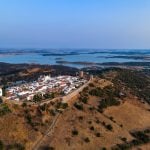
In Monsaraz, a single day can hold prehistoric mysteries, medieval arguments about justice and a long Alentejo lunch. Below the walls, Alqueva adds a newer story, written in water across an old farming landscape.
Morning begins with a standing stone
Before climbing to Monsaraz, stop below it. Near the village of Telheiro, the Menir da Bulhoa stands among the fields, a prehistoric stone bearing carved markings that reward a closer look. Its restored upright position belongs to modern times, but the stone itself reaches back thousands of years. There is no need to supply an elaborate explanation for every mark. Part of the pleasure is standing quietly before something whose original meaning remains uncertain.
Above, Monsaraz occupies its ridge with the confidence of a settlement that once needed to watch every approach. Olive trees, grazing land and scattered buildings fill the foreground. This is a good beginning because it puts the day’s history in order: people were making their mark here long before the castle, the churches or the great lake. A local driver/guide can shape the day around the guests, allowing more time for these outlying discoveries or saving energy for the village’s uneven streets.
Through the gate, into the borderlands
Leave the vehicle outside the walls and enter through Porta da Vila. The change is immediate. Whitewashed houses draw close, dark stone outlines doorways, and the streets ask for slower footsteps. Wear shoes with a reliable grip: the paving is irregular, and the gradients can feel steeper under the Alentejo sun. Morning gives you time to enjoy these small streets before lunch becomes the day’s main appointment.
Monsaraz was taken from Muslim rule by forces of Geraldo Sem Pavor in 1167, though control changed again before its definitive Portuguese conquest in 1232, under Sancho II. Those dates explain something of its position. This was not simply a picturesque hilltop but a strategic place in contested territory, later guarding a frontier with Castile. At the castle, the view makes that purpose legible. Look across the surrounding country before looking down at your camera. Distance was once a practical concern here, not merely a beautiful one.
A village with something to say about justice
Around Largo Dom Nuno Álvares Pereira, Monsaraz becomes more intimate. The Igreja de Nossa Senhora da Lagoa, rebuilt in the sixteenth century, anchors the square, while the pillory recalls the village’s former municipal authority. These are reminders that people lived within a framework of worship, law and local power, even in a settlement small enough to cross in a short walk.
If open, visit the former council chamber to see the fresco known as O Bom e o Mau Juiz, the Good and Bad Judge. Its contrast between honest judgment and corruption turns a civic room into a pointed moral lesson. You do not need specialist knowledge to recognize the subject. Centuries later, the question of whom power serves still feels current.
Afterward, wander without trying to turn every doorway into a landmark. A strip of shade beside a white wall, a flowerpot on a step and the sudden opening of a lake view are part of Monsaraz too. Leave room for them.
Browse our travel inspiration for ideas, or tell us what kind of day you have in mind.
Lunch belongs to the Alentejo
By midday, a table in the shade feels like the right destination. Look for a menu rooted in the Alentejo rather than a particular dish promised in advance. Açorda alentejana brings bread, garlic, coriander and olive oil together in a broth, often with a poached egg. It is different from the thicker bread preparations also called açorda elsewhere in Portugal. Here, yesterday’s bread becomes the foundation of a satisfying meal.
Migas offer another expression of that resourcefulness, often accompanying pork. Depending on the kitchen and season, you might find lamb stew, or porco preto, pork from the black Iberian pig. Ask what is being prepared that day. A glass of wine from the Reguengos de Monsaraz area keeps the meal firmly local; there is no obligation to turn lunch into a formal tasting.
For something sweet, sericaia, a light egg-based pudding associated with the Alentejo, is worth seeking when available. Then order coffee and linger. The lake will still be there when the plates are cleared.
The lake that changed the map
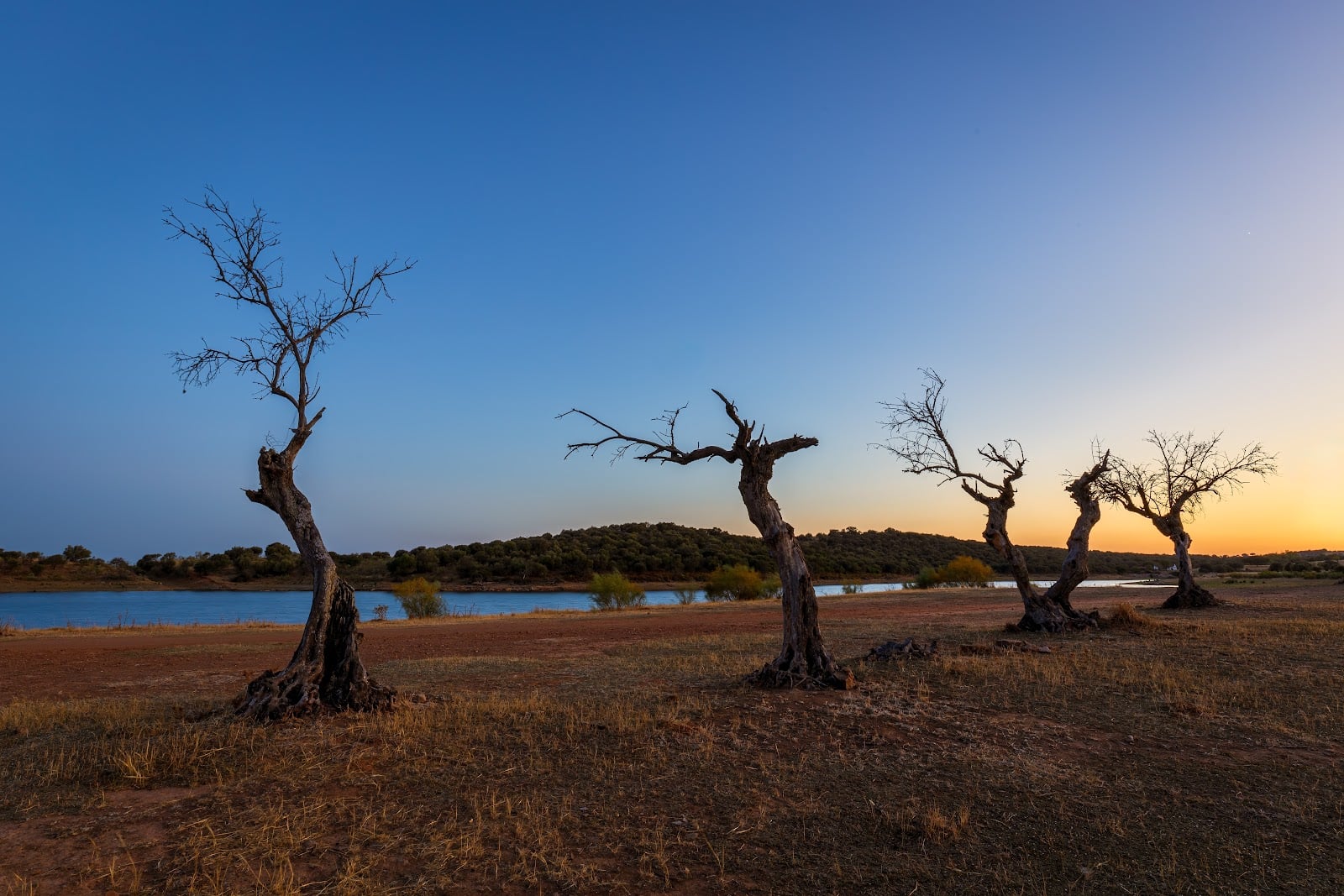
From the walls, Alqueva can look timeless, its blue reaches folding around low hills that now appear as islands. It is not. The reservoir began filling in 2002 after the closure of the Alqueva dam’s gates on the Guadiana. Water transformed a landscape of farms, roads and river valleys, supporting a major irrigation system as well as electricity generation and new forms of tourism.
That transformation has a human story. The old village of Luz was submerged, and its residents moved to a newly built village nearby. The Museu da Luz, farther south, explores the place, its memories and the changes brought by the reservoir. It deserves time of its own rather than being squeezed into an already full afternoon.
For this day, descend to Praia Fluvial de Monsaraz, near the nautical centre. In bathing season, check current swimming conditions and supervision locally. Even without entering the water, the shore offers a useful reversal: the lake is no longer a distant view, and the fortified village sits high above you.
An evening worth leaving unhurried
Stay by the water as the afternoon softens. The most memorable contrast is not between grand sights but between textures: warm castle stone in the morning, rough bread at lunch, then the small movement of water along the shore. Monsaraz and Alqueva belong together precisely because they tell different stories, one of a settlement holding its ground, the other of a landscape remade within living memory.
Portugal Magik’s Mercedes-Benz vehicles provide a comfortable base for the journey, but the itinerary benefits most from leaving breathing space between stops. For an evening extension, the Observatório do Lago Alqueva near Monsaraz offers astronomy experiences, subject to scheduling, booking and weather. Otherwise, let the day end simply, with one last look back at the ridge. The white village catches the remaining light, and the water below carries it a little farther.
Plan your own day
Share your dates, group size and interests, and we will suggest a tailored plan with a local driver/guide.