
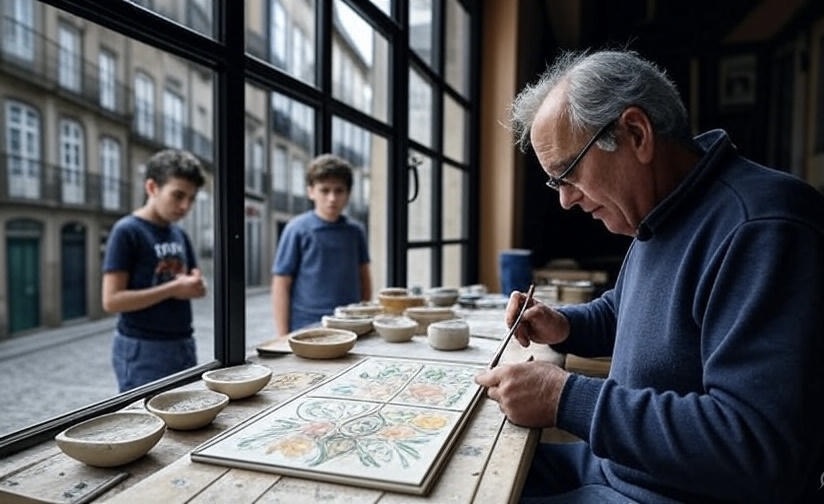
Few artistic traditions have traveled as gracefully across centuries and continents as Portugal’s azulejos. These hand-painted tiles, shimmering in cobalt blues, golden yellows, and emerald greens, have long adorned palaces, monasteries, fountains, and townhouses across the Iberian Peninsula. Today, they inspire interior designers, architects, and collectors worldwide, blending heritage with contemporary luxury living.
To design with azulejos is to bring Portugal’s essence into your home: elegance rooted in history, craftsmanship elevated by artistry, and a sense of storytelling that transcends mere decoration. For discerning travelers who discover tiles during their Portuguese journeys, incorporating them into interiors becomes the ultimate souvenir — not just an object brought home, but an aesthetic philosophy.
At Portugal Magik Private Tours, we’ve seen guests fall in love with tiles during private museum visits, artisan workshops, and exclusive shopping experiences. Many later collaborate with designers to integrate Portuguese azulejos into homes in New York, London, Dubai, or São Paulo. This article explores how tiles inspire interiors worldwide — and why their timeless appeal endures.
A Heritage of Design
The azulejo tradition in Portugal dates back to the 15th century, introduced via Moorish Spain. Early tiles carried geometric motifs, reflecting Islamic aesthetics. By the Renaissance, Portuguese artisans embraced figural designs, and by the 17th and 18th centuries, azulejos had become elaborate storytelling panels covering entire walls.
This heritage makes azulejos uniquely adaptable to interiors. They can be:
-
Narrative Murals: Telling stories across dining rooms or entryways.
-
Geometric Patterns: Adding rhythm to kitchens, patios, and bathrooms.
-
Single Accent Pieces: Framed as art, functioning like ceramic paintings.
Designers worldwide treasure this versatility — the ability to choose between grandeur and subtlety, tradition and innovation.
The Allure of Blue and White
The most iconic azulejos are painted in blue and white, inspired by Ming-dynasty porcelain imported through Portugal’s global trade networks. Blue evokes both the sky and the Atlantic, tying Portuguese tiles to a sense of infinity and exploration.
In interiors, blue-and-white tiles create serenity and timeless elegance. Designers often use them in:
-
Bathrooms and Spas: Where water themes harmonize with the aquatic palette.
-
Kitchens: Offering clean, fresh aesthetics with Mediterranean spirit.
-
Feature Walls: Evoking calm sophistication in living spaces.
One Portugal Magik guest from California, after visiting Lisbon’s National Azulejo Museum, commissioned a blue-and-white mural for her coastal home: “Every morning, I see my tile wall, and it feels like waking up in Lisbon.”
Other Visitors are reading now:



Beyond Blue: The Power of Color
While blue and white dominate, azulejos also come in vibrant yellows, greens, and polychrome schemes. These colors transform interiors into bold statements:
-
Yellows and Golds: Perfect for sunny, opulent spaces. They recall Portugal’s baroque churches and gilded palaces.
-
Greens: Evoke nature and fertility, ideal for garden rooms or indoor-outdoor transitions.
-
Polychrome Panels: Dramatic in entryways, creating a sense of arrival and storytelling.
In contemporary interiors, designers often mix traditional azulejo patterns with minimalist furnishings, letting the tiles provide drama while the rest of the space remains restrained.
Tiles as Architecture
Azulejos are not only decoration — they are also architecture. In Portugal, they protected walls from humidity, moderated temperature, and reflected light. Today, designers use them similarly:
-
Outdoor Walls and Pools: Adding Mediterranean flair and durability.
-
Fireplaces: Tiled surrounds that combine function with artistry.
-
Floors: Hardwearing ceramic makes striking patterned floors, equally at home in modern lofts or historic villas.
At luxury properties, tiles often appear in courtyards, creating atmospheric spaces where history meets contemporary leisure.
Contemporary Inspirations
Modern designers reinterpret azulejos in bold ways. Architects like Álvaro Siza and Eduardo Souto de Moura have used tiles in innovative projects, showing that azulejos are not relics but living design elements.
At Lisbon’s Viúva Lamego factory, contemporary artists collaborate on new collections, blending traditional hand-painting with abstract motifs. Internationally, luxury brands draw inspiration from Portuguese patterns for textiles, wallpapers, and ceramics.
For homeowners, this means azulejos are not confined to historic styles. They can be avant-garde, minimal, or experimental — while still rooted in authenticity.
Framing Tiles as Art
One of the simplest ways tiles inspire interiors is as framed art. A single antique tile becomes a collectible. A panel of four or nine creates a striking wall piece.
Collectors often source antique tiles from Lisbon boutiques like Solar Antiques or reclaimed specialists like Cortiço & Netos. Each tile carries history — a fragment of a demolished palace, a whisper of the 18th century brought into a modern living room.
As one Portugal Magik client from London shared: “I don’t just see decoration. I see the hand of an artisan from 200 years ago. It’s like living with history.”
Azulejos and Global Design
From Miami to Marrakech, designers integrate Portuguese tiles into global interiors. Their Mediterranean palette resonates in coastal villas. Their geometric rigor appeals in contemporary urban lofts. Their storytelling panels suit grand estates.
Portuguese tiles have also influenced broader design trends:
-
Moroccan Zellige: Shares geometric DNA with Moorish azulejos.
-
Spanish Talavera: Carries Iberian crosscurrents.
-
Modern Ceramic Trends: Many luxury tile brands reference azulejo motifs in wallpapers and fabrics.
Thus, Portugal’s tiles become part of a global design vocabulary, their language spoken far beyond Lisbon or Porto.
Luxury Interiors and Emotional Connection
Why do azulejos resonate so deeply with luxury homeowners? Because they are not just beautiful — they are meaningful. Each tile carries:
-
Craftsmanship: Handmade authenticity that contrasts with mass production.
-
Heritage: A link to Portugal’s layered history.
-
Emotion: Stories and symbols that speak across centuries.
Luxury today is not about excess, but about depth. Azulejos embody this perfectly — understated yet profound, decorative yet functional, traditional yet adaptable.
Portugal Magik: From Travel to Design
At Portugal Magik Private Tours, we often see the bridge between travel inspiration and interior design. Guests fall in love with tiles during private visits to Lisbon’s factories or Porto’s churches. We help them connect with artisans, source antiques, or arrange shipping for larger panels.
Some guests return home and commission designers to recreate Portuguese ambiances — tiled courtyards in Beverly Hills, blue-and-white bathrooms in London, rustic kitchen tiles in São Paulo. What begins as a travel experience becomes a lifelong design choice.
We curate these encounters carefully: private shopping appointments, behind-the-scenes factory visits, and hands-on painting workshops that give guests not just tiles, but stories to accompany them.
Conclusion: Living With Portugal
To design with azulejos is to live with Portugal every day. It is to bring into your home the elegance of Lisbon’s convents, the grandeur of Porto’s train station, the serenity of Coimbra’s cloisters, and the soul of Évora’s rustic tiles.
For travelers who fall in love with azulejos, incorporating them into interiors is more than style. It is memory made tangible. It is heritage made personal.
At Portugal Magik, we invite you to experience the artistry firsthand — and to take home not only tiles, but inspiration that will shape the way you live.
Book Your Portugal Experience:
-
Explore our bestseller tours: Multi-Day Tours
-
Best Private Day Tours Around Lisbon: Private Day Tours
-
Read Top Guests Reviews: Reviews
-
Contact Us: Contact
-
Or simply fill in the form below to request your custom itinerary.