Follow a day through Lisbon’s eastern hills, where tram bells interrupt conversations and each viewpoint reveals another chapter of the city. Between tiled terraces, a neighborhood lunch and the last light over the Tagus, the capital becomes more than a panorama.
Morning begins above the rooftops
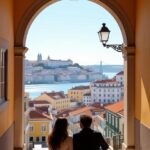
Begin at the Miradouro da Senhora do Monte, before the day gathers momentum. From this high perch in the Graça neighborhood, Lisbon seems to have settled into the folds of its hills: the castle on its ridge, the ordered streets of the Baixa below, the Tagus opening beyond them. Look long enough and the panorama stops being a collection of landmarks. A ferry makes progress across the water. Sunlight reaches one roof while its neighbor remains in shade.
Beside the viewpoint stands a small chapel dedicated to São Gens, a saint traditionally associated with Lisbon’s early Christian history. It is a useful reminder that these hilltops were places of devotion before they became places for photographs. With Portugal Magik, a local driver/guide can shape the day around the guests, using a Mercedes-Benz vehicle for the longer climbs and leaving time for the short walks that make the city personal. Start with the view, rather than a checklist.
Graça gives the city a human scale
Walk downhill toward the Miradouro da Graça, officially named for the poet Sophia de Mello Breyner Andresen. The outlook here feels closer to the city, with São Jorge Castle a strong presence across the intervening rooftops. Behind the terrace stands the church and former convent of Graça, whose origins reach back to the thirteenth century. The complex was rebuilt after the earthquake of 1755, the disaster that transformed so much of Lisbon.
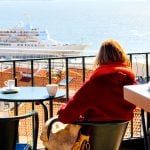
This is a good moment for a café stop: a bica, Lisbon’s usual word for an espresso, and a torrada, thick toast commonly served buttered. There is no need to make every breakfast a pastry pilgrimage. Graça rewards ordinary appetites and a little patience. Watch shopping bags arrive at neighboring tables and listen for the scrape of chairs. The best preparation for a tram ride is to spend a few minutes noticing the neighborhood it serves.
A tram ride, not a trophy
The yellow tram is most interesting when you remember that it belongs to a working transport network. Lisbon’s first electric trams entered service in 1901, replacing an earlier era of horse-drawn cars. The compact historic-style vehicles associated with route 28 suit streets where the bends are tight and the buildings seem almost within arm’s reach. Inside, timber details and the sound of wheels on rails give even a short journey a distinctive rhythm.
From Graça, consider a short ride on the 28E toward the São Vicente and Portas do Sol area, checking the day’s service and boarding arrangements first. Queues and crowded cars can make walking the better choice, and there is no reason to spend the morning pursuing an empty tram. Keep valuables secure, allow passengers to leave before boarding, and remember that residents need these seats too. If you walk instead, you can still enjoy the sight of a tram negotiating a corner, its bell briefly taking command of the street.
Browse our travel inspiration for ideas, or tell us what kind of day you have in mind.
Two terraces and an older Lisbon
At Largo das Portas do Sol, the view opens over Alfama toward the Tagus. The towers of São Vicente de Fora and the dome of the National Pantheon help give the jumble of roofs its bearings. The square’s name recalls a gate in the city’s medieval defenses. Today, the opening is visual rather than military: roofs, stairways and church walls seem to pour down the hillside toward the river.
A short walk away, the Miradouro de Santa Luzia offers a more intimate setting of tiles, planted terraces and stonework beside its church. Look for the azulejo panels depicting the Praça do Comércio before the 1755 earthquake and the Christian capture of Lisbon in 1147. They turn a pretty stop into a conversation about what the city has lost and rebuilt. From here, take a few lanes into Alfama, keeping voices low around doorways. These narrow streets are also people’s front gardens, conversations and routes home.
Lunch belongs to the neighborhood
By lunchtime, the hills have earned their place at the table. Choose a small restaurant in Alfama or return toward São Vicente, looking at the menu rather than relying on the charm of the doorway. Bacalhau à Brás brings shredded salt cod together with onions, fine fried potato sticks and egg, usually finished with parsley and black olives. It is comforting food for a day spent on foot, not simply another national dish to tick off.
Grilled sardines make particular sense in their warmer-season setting, especially around Lisbon’s June festivities, but they should not be treated as an obligatory year-round order. At another time, ask what fish is available or choose a straightforward soup and main course. Bread, olives and cheese brought to the table are generally charged if accepted and eaten; ask if unsure. Leave room for a coffee afterward. The pause matters as much as the meal, giving the morning’s churches, rooftops and tram windows time to settle into memory.
The last view changes the first
Later, cross to the western side of central Lisbon for the Miradouro de São Pedro de Alcântara. Its garden terraces face the castle hill, allowing you to look back toward the landscape that held the morning. Below lies the Avenida da Liberdade corridor; beyond it, the eastern slopes gather around the castle. The viewpoint’s tiled orientation panel helps identify landmarks, but the greater pleasure is recognizing places without needing it.
Stay as the light softens rather than racing to add another hill. A viewpoint is not always a place to watch the sun itself disappear; sometimes its reward is the changing color on the city opposite. Lisbon’s trams continue their work below, carrying people through streets you now understand a little better. What remains of the day may be surprisingly small: butter melting into toast, a bell at a blind corner, blue tiles beside a church. Together, those details give the great view its meaning.
Plan your own day
Share your dates, group size and interests, and we will suggest a tailored plan with a local driver/guide.